
17,005 Documents in our Technical Library
3191972 Total Downloads

Newest Additions

NASA-RP-1060 Subsonic Aircraft: Evolution and the Matching of Size to Performance
AA-CP-20212-001
AA-CP-20212-001
ADPO10769 Occurrence of Corrosion in Airframes
The purpose of this lecture is to provide an overview ...
MIL-STD-1759 Rivets and Rivet Type Fasteners Preferred for Design
The purpose of this book form standard is to provide ...
MIL-STD-810G Environmental Engineering Considerations and Laboratory Tests
This standard contains materiel acquisition program planning and engineering direction ...

AGARD-R-820

AGARD-R-820
  • Version
  • 208 Downloads
  • 5.40 MB File Size
  • 1 File Count
  • April 25, 2016 Create Date
  • April 25, 2016 Last Updated
Scroll for Details

Active Combustion Control for Propulsion Systems
AGARD-R-820 Active Combustion Control for Propulsion Systems
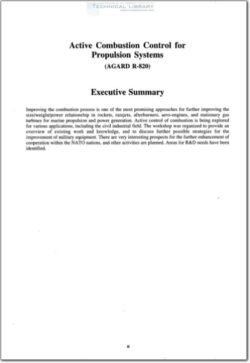
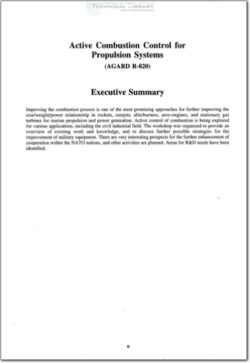
This report summarizes the findings and conclusions of a four-day AGARD workshop on
“Active Combustion Control for Propulsion Systems” that was held during May 6-9, 1996, in
Athens, Greece. This workshop, organized in response to increased interest in application of
active control in combustion systems, was attended by representatives from industry, government
and universities in Europe and the United States.’ The objectives of the workshop were to: (1)
define the requirements of future combustors and combustion processes, (2) determine the status
of active combustion control (ACC) systems, (3) assess the potential of ACC to meet the
performance goals of the future combustors, and (4) determine near- and long—term ACC research
and development needs. A special concern of the workshop was the confirmation of international
collaborations between organizations working in this field."
In contrast to passive control, the term ‘active control’ implies control of a system involving
expenditure of energy from a source external to the system. Generally, the purpose is to minimize
the difference or ‘error’ between the instantaneous desired and actual behavior of the system.
Control may be exercised with feedback of information about the actual response of the system
(closed-loop control) or without feedback (open-loop control). The field of active control of
combustion is concerned both with control of dynamics, notably combustion instabilities, and with
various forms of the ‘regular’ problem, for example maintaining operation to optimize some
property of the performance. In any case open-loop control does not seem to be a useful strategy
for the sort of applications envisioned for ACC.
Although the earliest proposals for active feedback control of combustors, and the initial
experiments, were motivated by the intention to control combustion instabilities in rockets,
and aftezrburners, subsequent work has demonstrated other possible applications. Thus one can
now conceive of situations in which the purpose of introducing ACC may be one or a combination
of two or more of the following: (1) improve the performance of a combustor (e.g., reduce
pollutant and/or noise emissions, reduce specific fuel consumption, increase combustion
efficiency, improve pattern factors in gas turbine combustors, etc.); (2) permit modification of
combustor design (e. g., reduce its length); (3) damp combustion instabilities; (4) increase
combustor reliability; (5) extend operational limits of combustors (e.g., permit stable operation at
lower equivalence ratios); and (6) improve performance of other military combustion processes
such as shipboard incineration, and power and heat generation in the field. Because the practical
problem of suppressing combustion instabilities has been the chief motivation for investigating
ACC, it is useful to explain some broad aspects of the subject by considering feedback control of
unsteady motions in a combustor.

FileAction
AGARD-R-820 Active Combustion Control for Propulsion Systems.pdfDownload 

Comment On This Post

Your email address will not be published. Required fields are marked *

AGARD-R-820

AGARD-R-820
  • Version
  • 208 Downloads
  • 5.40 MB File Size
  • 1 File Count
  • April 25, 2016 Create Date
  • April 25, 2016 Last Updated
Scroll for Details

Active Combustion Control for Propulsion Systems
AGARD-R-820 Active Combustion Control for Propulsion Systems
This report summarizes the findings and conclusions of a four-day AGARD workshop on
“Active Combustion Control for Propulsion Systems” that was held during May 6-9, 1996, in
Athens, Greece. This workshop, organized in response to increased interest in application of
active control in combustion systems, was attended by representatives from industry, government
and universities in Europe and the United States.’ The objectives of the workshop were to: (1)
define the requirements of future combustors and combustion processes, (2) determine the status
of active combustion control (ACC) systems, (3) assess the potential of ACC to meet the
performance goals of the future combustors, and (4) determine near- and long—term ACC research
and development needs. A special concern of the workshop was the confirmation of international
collaborations between organizations working in this field."
In contrast to passive control, the term ‘active control’ implies control of a system involving
expenditure of energy from a source external to the system. Generally, the purpose is to minimize
the difference or ‘error’ between the instantaneous desired and actual behavior of the system.
Control may be exercised with feedback of information about the actual response of the system
(closed-loop control) or without feedback (open-loop control). The field of active control of
combustion is concerned both with control of dynamics, notably combustion instabilities, and with
various forms of the ‘regular’ problem, for example maintaining operation to optimize some
property of the performance. In any case open-loop control does not seem to be a useful strategy
for the sort of applications envisioned for ACC.
Although the earliest proposals for active feedback control of combustors, and the initial
experiments, were motivated by the intention to control combustion instabilities in rockets,
and aftezrburners, subsequent work has demonstrated other possible applications. Thus one can
now conceive of situations in which the purpose of introducing ACC may be one or a combination
of two or more of the following: (1) improve the performance of a combustor (e.g., reduce
pollutant and/or noise emissions, reduce specific fuel consumption, increase combustion
efficiency, improve pattern factors in gas turbine combustors, etc.); (2) permit modification of
combustor design (e. g., reduce its length); (3) damp combustion instabilities; (4) increase
combustor reliability; (5) extend operational limits of combustors (e.g., permit stable operation at
lower equivalence ratios); and (6) improve performance of other military combustion processes
such as shipboard incineration, and power and heat generation in the field. Because the practical
problem of suppressing combustion instabilities has been the chief motivation for investigating
ACC, it is useful to explain some broad aspects of the subject by considering feedback control of
unsteady motions in a combustor.

FileAction
AGARD-R-820 Active Combustion Control for Propulsion Systems.pdfDownload 
17,005 Documents in our Technical Library
3191972 Total Downloads

Search The Technical Library

Newest Additions

NASA-RP-1060 Subsonic Aircraft: Evolution and the Matching of Size to Performance
AA-CP-20212-001
AA-CP-20212-001
ADPO10769 Occurrence of Corrosion in Airframes
The purpose of this lecture is to provide an overview ...
MIL-STD-1759 Rivets and Rivet Type Fasteners Preferred for Design
The purpose of this book form standard is to provide ...
MIL-STD-810G Environmental Engineering Considerations and Laboratory Tests
This standard contains materiel acquisition program planning and engineering direction ...