
17,005 Documents in our Technical Library
3180762 Total Downloads

Newest Additions

NASA-RP-1060 Subsonic Aircraft: Evolution and the Matching of Size to Performance
AA-CP-20212-001
AA-CP-20212-001
ADPO10769 Occurrence of Corrosion in Airframes
The purpose of this lecture is to provide an overview ...
MIL-STD-1759 Rivets and Rivet Type Fasteners Preferred for Design
The purpose of this book form standard is to provide ...
MIL-STD-810G Environmental Engineering Considerations and Laboratory Tests
This standard contains materiel acquisition program planning and engineering direction ...

AGARD-R-797

AGARD-R-797
  • Version
  • 348 Downloads
  • 66.89 MB File Size
  • 1 File Count
  • April 12, 2016 Create Date
  • April 12, 2016 Last Updated
Scroll for Details

An Assessment of Fatique Damage and Crack Growth Prediction Techniques
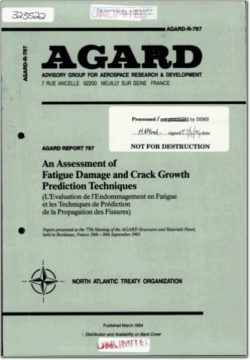
AGARD-R-797 An Assessment of Fatique Damage and Crack Growth Prediction Techniques

The following report attempts to provide a summary of the
Workshop on “An Assessment of Fatigue Damage and Crack
Growth Prediction Techniques” sponsored by the Structures
and Materials Panel of the Advisory Group for Aerospace
Research and Development (AGARD).

The theme of this Workshop, chaired by Dr S.G. Sarnpath,
(United States), was to assess fatigue damage and crack
rowth to categorize the degree of conservatism inherent in
each method with respect to full-scale test and service experi-
ence. The Workshop was intended to provoke a discussion
about all aspects of the fatigue process from spectra develop-
ment through the crack initiation and propagation phases to
in-service monitoring. Eighteen papers were presented in
four sessions, two of which were related to Measurements and
Predictive Methodologies, and two related to Design Experi-
ences. In addition, a lead paper was presented by Dr J.W.
Lincoln from the USAF which provided an overview of the
overall structural integrity process for US military aircraft.

It is believed the theme of the Workshop was amply satisfied by
the 19 technical papers presented followed by, in some cases,
animated discussions which again reinforced the scientific
communities’ view that there is more than one way to solve an
engineering problem. The papers covered a wide historical
segment of variable amplitude fatigue initiation and propaga-
tion development from the early 19205 to modern Neural
Network Monitoring Technology. The overview paper by Dr
' coln emphasized the importance of considering all the five
ks of the structural integrity process from Design Informa-
tion through Design Analysis and Development Tests, Full
Scale Testing, Force Management Data Package to Force
Management. Dr Lincoln outlined all the potential threats to
structural integrity encountered from material, manufactur—
ing, environmental and service operations. He also
emphasized the political threats often encountered during the
procurement of military aircraft in today’s economic environ-
ment.

FileAction
AGARD-R-797 An Assessment of Fatique Damage and Crack Growth Prediction Techniques.pdfDownload 

Comment On This Post

Your email address will not be published. Required fields are marked *

AGARD-R-797

AGARD-R-797
  • Version
  • 348 Downloads
  • 66.89 MB File Size
  • 1 File Count
  • April 12, 2016 Create Date
  • April 12, 2016 Last Updated
Scroll for Details

An Assessment of Fatique Damage and Crack Growth Prediction Techniques

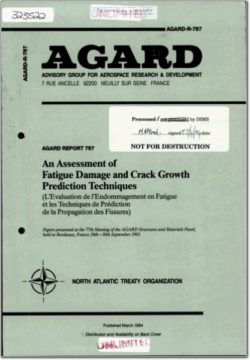
AGARD-R-797 An Assessment of Fatique Damage and Crack Growth Prediction Techniques

The following report attempts to provide a summary of the
Workshop on “An Assessment of Fatigue Damage and Crack
Growth Prediction Techniques” sponsored by the Structures
and Materials Panel of the Advisory Group for Aerospace
Research and Development (AGARD).

The theme of this Workshop, chaired by Dr S.G. Sarnpath,
(United States), was to assess fatigue damage and crack
rowth to categorize the degree of conservatism inherent in
each method with respect to full-scale test and service experi-
ence. The Workshop was intended to provoke a discussion
about all aspects of the fatigue process from spectra develop-
ment through the crack initiation and propagation phases to
in-service monitoring. Eighteen papers were presented in
four sessions, two of which were related to Measurements and
Predictive Methodologies, and two related to Design Experi-
ences. In addition, a lead paper was presented by Dr J.W.
Lincoln from the USAF which provided an overview of the
overall structural integrity process for US military aircraft.

It is believed the theme of the Workshop was amply satisfied by
the 19 technical papers presented followed by, in some cases,
animated discussions which again reinforced the scientific
communities’ view that there is more than one way to solve an
engineering problem. The papers covered a wide historical
segment of variable amplitude fatigue initiation and propaga-
tion development from the early 19205 to modern Neural
Network Monitoring Technology. The overview paper by Dr
' coln emphasized the importance of considering all the five
ks of the structural integrity process from Design Informa-
tion through Design Analysis and Development Tests, Full
Scale Testing, Force Management Data Package to Force
Management. Dr Lincoln outlined all the potential threats to
structural integrity encountered from material, manufactur—
ing, environmental and service operations. He also
emphasized the political threats often encountered during the
procurement of military aircraft in today’s economic environ-
ment.

FileAction
AGARD-R-797 An Assessment of Fatique Damage and Crack Growth Prediction Techniques.pdfDownload 
17,005 Documents in our Technical Library
3180762 Total Downloads

Search The Technical Library

Newest Additions

NASA-RP-1060 Subsonic Aircraft: Evolution and the Matching of Size to Performance
AA-CP-20212-001
AA-CP-20212-001
ADPO10769 Occurrence of Corrosion in Airframes
The purpose of this lecture is to provide an overview ...
MIL-STD-1759 Rivets and Rivet Type Fasteners Preferred for Design
The purpose of this book form standard is to provide ...
MIL-STD-810G Environmental Engineering Considerations and Laboratory Tests
This standard contains materiel acquisition program planning and engineering direction ...