
17,005 Documents in our Technical Library
3213316 Total Downloads

Newest Additions

NASA-RP-1060 Subsonic Aircraft: Evolution and the Matching of Size to Performance
AA-CP-20212-001
AA-CP-20212-001
ADPO10769 Occurrence of Corrosion in Airframes
The purpose of this lecture is to provide an overview ...
MIL-STD-1759 Rivets and Rivet Type Fasteners Preferred for Design
The purpose of this book form standard is to provide ...
MIL-STD-810G Environmental Engineering Considerations and Laboratory Tests
This standard contains materiel acquisition program planning and engineering direction ...

AGARD-R-573-70

AGARD-R-573-70
  • Version
  • 137 Downloads
  • 5.34 MB File Size
  • 1 File Count
  • April 26, 2016 Create Date
  • April 26, 2016 Last Updated
Scroll for Details

Aeroelastic Test Methods - Experimental Techniques
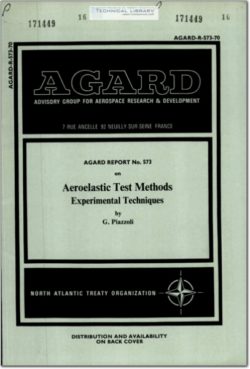
AGARD-R-573-70 Aeroelastic Test Methods - Experimental Techniques
The object of this Chapter is to present a general survey of the methods of
investigating the dynamic stability of aircraft structures — in flight — which are used
at present in the various countries with aeronautical interests.
Since the end of World War II, the importance of the role played by this field
of study has asserted itself progressively. Nowadays, series of vibratory tests are an
integral part of the flight programme evolved for any important prototype development
and - in the case of the supersonic transport aircraft — the time allotted to them
amounts to nearly ten per cent of the total time allowed for development and Certificate
of Airworthiness approval.
At the same time, novel practical techniques have developed in the past ten
years — both in the field of excitation and that of analysis - and it becomes necessary
to make a critical survey of their respective capabilities and of the specific conditions
of their use.
A close interdependence relates the aeroelastic test to other methods of inves-
tigation available to the structural specialists in order to achieve predicition and
control of the flutter phenomenon: ground vibration tests, theoretical or experimental
knowledge of aerodynamic coefficients, calculation of critical speeds. These various
approaches to the same physical situation, which is known to be difficult to apprehend
with accuraty, must be pursued with knowledge and understanding of the problems en—
countered within each specific area in order to formulate a reliable diagnosis. The
flight vibration test certainly has the advantage of not being burdened by a number of
restrictive hypotheses which are inherent in the formulation of a mathematical "model";
but, on the other hand, interpretation of the results is often difficult, owing to aero—
dynamic coupling between structural modes and to the random "noise" generated by flow
turbulence.
In any case, the preparatory phase of a flight vibration test must be sup—
ported by a‘survey of the structural mode shapes on the ground and knowledge of the
calculations of the critical flutter speeds. The methods developed must ensure uni—
formity of definition and representation in the treatment of the structure by theoreti—
cal and experimental means, so that the comparison of their results may be direct and
fruitful.

FileAction
AGARD-R-573-70 Aeroelastic Test Methods - Experimental Techniques.pdfDownload 

Comment On This Post

Your email address will not be published. Required fields are marked *

AGARD-R-573-70

AGARD-R-573-70
  • Version
  • 137 Downloads
  • 5.34 MB File Size
  • 1 File Count
  • April 26, 2016 Create Date
  • April 26, 2016 Last Updated
Scroll for Details

Aeroelastic Test Methods - Experimental Techniques
AGARD-R-573-70 Aeroelastic Test Methods - Experimental Techniques
The object of this Chapter is to present a general survey of the methods of
investigating the dynamic stability of aircraft structures — in flight — which are used
at present in the various countries with aeronautical interests.
Since the end of World War II, the importance of the role played by this field
of study has asserted itself progressively. Nowadays, series of vibratory tests are an
integral part of the flight programme evolved for any important prototype development
and - in the case of the supersonic transport aircraft — the time allotted to them
amounts to nearly ten per cent of the total time allowed for development and Certificate
of Airworthiness approval.
At the same time, novel practical techniques have developed in the past ten
years — both in the field of excitation and that of analysis - and it becomes necessary
to make a critical survey of their respective capabilities and of the specific conditions
of their use.
A close interdependence relates the aeroelastic test to other methods of inves-
tigation available to the structural specialists in order to achieve predicition and
control of the flutter phenomenon: ground vibration tests, theoretical or experimental
knowledge of aerodynamic coefficients, calculation of critical speeds. These various
approaches to the same physical situation, which is known to be difficult to apprehend
with accuraty, must be pursued with knowledge and understanding of the problems en—
countered within each specific area in order to formulate a reliable diagnosis. The
flight vibration test certainly has the advantage of not being burdened by a number of
restrictive hypotheses which are inherent in the formulation of a mathematical "model";
but, on the other hand, interpretation of the results is often difficult, owing to aero—
dynamic coupling between structural modes and to the random "noise" generated by flow
turbulence.
In any case, the preparatory phase of a flight vibration test must be sup—
ported by a‘survey of the structural mode shapes on the ground and knowledge of the
calculations of the critical flutter speeds. The methods developed must ensure uni—
formity of definition and representation in the treatment of the structure by theoreti—
cal and experimental means, so that the comparison of their results may be direct and
fruitful.

FileAction
AGARD-R-573-70 Aeroelastic Test Methods - Experimental Techniques.pdfDownload 
17,005 Documents in our Technical Library
3213316 Total Downloads

Search The Technical Library

Newest Additions

NASA-RP-1060 Subsonic Aircraft: Evolution and the Matching of Size to Performance
AA-CP-20212-001
AA-CP-20212-001
ADPO10769 Occurrence of Corrosion in Airframes
The purpose of this lecture is to provide an overview ...
MIL-STD-1759 Rivets and Rivet Type Fasteners Preferred for Design
The purpose of this book form standard is to provide ...
MIL-STD-810G Environmental Engineering Considerations and Laboratory Tests
This standard contains materiel acquisition program planning and engineering direction ...