
17,005 Documents in our Technical Library
3213477 Total Downloads

Newest Additions

NASA-RP-1060 Subsonic Aircraft: Evolution and the Matching of Size to Performance
AA-CP-20212-001
AA-CP-20212-001
ADPO10769 Occurrence of Corrosion in Airframes
The purpose of this lecture is to provide an overview ...
MIL-STD-1759 Rivets and Rivet Type Fasteners Preferred for Design
The purpose of this book form standard is to provide ...
MIL-STD-810G Environmental Engineering Considerations and Laboratory Tests
This standard contains materiel acquisition program planning and engineering direction ...

AGARD-LS-205

AGARD-LS-205
  • Version
  • 161 Downloads
  • 40.60 MB File Size
  • 1 File Count
  • April 26, 2016 Create Date
  • April 26, 2016 Last Updated
Scroll for Details

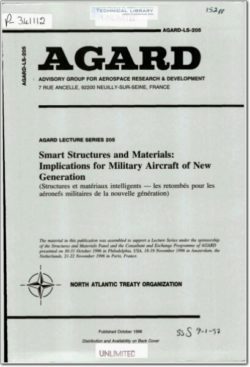
Smart Structures and Materials-Implications for Military Aircraft of New Generation
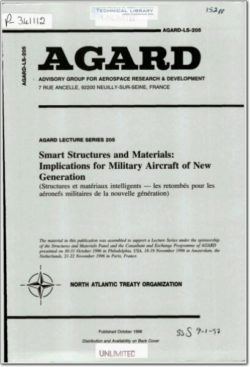
AGARD-LS-205 Smart Structures and Materials-Implications for Military Aircraft of New Generation
Development in disciplines such as sensing technology,
computation, control, micromechanics, materials including
processing and many others has made significant progress
duringthepastdecades.'l‘hisprogresshasbeenmainly
possible through an in-depth analysis of the different
aspects in these disciplines. To consequently take more
advantage of this progress a synergy between these
different disciplines has to be established, resulting in
whathasbeentermedtobesmartmaterialsand structures.
Smart (alternatively. active, adaptive, multifunc-tional or
intelligent) materials and structures is - briefly explained -
the integration of sensing and actuation elements into a
structure or even more ambitiously into a material, with
sensor and actuator being linked by a controller. Materials
actually favoured for integration include optical fibres and
piezoelectric materials with respect to sensors, piezoelec»
tric/electrostrietive materials, shape memory alloys and
electro-rheological fluids with respect to actuators and
microprocessors, neural networks, fuzzy logic and various
types of signal processing with respect to control. Since
performanceofmilitaryaircrafiandspacecrafihaspro-
greasedmasequenceofstepsmthepasgsmartmaterials
andstructm'estechnologycanthusbeconsideredtobea
next step in mhancement.
It is now more than a decade ago since people have started
to talk about smart materials and structures. Various
definitions have been given (e.g. Ahmad 1988, Takagi
1989, Measures 1989) and various expressions such as
intelligenL multifunctional or adaptive are used, which
sometimes need to be clarified. There is however some
commonsenseinthewaythatasmartmaterialorsystem
incorporates sensors and actuators with both being linked
via a controller. Trying to summarize the various defini-
tions and expressions can result in a view as shown in Fig.
A key question leading to smart materials and systems is
Why cannot materials and systems with structural
junctions take over additional fimctions? Their basic/tra-
ditional use is mainly related to passive functionality. It is
therefore termed to be a passive material or structure.
Addingsensorstothematerialorstructureleadstowhat
can be called a sensory material or structure. The term
active material or structure can be used if the material or
structure also includes actuators. Sophistication is im-
proved if sensors and actuators are linked via a controller
allowing the material or system to adapt itself to various
prescribed conditions which can be called an adaptive
material or structure. The highest level that can be
actually thought of is achieved when the adaptive material
or system also includes a processor allowing itselfto adapt
to various conditions by self-learning. It can be specified to
be the real intelligent material or structure and is in many
cases a vision which still requires to be achieved.

FileAction
AGARD-LS-205 Smart Structures and Materials-Implications for Military Aircraft of New Generation.pdfDownload 

Comment On This Post

Your email address will not be published. Required fields are marked *

AGARD-LS-205

AGARD-LS-205
  • Version
  • 161 Downloads
  • 40.60 MB File Size
  • 1 File Count
  • April 26, 2016 Create Date
  • April 26, 2016 Last Updated
Scroll for Details

Smart Structures and Materials-Implications for Military Aircraft of New Generation
AGARD-LS-205 Smart Structures and Materials-Implications for Military Aircraft of New Generation
Development in disciplines such as sensing technology,
computation, control, micromechanics, materials including
processing and many others has made significant progress
duringthepastdecades.'l‘hisprogresshasbeenmainly
possible through an in-depth analysis of the different
aspects in these disciplines. To consequently take more
advantage of this progress a synergy between these
different disciplines has to be established, resulting in
whathasbeentermedtobesmartmaterialsand structures.
Smart (alternatively. active, adaptive, multifunc-tional or
intelligent) materials and structures is - briefly explained -
the integration of sensing and actuation elements into a
structure or even more ambitiously into a material, with
sensor and actuator being linked by a controller. Materials
actually favoured for integration include optical fibres and
piezoelectric materials with respect to sensors, piezoelec»
tric/electrostrietive materials, shape memory alloys and
electro-rheological fluids with respect to actuators and
microprocessors, neural networks, fuzzy logic and various
types of signal processing with respect to control. Since
performanceofmilitaryaircrafiandspacecrafihaspro-
greasedmasequenceofstepsmthepasgsmartmaterials
andstructm'estechnologycanthusbeconsideredtobea
next step in mhancement.
It is now more than a decade ago since people have started
to talk about smart materials and structures. Various
definitions have been given (e.g. Ahmad 1988, Takagi
1989, Measures 1989) and various expressions such as
intelligenL multifunctional or adaptive are used, which
sometimes need to be clarified. There is however some
commonsenseinthewaythatasmartmaterialorsystem
incorporates sensors and actuators with both being linked
via a controller. Trying to summarize the various defini-
tions and expressions can result in a view as shown in Fig.
A key question leading to smart materials and systems is
Why cannot materials and systems with structural
junctions take over additional fimctions? Their basic/tra-
ditional use is mainly related to passive functionality. It is
therefore termed to be a passive material or structure.
Addingsensorstothematerialorstructureleadstowhat
can be called a sensory material or structure. The term
active material or structure can be used if the material or
structure also includes actuators. Sophistication is im-
proved if sensors and actuators are linked via a controller
allowing the material or system to adapt itself to various
prescribed conditions which can be called an adaptive
material or structure. The highest level that can be
actually thought of is achieved when the adaptive material
or system also includes a processor allowing itselfto adapt
to various conditions by self-learning. It can be specified to
be the real intelligent material or structure and is in many
cases a vision which still requires to be achieved.

FileAction
AGARD-LS-205 Smart Structures and Materials-Implications for Military Aircraft of New Generation.pdfDownload 
17,005 Documents in our Technical Library
3213477 Total Downloads

Search The Technical Library

Newest Additions

NASA-RP-1060 Subsonic Aircraft: Evolution and the Matching of Size to Performance
AA-CP-20212-001
AA-CP-20212-001
ADPO10769 Occurrence of Corrosion in Airframes
The purpose of this lecture is to provide an overview ...
MIL-STD-1759 Rivets and Rivet Type Fasteners Preferred for Design
The purpose of this book form standard is to provide ...
MIL-STD-810G Environmental Engineering Considerations and Laboratory Tests
This standard contains materiel acquisition program planning and engineering direction ...