
17,005 Documents in our Technical Library
3214155 Total Downloads

Newest Additions

NASA-RP-1060 Subsonic Aircraft: Evolution and the Matching of Size to Performance
AA-CP-20212-001
AA-CP-20212-001
ADPO10769 Occurrence of Corrosion in Airframes
The purpose of this lecture is to provide an overview ...
MIL-STD-1759 Rivets and Rivet Type Fasteners Preferred for Design
The purpose of this book form standard is to provide ...
MIL-STD-810G Environmental Engineering Considerations and Laboratory Tests
This standard contains materiel acquisition program planning and engineering direction ...

AGARD-LS-193

AGARD-LS-193
  • Version
  • 88 Downloads
  • 31.52 MB File Size
  • 1 File Count
  • April 26, 2016 Create Date
  • April 26, 2016 Last Updated
Scroll for Details

Advanced Guidance and Control Aspects in Robotics
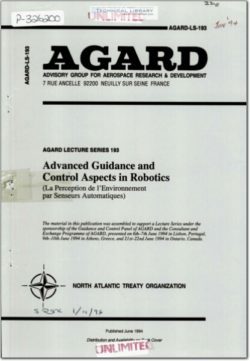
AGARD-LS-193 Advanced Guidance and Control Aspects in Robotics
Historically, the space robotics
community has been pursuing the goal
of creating fully autonomous, self-
contained robotic systems with
considerable onboard intelligence as
the next major objective in space
robotics evolution. Systems such as the
Flight Telerobotic Servicer (FTS) were
intended to provide near-human levels
of intelligence and dexterity, capable of
interpreting very high level command
structures and autonomously
executing the commands without
human intervention. Incomplete task
operations, erroneous command
structures, and reconciliation of
differences between the world model
and the real world were to be handled
autonomously, and the entire system
was to survive for up to 30 years on—
orbit with little or no maintenance.
The robot was designed to replace a
full-time human operator with
automated sensing, perception,
planning and reasoning sufficient to
conduct daily operations. The incentive
was to remove the need for intensive
human oversight of the robot’s
activities, and (anticipating that the
human operator would be an on—orbit
astronaut) thereby reduce the
astronaut workload.
Since the initiation of the FTS and
similar ambitious undertakings, the
robotics community has gained new
understanding of the research still
required to create the technologies
needed for such systems. While very
significant progress has been made in
supporting technologies such as
system autonomy, task level
controllers, control execution and
robust operations, the day when all of
these elements Will come together into
an operational autonomous space robot
system is probably still a decade away
(some roboticists have conjectured that
it will not happen during their
professional lifetimes).
While the technology to support fully
autonomous intelligent robotics is not
yet available, operational needs for
capable remote manipulation and
locomotion still exist. To contend with
these needs, the space robotics
community has adopted a new
approach which parallels that of the
underwater robotics industry.

FileAction
AGARD-LS-193 Advanced Guidance and Control Aspects in Robotics.pdfDownload 

Comment On This Post

Your email address will not be published. Required fields are marked *

AGARD-LS-193

AGARD-LS-193
  • Version
  • 88 Downloads
  • 31.52 MB File Size
  • 1 File Count
  • April 26, 2016 Create Date
  • April 26, 2016 Last Updated
Scroll for Details

Advanced Guidance and Control Aspects in Robotics
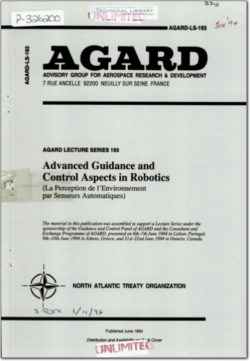
AGARD-LS-193 Advanced Guidance and Control Aspects in Robotics
Historically, the space robotics
community has been pursuing the goal
of creating fully autonomous, self-
contained robotic systems with
considerable onboard intelligence as
the next major objective in space
robotics evolution. Systems such as the
Flight Telerobotic Servicer (FTS) were
intended to provide near-human levels
of intelligence and dexterity, capable of
interpreting very high level command
structures and autonomously
executing the commands without
human intervention. Incomplete task
operations, erroneous command
structures, and reconciliation of
differences between the world model
and the real world were to be handled
autonomously, and the entire system
was to survive for up to 30 years on—
orbit with little or no maintenance.
The robot was designed to replace a
full-time human operator with
automated sensing, perception,
planning and reasoning sufficient to
conduct daily operations. The incentive
was to remove the need for intensive
human oversight of the robot’s
activities, and (anticipating that the
human operator would be an on—orbit
astronaut) thereby reduce the
astronaut workload.
Since the initiation of the FTS and
similar ambitious undertakings, the
robotics community has gained new
understanding of the research still
required to create the technologies
needed for such systems. While very
significant progress has been made in
supporting technologies such as
system autonomy, task level
controllers, control execution and
robust operations, the day when all of
these elements Will come together into
an operational autonomous space robot
system is probably still a decade away
(some roboticists have conjectured that
it will not happen during their
professional lifetimes).
While the technology to support fully
autonomous intelligent robotics is not
yet available, operational needs for
capable remote manipulation and
locomotion still exist. To contend with
these needs, the space robotics
community has adopted a new
approach which parallels that of the
underwater robotics industry.

FileAction
AGARD-LS-193 Advanced Guidance and Control Aspects in Robotics.pdfDownload 
17,005 Documents in our Technical Library
3214155 Total Downloads

Search The Technical Library

Newest Additions

NASA-RP-1060 Subsonic Aircraft: Evolution and the Matching of Size to Performance
AA-CP-20212-001
AA-CP-20212-001
ADPO10769 Occurrence of Corrosion in Airframes
The purpose of this lecture is to provide an overview ...
MIL-STD-1759 Rivets and Rivet Type Fasteners Preferred for Design
The purpose of this book form standard is to provide ...
MIL-STD-810G Environmental Engineering Considerations and Laboratory Tests
This standard contains materiel acquisition program planning and engineering direction ...