
17,005 Documents in our Technical Library
3193295 Total Downloads

Newest Additions

NASA-RP-1060 Subsonic Aircraft: Evolution and the Matching of Size to Performance
AA-CP-20212-001
AA-CP-20212-001
ADPO10769 Occurrence of Corrosion in Airframes
The purpose of this lecture is to provide an overview ...
MIL-STD-1759 Rivets and Rivet Type Fasteners Preferred for Design
The purpose of this book form standard is to provide ...
MIL-STD-810G Environmental Engineering Considerations and Laboratory Tests
This standard contains materiel acquisition program planning and engineering direction ...

AGARD-LS-172

AGARD-LS-172
  • Version
  • 142 Downloads
  • 6.27 MB File Size
  • 1 File Count
  • April 26, 2016 Create Date
  • April 26, 2016 Last Updated
Scroll for Details

Propagation Limitations for Systems Using Band-Spreading
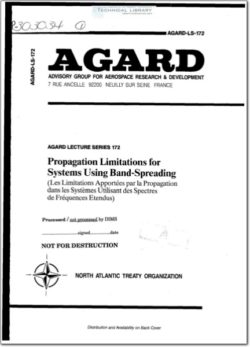
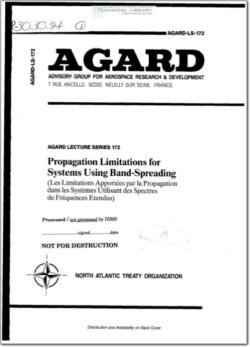
AGARD-LS-172 Propagation Limitations for Systems Using Band-Spreading
Most radio communication systems being presently introduced or under development are digital systems. Depen—
ding on the transmission bandwidth relative to the information rate, such systems can be divided into the
class of narrow band systems and the class of wide band systems. The lecture has the final aim to work out
in a tutorial way the advantages wide band systems have to offer under adverse propagation conditions. In
the lecture, after an introduction to digital information transmission, digital wide band systems are defined on
the basis of the used transmission signal forms and are compared with narrow band systems. The need for the
application of wide band systems is pointed out referring to information theory, with the resistance against
noise and interference as well as the capabilities of multiple access and selective addressing being addressed.
leferent types of wide band systems including spread spectrum systems are presented. The quantitative
treatment of propagation problems in narrow band and wide band systems due to time variant multipath pro-
pagation is tackled and the potential of wide band systems in combatting propagation effects is shown. it is
explained that properly designed spread spectrum systems are less affected by multipath reception than
narrow band systems.
Most radio communication systems being presently introduced or under development are digital systems. Also
originally analog source signals as for instance speech, picture or telemetry signals are - after A/D
conversion and source encoding - preferably transmitted in digital form. Compared with conventional analog
PM or AM radio communication systems, digital radio systems have a number of advantages: Reliability and
stability of system behavior, high resistance against noise and jamming, tolerance of multipath effects. system
flexibility due to easily modifiable system parameters, fast and automatic adaption to changing operation
scenarios, and cost efficient system implementation by modern microelectronics and VLSI. Also sophisticated
features as e.g. multiple access and selective addressing capabilities can be readily achieved by digital
means. Digital radio communication techniques are e.g. applied in radio relay systems, land mobile radio
systems, satellite communication systems, HF communications and Q&R IFF systems. Even for future public
sound broadcasting, digital systems are under consideration.

FileAction
AGARD-LS-172 Propagation Limitations for Systems Using Band-Spreading.pdfDownload 

Comment On This Post

Your email address will not be published. Required fields are marked *

AGARD-LS-172

AGARD-LS-172
  • Version
  • 142 Downloads
  • 6.27 MB File Size
  • 1 File Count
  • April 26, 2016 Create Date
  • April 26, 2016 Last Updated
Scroll for Details

Propagation Limitations for Systems Using Band-Spreading
AGARD-LS-172 Propagation Limitations for Systems Using Band-Spreading
Most radio communication systems being presently introduced or under development are digital systems. Depen—
ding on the transmission bandwidth relative to the information rate, such systems can be divided into the
class of narrow band systems and the class of wide band systems. The lecture has the final aim to work out
in a tutorial way the advantages wide band systems have to offer under adverse propagation conditions. In
the lecture, after an introduction to digital information transmission, digital wide band systems are defined on
the basis of the used transmission signal forms and are compared with narrow band systems. The need for the
application of wide band systems is pointed out referring to information theory, with the resistance against
noise and interference as well as the capabilities of multiple access and selective addressing being addressed.
leferent types of wide band systems including spread spectrum systems are presented. The quantitative
treatment of propagation problems in narrow band and wide band systems due to time variant multipath pro-
pagation is tackled and the potential of wide band systems in combatting propagation effects is shown. it is
explained that properly designed spread spectrum systems are less affected by multipath reception than
narrow band systems.
Most radio communication systems being presently introduced or under development are digital systems. Also
originally analog source signals as for instance speech, picture or telemetry signals are - after A/D
conversion and source encoding - preferably transmitted in digital form. Compared with conventional analog
PM or AM radio communication systems, digital radio systems have a number of advantages: Reliability and
stability of system behavior, high resistance against noise and jamming, tolerance of multipath effects. system
flexibility due to easily modifiable system parameters, fast and automatic adaption to changing operation
scenarios, and cost efficient system implementation by modern microelectronics and VLSI. Also sophisticated
features as e.g. multiple access and selective addressing capabilities can be readily achieved by digital
means. Digital radio communication techniques are e.g. applied in radio relay systems, land mobile radio
systems, satellite communication systems, HF communications and Q&R IFF systems. Even for future public
sound broadcasting, digital systems are under consideration.

FileAction
AGARD-LS-172 Propagation Limitations for Systems Using Band-Spreading.pdfDownload 
17,005 Documents in our Technical Library
3193295 Total Downloads

Search The Technical Library

Newest Additions

NASA-RP-1060 Subsonic Aircraft: Evolution and the Matching of Size to Performance
AA-CP-20212-001
AA-CP-20212-001
ADPO10769 Occurrence of Corrosion in Airframes
The purpose of this lecture is to provide an overview ...
MIL-STD-1759 Rivets and Rivet Type Fasteners Preferred for Design
The purpose of this book form standard is to provide ...
MIL-STD-810G Environmental Engineering Considerations and Laboratory Tests
This standard contains materiel acquisition program planning and engineering direction ...