
17,005 Documents in our Technical Library
3180469 Total Downloads

Newest Additions

NASA-RP-1060 Subsonic Aircraft: Evolution and the Matching of Size to Performance
AA-CP-20212-001
AA-CP-20212-001
ADPO10769 Occurrence of Corrosion in Airframes
The purpose of this lecture is to provide an overview ...
MIL-STD-1759 Rivets and Rivet Type Fasteners Preferred for Design
The purpose of this book form standard is to provide ...
MIL-STD-810G Environmental Engineering Considerations and Laboratory Tests
This standard contains materiel acquisition program planning and engineering direction ...

AGARD-LS-171

AGARD-LS-171
  • Version
  • 104 Downloads
  • 50.37 MB File Size
  • 1 File Count
  • April 25, 2016 Create Date
  • April 25, 2016 Last Updated
Scroll for Details

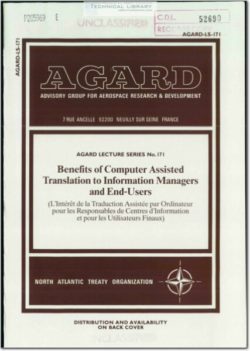
Benefits of Computer Assisted Translation to Information Managers and End Users
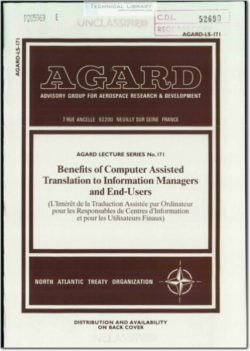
AGARD-LS-171 Benefits of Computer Assisted Translation to Information Managers and End Users
The typology of machine translation systems has been discussed and rediscussed over the past ten to
fifteen years. Initially, suppliers and research centres tended to equate the maturity of their
developments in terms of "software generations" in much the same way as computer suppliers.
Distinctions based on generations became less and less meaningful as time went by, particularly as
some approaches labelled second, third or even fourth generation proved less reliable in practice than
earlier developments which had continued to mature.
John Hutchins in "Machine Translation - past, present, future" bases his typology on the nature of the
translation process itself. He thus distinguishes between direct (bilingual), interlingual, transfer
and semantics-based systems. The problem here is that practically all major developments have tended
to progress along similar lines. Systems which originally took a direct or bilingual approach have
since evolved into interlingual or even transfer systems while "semantics—based" systems have begun to
give additional attention to many of the syntactic criteria adopted in earlier developments.
It is for the above reasons that in presenting my own ideas on MT typology, I shall give more emphasis
to performance, improvability and user-friendliness than to distinctions in the linguistic make-up of
systems. Users are after all more interested in how well a system can do the job than in how the Job
is actually done.
Most of the systems in current use originated in the United States in the sixities and seventies. They
fall into two basic categories: the larger, more complex systems such as Logos, Spanam and Systran
which are normally installed on centralized mainframe computers and can be accessed by
telecommunications; and less sophisticated products such as Smart, Globalink, Linguistic Products and
Weidner which run on personal computers or workstations at the user site. This second category should
however not be underestimated since in the language software industry, as in other areas, there is a
general tendency for desktop applications to evolve rapidly on the basis of user requirements.

FileAction
AGARD-LS-171 Benefits of Computer Assisted Translation to Information Managers and End Users.pdfDownload 

Comment On This Post

Your email address will not be published. Required fields are marked *

AGARD-LS-171

AGARD-LS-171
  • Version
  • 104 Downloads
  • 50.37 MB File Size
  • 1 File Count
  • April 25, 2016 Create Date
  • April 25, 2016 Last Updated
Scroll for Details

Benefits of Computer Assisted Translation to Information Managers and End Users
AGARD-LS-171 Benefits of Computer Assisted Translation to Information Managers and End Users
The typology of machine translation systems has been discussed and rediscussed over the past ten to
fifteen years. Initially, suppliers and research centres tended to equate the maturity of their
developments in terms of "software generations" in much the same way as computer suppliers.
Distinctions based on generations became less and less meaningful as time went by, particularly as
some approaches labelled second, third or even fourth generation proved less reliable in practice than
earlier developments which had continued to mature.
John Hutchins in "Machine Translation - past, present, future" bases his typology on the nature of the
translation process itself. He thus distinguishes between direct (bilingual), interlingual, transfer
and semantics-based systems. The problem here is that practically all major developments have tended
to progress along similar lines. Systems which originally took a direct or bilingual approach have
since evolved into interlingual or even transfer systems while "semantics—based" systems have begun to
give additional attention to many of the syntactic criteria adopted in earlier developments.
It is for the above reasons that in presenting my own ideas on MT typology, I shall give more emphasis
to performance, improvability and user-friendliness than to distinctions in the linguistic make-up of
systems. Users are after all more interested in how well a system can do the job than in how the Job
is actually done.
Most of the systems in current use originated in the United States in the sixities and seventies. They
fall into two basic categories: the larger, more complex systems such as Logos, Spanam and Systran
which are normally installed on centralized mainframe computers and can be accessed by
telecommunications; and less sophisticated products such as Smart, Globalink, Linguistic Products and
Weidner which run on personal computers or workstations at the user site. This second category should
however not be underestimated since in the language software industry, as in other areas, there is a
general tendency for desktop applications to evolve rapidly on the basis of user requirements.

FileAction
AGARD-LS-171 Benefits of Computer Assisted Translation to Information Managers and End Users.pdfDownload 
17,005 Documents in our Technical Library
3180469 Total Downloads

Search The Technical Library

Newest Additions

NASA-RP-1060 Subsonic Aircraft: Evolution and the Matching of Size to Performance
AA-CP-20212-001
AA-CP-20212-001
ADPO10769 Occurrence of Corrosion in Airframes
The purpose of this lecture is to provide an overview ...
MIL-STD-1759 Rivets and Rivet Type Fasteners Preferred for Design
The purpose of this book form standard is to provide ...
MIL-STD-810G Environmental Engineering Considerations and Laboratory Tests
This standard contains materiel acquisition program planning and engineering direction ...