17,005 Documents in our Technical Library
3177326 Total Downloads

Newest Additions

NASA-RP-1060 Subsonic Aircraft: Evolution and the Matching of Size to Performance
AA-CP-20212-001
AA-CP-20212-001
ADPO10769 Occurrence of Corrosion in Airframes
The purpose of this lecture is to provide an overview ...
MIL-STD-1759 Rivets and Rivet Type Fasteners Preferred for Design
The purpose of this book form standard is to provide ...
MIL-STD-810G Environmental Engineering Considerations and Laboratory Tests
This standard contains materiel acquisition program planning and engineering direction ...

AGARD-LS-118

AGARD-LS-118
  • Version
  • 209 Downloads
  • 102.55 MB File Size
  • 1 File Count
  • April 12, 2016 Create Date
  • April 12, 2016 Last Updated
Scroll for Details

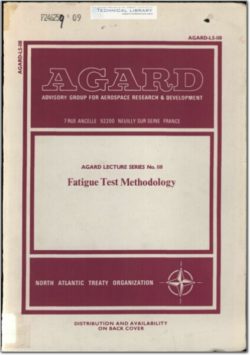
Fatigue Test Methodology

AGARD-LS-118 Fatigue Test Methodology

When a metal component is subjected to alternating stresses, fatigue cracks may occur, even where the
applied stresses are well below the ultimate strength of the component. Cracks originate from areas of
stress concentration or where metal surfaces are rubbing together (fretting), and propagate under the
influence of subsequent alternating stresses until final failure occurs, which can be catastrophic, as
indicated in Fig.1.

Over the past thirty years millions of pounds have been spent on fatigue testing and research, and
each year well over one thousand relevant papers are published. Nevertheless fatigue remains a major
problem and is the primary reason for the retirement of airframes, military and civil, from service. The
reason for this is quite fundamental. Most current aircraft are manufactured from age—hardening aluminium
alloys, because of their high strength/weight ratio. Unfortunately these materials have a very low fatigue
resistancei which has not improved greatly over the last twenty years. Fig.2 shows S-N diagrams for plain
specimens and lug specimens 2 of an age-hardening aluminium alloy. As can be seen, for the relatively
severe case of a lug, where failure occurs from an area of fretting between the pin and the bore of the
hole, failures can occur when alternating stresses as small as 13% of the ultimate tensile strength are
applied. Even for the plain specimen failures can occur where alternating stresses greater than 125% of
the UTS are applied. Since the initiation of fatigue damage depends on the value of local stresses, which
can often be several times the nominal values, it is not surprising that large areas of an aircraft are
designed from the point of view of fatigue rather than that of static strength. Fatigue research has
increased our understanding and accuracy of life prediction methods. Also considerable progress has been
made in increasing the fatigue strength of aircraft structures for a given weight. However, this effort
has not pushed fatigue strengths beyond the point where fatigue is a problem.

In fatigue-critical areas the designer will try to pare the structure so that adequate fatigue strength
is achieved throughout whilst ensuring that overdesign and hence extra weight are kept to a minimum. It
follows therefore that, when certifying aircraft, considerable areas of the structure need to be assessed
carefully for susceptibility to fatigue cracking. Also it is necessary to determine the rate of crack
propagation, should cracking occur, with a view to determining either (i) that complete failure of a struc-
tural element would not be catastrophic, or (ii) that it would be detected before it became catastrophic,
or (iii) that failure would not occur in the life of the aircraft.

FileAction
AGARD-LS-118 Fatigue Test Methodology.pdfDownload 

Comment On This Post

Your email address will not be published. Required fields are marked *

AGARD-LS-118

AGARD-LS-118
  • Version
  • 209 Downloads
  • 102.55 MB File Size
  • 1 File Count
  • April 12, 2016 Create Date
  • April 12, 2016 Last Updated
Scroll for Details

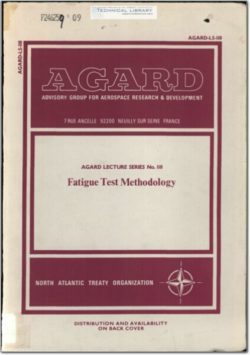
Fatigue Test Methodology

AGARD-LS-118 Fatigue Test Methodology

When a metal component is subjected to alternating stresses, fatigue cracks may occur, even where the
applied stresses are well below the ultimate strength of the component. Cracks originate from areas of
stress concentration or where metal surfaces are rubbing together (fretting), and propagate under the
influence of subsequent alternating stresses until final failure occurs, which can be catastrophic, as
indicated in Fig.1.

Over the past thirty years millions of pounds have been spent on fatigue testing and research, and
each year well over one thousand relevant papers are published. Nevertheless fatigue remains a major
problem and is the primary reason for the retirement of airframes, military and civil, from service. The
reason for this is quite fundamental. Most current aircraft are manufactured from age—hardening aluminium
alloys, because of their high strength/weight ratio. Unfortunately these materials have a very low fatigue
resistancei which has not improved greatly over the last twenty years. Fig.2 shows S-N diagrams for plain
specimens and lug specimens 2 of an age-hardening aluminium alloy. As can be seen, for the relatively
severe case of a lug, where failure occurs from an area of fretting between the pin and the bore of the
hole, failures can occur when alternating stresses as small as 13% of the ultimate tensile strength are
applied. Even for the plain specimen failures can occur where alternating stresses greater than 125% of
the UTS are applied. Since the initiation of fatigue damage depends on the value of local stresses, which
can often be several times the nominal values, it is not surprising that large areas of an aircraft are
designed from the point of view of fatigue rather than that of static strength. Fatigue research has
increased our understanding and accuracy of life prediction methods. Also considerable progress has been
made in increasing the fatigue strength of aircraft structures for a given weight. However, this effort
has not pushed fatigue strengths beyond the point where fatigue is a problem.

In fatigue-critical areas the designer will try to pare the structure so that adequate fatigue strength
is achieved throughout whilst ensuring that overdesign and hence extra weight are kept to a minimum. It
follows therefore that, when certifying aircraft, considerable areas of the structure need to be assessed
carefully for susceptibility to fatigue cracking. Also it is necessary to determine the rate of crack
propagation, should cracking occur, with a view to determining either (i) that complete failure of a struc-
tural element would not be catastrophic, or (ii) that it would be detected before it became catastrophic,
or (iii) that failure would not occur in the life of the aircraft.

FileAction
AGARD-LS-118 Fatigue Test Methodology.pdfDownload 
17,005 Documents in our Technical Library
3177326 Total Downloads

Search The Technical Library

Newest Additions

NASA-RP-1060 Subsonic Aircraft: Evolution and the Matching of Size to Performance
AA-CP-20212-001
AA-CP-20212-001
ADPO10769 Occurrence of Corrosion in Airframes
The purpose of this lecture is to provide an overview ...
MIL-STD-1759 Rivets and Rivet Type Fasteners Preferred for Design
The purpose of this book form standard is to provide ...
MIL-STD-810G Environmental Engineering Considerations and Laboratory Tests
This standard contains materiel acquisition program planning and engineering direction ...