17,005 Documents in our Technical Library
3180688 Total Downloads

Newest Additions

NASA-RP-1060 Subsonic Aircraft: Evolution and the Matching of Size to Performance
AA-CP-20212-001
AA-CP-20212-001
ADPO10769 Occurrence of Corrosion in Airframes
The purpose of this lecture is to provide an overview ...
MIL-STD-1759 Rivets and Rivet Type Fasteners Preferred for Design
The purpose of this book form standard is to provide ...
MIL-STD-810G Environmental Engineering Considerations and Laboratory Tests
This standard contains materiel acquisition program planning and engineering direction ...

AGARD-AR-001

AGARD-AR-001
  • Version
  • 108 Downloads
  • 3.75 MB File Size
  • 1 File Count
  • April 26, 2016 Create Date
  • April 26, 2016 Last Updated
Scroll for Details

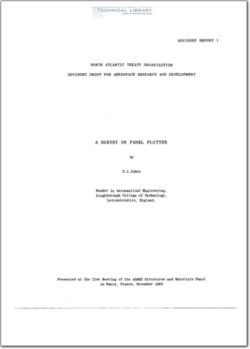
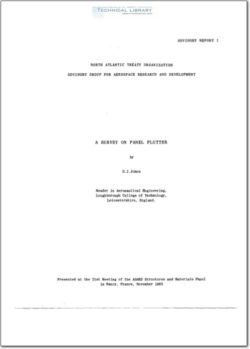
A Survey on Panel Flutter
AGARD-AR-001 A Survey on Panel Flutter
The outer surfaces of all flight vehicles are generally supported on internal
structural members which divide the surface into individual panels forming part of an
array. These panels are subject to in-plane loads and normal aerodynamic loads and
it is well-known that unstable oscillatory motions of the panels (either singly or as
an array) can be caused by the couplings set up between the elastic, inertia and
aerodynamic forces due to the panel motion. This phenomenon is known as “panel
flutter” and since 1945 a very large literature on this subject has developed
(see Bibliography in Appendix A).
Static aeroelastic problems (e.g. panel divergence) have received much less
attention (see Bibliography in Appendix B) since the occurrence of such incidents is
less likely and their effects are generally of less concern.
Dynamic aeroelastic problems (i.e. panel flutter) are of greater concern since
either immediate failure or long-term fatigue may be the result. For those outer
surfaces of supersonic aircraft and missiles which are not designed to carry primary
structural loads, e.g. on fairings to control surfaces and at wing-fuselage inter-
sections etc. the panel skin thicknesses are often so low from static loading con-
siderations that panel flutter may become the primary design criterion for such panels.
A further consequence of supersonic flight viz. aerodynamic heating. complicates this
problem since large thermal stresses may arise and if the panel experiences high com—
pressive in-plane loads its susceptibility to panel flutter may be increased.
Appendix A contains many references on the theoretical and experimental aspects of
panel flutter but unfortunately many of them are now of limited usefulness since at
the time they were written many of the important parameters were not recognised or
considered. A critical assessment of most of the earlier papers will not be attempted
here for that reason. It should be mentioned that many comprehensive surveys of the
panel flutter literature have now been published which should be consulted for further
detailed descriptions of these earlier papers. These survey papers are referred to
at the appropriate points in this report.

FileAction
AGARD-AR-001 A Survey on Panel Flutter.pdfDownload 

Comment On This Post

Your email address will not be published. Required fields are marked *

AGARD-AR-001

AGARD-AR-001
  • Version
  • 108 Downloads
  • 3.75 MB File Size
  • 1 File Count
  • April 26, 2016 Create Date
  • April 26, 2016 Last Updated
Scroll for Details

A Survey on Panel Flutter
AGARD-AR-001 A Survey on Panel Flutter
The outer surfaces of all flight vehicles are generally supported on internal
structural members which divide the surface into individual panels forming part of an
array. These panels are subject to in-plane loads and normal aerodynamic loads and
it is well-known that unstable oscillatory motions of the panels (either singly or as
an array) can be caused by the couplings set up between the elastic, inertia and
aerodynamic forces due to the panel motion. This phenomenon is known as “panel
flutter” and since 1945 a very large literature on this subject has developed
(see Bibliography in Appendix A).
Static aeroelastic problems (e.g. panel divergence) have received much less
attention (see Bibliography in Appendix B) since the occurrence of such incidents is
less likely and their effects are generally of less concern.
Dynamic aeroelastic problems (i.e. panel flutter) are of greater concern since
either immediate failure or long-term fatigue may be the result. For those outer
surfaces of supersonic aircraft and missiles which are not designed to carry primary
structural loads, e.g. on fairings to control surfaces and at wing-fuselage inter-
sections etc. the panel skin thicknesses are often so low from static loading con-
siderations that panel flutter may become the primary design criterion for such panels.
A further consequence of supersonic flight viz. aerodynamic heating. complicates this
problem since large thermal stresses may arise and if the panel experiences high com—
pressive in-plane loads its susceptibility to panel flutter may be increased.
Appendix A contains many references on the theoretical and experimental aspects of
panel flutter but unfortunately many of them are now of limited usefulness since at
the time they were written many of the important parameters were not recognised or
considered. A critical assessment of most of the earlier papers will not be attempted
here for that reason. It should be mentioned that many comprehensive surveys of the
panel flutter literature have now been published which should be consulted for further
detailed descriptions of these earlier papers. These survey papers are referred to
at the appropriate points in this report.

FileAction
AGARD-AR-001 A Survey on Panel Flutter.pdfDownload 
17,005 Documents in our Technical Library
3180688 Total Downloads

Search The Technical Library

Newest Additions

NASA-RP-1060 Subsonic Aircraft: Evolution and the Matching of Size to Performance
AA-CP-20212-001
AA-CP-20212-001
ADPO10769 Occurrence of Corrosion in Airframes
The purpose of this lecture is to provide an overview ...
MIL-STD-1759 Rivets and Rivet Type Fasteners Preferred for Design
The purpose of this book form standard is to provide ...
MIL-STD-810G Environmental Engineering Considerations and Laboratory Tests
This standard contains materiel acquisition program planning and engineering direction ...