
17,005 Documents in our Technical Library
3067441 Total Downloads

Newest Additions

NASA-RP-1060 Subsonic Aircraft: Evolution and the Matching of Size to Performance
AA-CP-20212-001
AA-CP-20212-001
ADPO10769 Occurrence of Corrosion in Airframes
The purpose of this lecture is to provide an overview ...
MIL-STD-1759 Rivets and Rivet Type Fasteners Preferred for Design
The purpose of this book form standard is to provide ...
MIL-STD-810G Environmental Engineering Considerations and Laboratory Tests
This standard contains materiel acquisition program planning and engineering direction ...

WADC-TR-53-114

  • Version
  • 165 Downloads
  • 43.02 MB File Size
  • 1 File Count
  • March 7, 2017 Create Date
  • March 7, 2017 Last Updated
Scroll for Details

Ohio State University Research Foundation - Methods of Controlling Temperature Rise in Airborne Compartments at Supersonic Velocities with and Without Internal Heat Generation
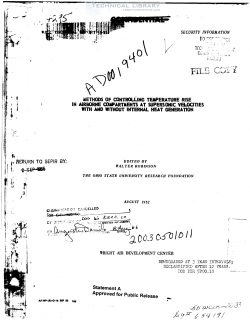
Thig report 1B eoneeræa v1th presentation of the infomation de- 
veloped In an Investigation with the ±Jective of studying methods 
of cooling airborne but specifically intended produce data 
for controlling the temperature rise of electronic echanical 
control cæponents in ruået Installations. only 
Sections I 11 are conceræd vith analyges assuming Bteady-state thermal 
operation, vh11e Sections 111 through XI end Appendix 111 on fuel tempera— 
ture rise in flight concerned Vltb methods of analysis ana results 
obtained in the study Of transient thermal latter approach 
hag been chosen because when operating under constant environæntal condi- 
Clone conducive to high heat gain, fev equipnents vould reach thermal 
equilibrium in less tvo hours, vhich has been ooneidered ae a reason- 
ably long operating ti.æ for the specified applications consideration. 
The reductions In size and of insulation or cooling apparatus, 
realized by for urminal temperatures to be reached in 
•the transient state, rather than to be maintained in the under 
terminal environæntal conditions, are substantial, as indicated repeatedly 
In thie report. 
It hag been intention in preparing this N•port to present in 
each section a phage Of study as a self-contained unit since ele variety of 
aspects covered in the report has not been found to lend itBe1f reedlly to 
joint Bunarization. Therefore, the gunary presented in each section after 
the Introductory remarks 1B intended to provide indication of anaaysee, 
data, cone1ue10n3, degign procedures, etc. contained In that particular sec— 
tion. Throughout the report methods of calculations and are 
emphasized since it intended to provide the necessary information that 
•ould enable the to cope vith qpeclfic problems of similar nature In 
vhich are defined. Because of the number of 
their possible cæbinatione fev unconditional recæændatione are pre— 
sented. Instead an made to develop In each section the necessary 
criteria for the election of each of limiting temperature 
rise, as summarized in Section XI.


FileAction
WADC-TR-53-114 Methods of Controlling Temperature Rise in Airborne Compartments at Supersonic Velocities with and.pdfDownload 

Comment On This Post

Your email address will not be published. Required fields are marked *

WADC-TR-53-114

  • Version
  • 165 Downloads
  • 43.02 MB File Size
  • 1 File Count
  • March 7, 2017 Create Date
  • March 7, 2017 Last Updated
Scroll for Details

Ohio State University Research Foundation - Methods of Controlling Temperature Rise in Airborne Compartments at Supersonic Velocities with and Without Internal Heat Generation

Thig report 1B eoneeræa v1th presentation of the infomation de- 
veloped In an Investigation with the ±Jective of studying methods 
of cooling airborne but specifically intended produce data 
for controlling the temperature rise of electronic echanical 
control cæponents in ruået Installations. only 
Sections I 11 are conceræd vith analyges assuming Bteady-state thermal 
operation, vh11e Sections 111 through XI end Appendix 111 on fuel tempera— 
ture rise in flight concerned Vltb methods of analysis ana results 
obtained in the study Of transient thermal latter approach 
hag been chosen because when operating under constant environæntal condi- 
Clone conducive to high heat gain, fev equipnents vould reach thermal 
equilibrium in less tvo hours, vhich has been ooneidered ae a reason- 
ably long operating ti.æ for the specified applications consideration. 
The reductions In size and of insulation or cooling apparatus, 
realized by for urminal temperatures to be reached in 
•the transient state, rather than to be maintained in the under 
terminal environæntal conditions, are substantial, as indicated repeatedly 
In thie report. 
It hag been intention in preparing this N•port to present in 
each section a phage Of study as a self-contained unit since ele variety of 
aspects covered in the report has not been found to lend itBe1f reedlly to 
joint Bunarization. Therefore, the gunary presented in each section after 
the Introductory remarks 1B intended to provide indication of anaaysee, 
data, cone1ue10n3, degign procedures, etc. contained In that particular sec— 
tion. Throughout the report methods of calculations and are 
emphasized since it intended to provide the necessary information that 
•ould enable the to cope vith qpeclfic problems of similar nature In 
vhich are defined. Because of the number of 
their possible cæbinatione fev unconditional recæændatione are pre— 
sented. Instead an made to develop In each section the necessary 
criteria for the election of each of limiting temperature 
rise, as summarized in Section XI.


FileAction
WADC-TR-53-114 Methods of Controlling Temperature Rise in Airborne Compartments at Supersonic Velocities with and.pdfDownload 
17,005 Documents in our Technical Library
3067441 Total Downloads

Search The Technical Library

Newest Additions

NASA-RP-1060 Subsonic Aircraft: Evolution and the Matching of Size to Performance
AA-CP-20212-001
AA-CP-20212-001
ADPO10769 Occurrence of Corrosion in Airframes
The purpose of this lecture is to provide an overview ...
MIL-STD-1759 Rivets and Rivet Type Fasteners Preferred for Design
The purpose of this book form standard is to provide ...
MIL-STD-810G Environmental Engineering Considerations and Laboratory Tests
This standard contains materiel acquisition program planning and engineering direction ...

Popular Items