
17,005 Documents in our Technical Library
3168413 Total Downloads

Newest Additions

NASA-RP-1060 Subsonic Aircraft: Evolution and the Matching of Size to Performance
AA-CP-20212-001
AA-CP-20212-001
ADPO10769 Occurrence of Corrosion in Airframes
The purpose of this lecture is to provide an overview ...
MIL-STD-1759 Rivets and Rivet Type Fasteners Preferred for Design
The purpose of this book form standard is to provide ...
MIL-STD-810G Environmental Engineering Considerations and Laboratory Tests
This standard contains materiel acquisition program planning and engineering direction ...

NASA-TM-1999-209512

NASA-TM-1999-209512
  • Version
  • 268 Downloads
  • 3.33 MB File Size
  • 1 File Count
  • April 21, 2016 Create Date
  • April 21, 2016 Last Updated
Scroll for Details

Development of Curved-Plate Elements for the Exact Buckling Analysis of Composite Plate Assemblies Including Transverse Shear Effects
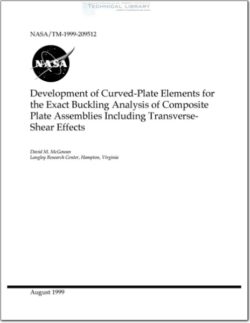
NASA-TM-1999-209512 Development of Curved-Plate Elements for the Exact Buckling Analysis of Composite Plate Assemblies Including Transverse Shear Effects
Longitudinally stiffened plate structures occur frequently in aerospace vehicle
structures. These structures can typically be represented by long, thin, flat or curved
plates that are rigidly connected along their longitudinal edges, see Figure 1.1. The
designs for these structures often exploit the increased structural efficiency that can be
obtained by the use of advanced composite materials. Therefore, the plates used to
represent the structure may consist of anisotropic laminates. The buckling and vibration
behavior of this type of structure must be understood to design the structure.
Additionally, to satisfy the current demands for more cost—effective and structurally
efficient aerospace vehicles, these structures are frequently optimized to obtain an
optimal design that satisfies either buckling or vibration constraints or a combination of
these two constraints. There is a need for analytical tools that can provide the analysis
capability required to optimize panel designs.
The VICONOPT computer code [1] is an exact analysis and optimum design
program that includes the buckling and vibration analyses of prismatic assemblies of flat,
in—plane—loaded anisotropic plates. The code also includes approximations for curved and
tapered plates, discrete supports, and transverse stiffeners. Anisotropic composite
laminates having fully populated A, B and D stiffness matrices may be analyzed. Either
classical plate theory (CPT) or first—order transverse—shear—deformation plate theory
(SDPT) may be used [2]. The analyses of the plate assemblies assume a sinusoidal
response along the plate length. The analysis used in the code is referred to as “exact”
because it uses stiffness matrices that result from the exact solution to the differential
equations that describe the behavior of the plates.
Currently, VICONOPT approximates a curved plate by subdividing it into a series of
flat—plate segments that are joined along their longitudinal edges to form the complete
curved—plate structure, see Figure 1.2. This procedure is analogous to the discretization
approach used in finite element analysis. The code uses exact stiffnesses for the flat—plate
segments and enforces continuity of displacements and rotations at the segment
connections. Thus, the analyst must ensure that an adequate number of flat—plate
segments is used in the analysis. The next logical step in the development of the
VICONOPT code is to eliminate the need to approximate curved—plate geometries by
flat—plate segments by adding the capability to analyze curved—plate segments exactly.

FileAction
NASA-TM-1999-209512 Development of Curved-Plate Elements for the Exact Buckling Analysis of Composite Plate Assemblies Including Transverse Shear Effects.pdfDownload 

Comment On This Post

Your email address will not be published. Required fields are marked *

NASA-TM-1999-209512

NASA-TM-1999-209512
  • Version
  • 268 Downloads
  • 3.33 MB File Size
  • 1 File Count
  • April 21, 2016 Create Date
  • April 21, 2016 Last Updated
Scroll for Details

Development of Curved-Plate Elements for the Exact Buckling Analysis of Composite Plate Assemblies Including Transverse Shear Effects
NASA-TM-1999-209512 Development of Curved-Plate Elements for the Exact Buckling Analysis of Composite Plate Assemblies Including Transverse Shear Effects
Longitudinally stiffened plate structures occur frequently in aerospace vehicle
structures. These structures can typically be represented by long, thin, flat or curved
plates that are rigidly connected along their longitudinal edges, see Figure 1.1. The
designs for these structures often exploit the increased structural efficiency that can be
obtained by the use of advanced composite materials. Therefore, the plates used to
represent the structure may consist of anisotropic laminates. The buckling and vibration
behavior of this type of structure must be understood to design the structure.
Additionally, to satisfy the current demands for more cost—effective and structurally
efficient aerospace vehicles, these structures are frequently optimized to obtain an
optimal design that satisfies either buckling or vibration constraints or a combination of
these two constraints. There is a need for analytical tools that can provide the analysis
capability required to optimize panel designs.
The VICONOPT computer code [1] is an exact analysis and optimum design
program that includes the buckling and vibration analyses of prismatic assemblies of flat,
in—plane—loaded anisotropic plates. The code also includes approximations for curved and
tapered plates, discrete supports, and transverse stiffeners. Anisotropic composite
laminates having fully populated A, B and D stiffness matrices may be analyzed. Either
classical plate theory (CPT) or first—order transverse—shear—deformation plate theory
(SDPT) may be used [2]. The analyses of the plate assemblies assume a sinusoidal
response along the plate length. The analysis used in the code is referred to as “exact”
because it uses stiffness matrices that result from the exact solution to the differential
equations that describe the behavior of the plates.
Currently, VICONOPT approximates a curved plate by subdividing it into a series of
flat—plate segments that are joined along their longitudinal edges to form the complete
curved—plate structure, see Figure 1.2. This procedure is analogous to the discretization
approach used in finite element analysis. The code uses exact stiffnesses for the flat—plate
segments and enforces continuity of displacements and rotations at the segment
connections. Thus, the analyst must ensure that an adequate number of flat—plate
segments is used in the analysis. The next logical step in the development of the
VICONOPT code is to eliminate the need to approximate curved—plate geometries by
flat—plate segments by adding the capability to analyze curved—plate segments exactly.

FileAction
NASA-TM-1999-209512 Development of Curved-Plate Elements for the Exact Buckling Analysis of Composite Plate Assemblies Including Transverse Shear Effects.pdfDownload 
17,005 Documents in our Technical Library
3168413 Total Downloads

Search The Technical Library

Newest Additions

NASA-RP-1060 Subsonic Aircraft: Evolution and the Matching of Size to Performance
AA-CP-20212-001
AA-CP-20212-001
ADPO10769 Occurrence of Corrosion in Airframes
The purpose of this lecture is to provide an overview ...
MIL-STD-1759 Rivets and Rivet Type Fasteners Preferred for Design
The purpose of this book form standard is to provide ...
MIL-STD-810G Environmental Engineering Considerations and Laboratory Tests
This standard contains materiel acquisition program planning and engineering direction ...