
17,005 Documents in our Technical Library
3247408 Total Downloads

Newest Additions

NASA-RP-1060 Subsonic Aircraft: Evolution and the Matching of Size to Performance
AA-CP-20212-001
AA-CP-20212-001
ADPO10769 Occurrence of Corrosion in Airframes
The purpose of this lecture is to provide an overview ...
MIL-STD-1759 Rivets and Rivet Type Fasteners Preferred for Design
The purpose of this book form standard is to provide ...
MIL-STD-810G Environmental Engineering Considerations and Laboratory Tests
This standard contains materiel acquisition program planning and engineering direction ...

naca-tn-2222

  • Version
  • 81 Downloads
  • 2.00 MB File Size
  • 1 File Count
  • December 14, 2016 Create Date
  • December 14, 2016 Last Updated
Scroll for Details

National Advisory Committee for Aeronautics, Technical Notes - A Method for the Determination of the Spanwise Load Distribution of a Flexible Swept Wing at Subsonic Speeds
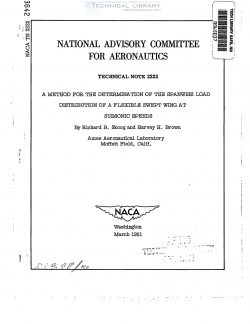
A method is presented for the determination of the spanwise load
distribution of a flexible swept wing at subsonic speeds. The method
is based on a relaxation approach utilizing aerodynamic loadings
obtained from previously published work (NACA Rep. 921, 19%) based on
Weissinger's simlified lifting-surface theory together with simple beam
theory. The solution is expressed in a convenient form such that the
amount of detailed computing involved when extensive aeroelastic cal—
culations for many flight conditions are desired is reduced to that for
a single set of flight conditions. The method is simplified further by
an abbreviated solution to the relaxation process. Sample computing
forms and a numerical example are presented to illustrate the method.

In the design of unswept wings, the spanwise distribution of.aero-
dynamic load usually has been considered to be independent of structural
deflections since torsional deflections normally are negligible at
design operating speeds (usually well below the wing divergence speed)
and bending deflections are not a factor for zero sweep. On a swept
wing, however, the span load distribution no longer may be considered to
be independent of structural deflections since the contribution of
bending to the streamise change in section angle of attack can become |
of considerable magnitude as the sweep angle is increased. In addition
to this aeroelastic effect associated with wing sweep the trend toward
higher operating dynamic pressures causes factors, which were previously
negligible, to assume increased significance.

Several methods have been suggested for calculating the aerodynamic
loading of the flexible swept wing, both explicitly (references 1 and 2)
and by iteration (reference 3). The approach in each of these methods
has been to incorporate aerodynamic and structural theory in an equation
of equilibrium expressing the balance existing between external and 'u
internal forces on the wing. To simplify the mathematics involved,
matrix notations have been employed in two of these methods.

FileAction
naca-tn-2222 A Method for the Determination of the Spanwise Load Distribution of a Flexible Swept Wing at Subsonic Speeds.pdfDownload 

Comment On This Post

Your email address will not be published. Required fields are marked *

naca-tn-2222

  • Version
  • 81 Downloads
  • 2.00 MB File Size
  • 1 File Count
  • December 14, 2016 Create Date
  • December 14, 2016 Last Updated
Scroll for Details

National Advisory Committee for Aeronautics, Technical Notes - A Method for the Determination of the Spanwise Load Distribution of a Flexible Swept Wing at Subsonic Speeds

A method is presented for the determination of the spanwise load
distribution of a flexible swept wing at subsonic speeds. The method
is based on a relaxation approach utilizing aerodynamic loadings
obtained from previously published work (NACA Rep. 921, 19%) based on
Weissinger's simlified lifting-surface theory together with simple beam
theory. The solution is expressed in a convenient form such that the
amount of detailed computing involved when extensive aeroelastic cal—
culations for many flight conditions are desired is reduced to that for
a single set of flight conditions. The method is simplified further by
an abbreviated solution to the relaxation process. Sample computing
forms and a numerical example are presented to illustrate the method.

In the design of unswept wings, the spanwise distribution of.aero-
dynamic load usually has been considered to be independent of structural
deflections since torsional deflections normally are negligible at
design operating speeds (usually well below the wing divergence speed)
and bending deflections are not a factor for zero sweep. On a swept
wing, however, the span load distribution no longer may be considered to
be independent of structural deflections since the contribution of
bending to the streamise change in section angle of attack can become |
of considerable magnitude as the sweep angle is increased. In addition
to this aeroelastic effect associated with wing sweep the trend toward
higher operating dynamic pressures causes factors, which were previously
negligible, to assume increased significance.

Several methods have been suggested for calculating the aerodynamic
loading of the flexible swept wing, both explicitly (references 1 and 2)
and by iteration (reference 3). The approach in each of these methods
has been to incorporate aerodynamic and structural theory in an equation
of equilibrium expressing the balance existing between external and 'u
internal forces on the wing. To simplify the mathematics involved,
matrix notations have been employed in two of these methods.

FileAction
naca-tn-2222 A Method for the Determination of the Spanwise Load Distribution of a Flexible Swept Wing at Subsonic Speeds.pdfDownload 
17,005 Documents in our Technical Library
3247408 Total Downloads

Search The Technical Library

Newest Additions

NASA-RP-1060 Subsonic Aircraft: Evolution and the Matching of Size to Performance
AA-CP-20212-001
AA-CP-20212-001
ADPO10769 Occurrence of Corrosion in Airframes
The purpose of this lecture is to provide an overview ...
MIL-STD-1759 Rivets and Rivet Type Fasteners Preferred for Design
The purpose of this book form standard is to provide ...
MIL-STD-810G Environmental Engineering Considerations and Laboratory Tests
This standard contains materiel acquisition program planning and engineering direction ...