
17,005 Documents in our Technical Library
3247413 Total Downloads

Newest Additions

NASA-RP-1060 Subsonic Aircraft: Evolution and the Matching of Size to Performance
AA-CP-20212-001
AA-CP-20212-001
ADPO10769 Occurrence of Corrosion in Airframes
The purpose of this lecture is to provide an overview ...
MIL-STD-1759 Rivets and Rivet Type Fasteners Preferred for Design
The purpose of this book form standard is to provide ...
MIL-STD-810G Environmental Engineering Considerations and Laboratory Tests
This standard contains materiel acquisition program planning and engineering direction ...

NACA-TN-1739

NACA-TN-1739
  • Version
  • 196 Downloads
  • 1.31 MB File Size
  • 1 File Count
  • December 4, 2015 Create Date
  • December 4, 2015 Last Updated
Scroll for Details

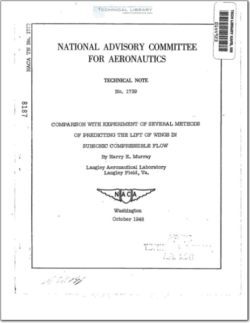
National Advisory Committee for Aeronautics, Technical Notes - Comparison with Experiment of Several Methods of Predicting the Lift of Wings in Subsonic Compressible Flow
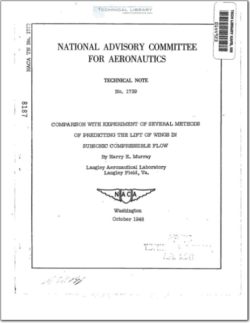
naca-tn-1739 Comparison with Experiment of Several Methods of Predicting the Lift of Wings in Subsonic Compressible Flow

Several methods of predicting the lift of wings in subsonic com—
pressible flow were compared with experiment. An experimental verifica—
tion of Kaplan’s formula for the effect of compressibility on the lift
of wing sections was obtained.

Semiempirical fomfias were developed for predicting the subsonic
effects of compressibility on the lift of finite-span wings based on
corrections to the section lift—curve slope. lJhese semiempirical
formulas yielded better agreement with experiment than previously
derived theoretical methods. The ayeement at small sweep angles was
slightly better when thickness was considered in the semiempirical
formulas.

Both experiments and calculations indicated a. decrease in the
variation of lift with Mach number for increasing sweep.

The effect of compressibility on the lift of finite—span wings has
been extensively discussed in previous papers (references 1, 2, and 3,
for example). These papers discuss compressibility effects in terms
of an affine transformation based on small—perturbation theory herein
referred to as the three-dimensional Prandtl transformation. The
application of the three—dimensional Prandtl transformation to the
lifting-line theory of unswept wings is discussed in references 1 and 2.
An application of Weiss r's approximate lifting—surface theory of -
wings of arbitrary sweep reference 1;) is discussed in reference 3.
When compared with experiment, these existing methods did not yield
entirely satisfactory results.

Kaplan (reference 5) has shown that including the thickness of a
two-dimensional airfoil in calculations of the effect of compressibility
on the lift results in appreciable effect at high subsonic Mach numbers.

Inclusion of thickness in the three-dimensional case consequently may
also have an appreciable effect. Rather formidable mathematical
difficulties are encountered in any rigorous attempt to consider the
thickness of a finite—span wing in. subsonic compressible flow. To - ’1
attempt an approximate adaptation of Kaplan's two—dimensional solution
to finite—span wings therefore seems reasonable.

FileAction
naca-tn-1739.pdfDownload 

Comment On This Post

Your email address will not be published. Required fields are marked *

NACA-TN-1739

NACA-TN-1739
  • Version
  • 196 Downloads
  • 1.31 MB File Size
  • 1 File Count
  • December 4, 2015 Create Date
  • December 4, 2015 Last Updated
Scroll for Details

National Advisory Committee for Aeronautics, Technical Notes - Comparison with Experiment of Several Methods of Predicting the Lift of Wings in Subsonic Compressible Flow

naca-tn-1739 Comparison with Experiment of Several Methods of Predicting the Lift of Wings in Subsonic Compressible Flow

Several methods of predicting the lift of wings in subsonic com—
pressible flow were compared with experiment. An experimental verifica—
tion of Kaplan’s formula for the effect of compressibility on the lift
of wing sections was obtained.

Semiempirical fomfias were developed for predicting the subsonic
effects of compressibility on the lift of finite-span wings based on
corrections to the section lift—curve slope. lJhese semiempirical
formulas yielded better agreement with experiment than previously
derived theoretical methods. The ayeement at small sweep angles was
slightly better when thickness was considered in the semiempirical
formulas.

Both experiments and calculations indicated a. decrease in the
variation of lift with Mach number for increasing sweep.

The effect of compressibility on the lift of finite—span wings has
been extensively discussed in previous papers (references 1, 2, and 3,
for example). These papers discuss compressibility effects in terms
of an affine transformation based on small—perturbation theory herein
referred to as the three-dimensional Prandtl transformation. The
application of the three—dimensional Prandtl transformation to the
lifting-line theory of unswept wings is discussed in references 1 and 2.
An application of Weiss r's approximate lifting—surface theory of -
wings of arbitrary sweep reference 1;) is discussed in reference 3.
When compared with experiment, these existing methods did not yield
entirely satisfactory results.

Kaplan (reference 5) has shown that including the thickness of a
two-dimensional airfoil in calculations of the effect of compressibility
on the lift results in appreciable effect at high subsonic Mach numbers.

Inclusion of thickness in the three-dimensional case consequently may
also have an appreciable effect. Rather formidable mathematical
difficulties are encountered in any rigorous attempt to consider the
thickness of a finite—span wing in. subsonic compressible flow. To - ’1
attempt an approximate adaptation of Kaplan's two—dimensional solution
to finite—span wings therefore seems reasonable.

FileAction
naca-tn-1739.pdfDownload 
17,005 Documents in our Technical Library
3247413 Total Downloads

Search The Technical Library

Newest Additions

NASA-RP-1060 Subsonic Aircraft: Evolution and the Matching of Size to Performance
AA-CP-20212-001
AA-CP-20212-001
ADPO10769 Occurrence of Corrosion in Airframes
The purpose of this lecture is to provide an overview ...
MIL-STD-1759 Rivets and Rivet Type Fasteners Preferred for Design
The purpose of this book form standard is to provide ...
MIL-STD-810G Environmental Engineering Considerations and Laboratory Tests
This standard contains materiel acquisition program planning and engineering direction ...