
17,005 Documents in our Technical Library
3167404 Total Downloads

Newest Additions

NASA-RP-1060 Subsonic Aircraft: Evolution and the Matching of Size to Performance
AA-CP-20212-001
AA-CP-20212-001
ADPO10769 Occurrence of Corrosion in Airframes
The purpose of this lecture is to provide an overview ...
MIL-STD-1759 Rivets and Rivet Type Fasteners Preferred for Design
The purpose of this book form standard is to provide ...
MIL-STD-810G Environmental Engineering Considerations and Laboratory Tests
This standard contains materiel acquisition program planning and engineering direction ...

naca-rm-l50i22

  • Version
  • 48 Downloads
  • 582.22 KB File Size
  • 1 File Count
  • April 26, 2017 Create Date
  • April 26, 2017 Last Updated
Scroll for Details

National Advisory Committee for Aeronautics, Research Memorandum - Comparison of Large Scale Flight Measurements of Zero lift Drag at Mach Numbers from 0.9 to 1.7 of Two Wing Body Combinations Having Similar 60° Triangular Wings with NACA 65A003 Sections
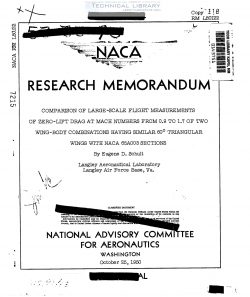
An investigation of zero—lift drag of a fin-stabilized wing-body
combination was made at high-subsonic and supersonic speeds in the
Reynolds number range of 13 x h06 to #1 X 10⁶. The ratio of body
frontal area to wing area was 0.0612. These data are presented with
those of a wingless body and similar winged body described in NACA
RM L50D26 in which the ratio of body frontal area to wing area was
0.0306. The bodies of both configurations were the same as the wing—
less body and had parabolic profiles and fineness ratios of 10. The
wings were triangular in plan form with a leading-edge sweep of 600
and NACA 65A003 airfoil sections.

The results indicated that the small-winged combination with two
fins had a total drag coefficient of 0.01 at subsonic speeds and 0.018
to 0.015 at supersonic speeds. Wing—plus—interference drag coefficient
varied from 0.006 at high—subsonic speeds-to 0.01 at transonic speeds
and 0.005 at supersonic speeds.

A comparison of results with a similar configuration having twice
the wing area indicated that the smallawinged body had a greater wing—
plus-interference drag coefficient in the subsonic and transonic range
and approximately equal drag coefficient in the supersonic range. The
mutual interference effects were unfavorable for the smalldwinged con—
figuration and favorable for the largeswinged configuration. The base
pressure coefficients for the small—winged body changed from approxi-
mately zero at subsonic speeds to —0.075 at supersonic speeds; Doubling
the wing area increased the absolute pressures at the base and corre-
spondingly reduced the base drag. This drag, however, represented a
very small part of the total drag of the configuration.

As part of its program on transonic research, the Iangley Pilotless
Aircraft Research Division is conducting a series of free-flight tests
at high Reynolds numbers to determine the zero—lift drag characteristics
of several winged—body configurations. TheSe tests employ the rocket-
powered model technique and provide continuous data from supersonic to
high-subsonic speeds.

FileAction
naca-rm-l50i22 Comparison of Large Scale Flight Measurements of Zero lift Drag at Mach Numbers from 0.9 to 1.7 of Two Wing Body Combinations Having Similar 60° Triangular Wings with NACA 65A003 Sections.pdfDownload 

Comment On This Post

Your email address will not be published. Required fields are marked *

naca-rm-l50i22

  • Version
  • 48 Downloads
  • 582.22 KB File Size
  • 1 File Count
  • April 26, 2017 Create Date
  • April 26, 2017 Last Updated
Scroll for Details

National Advisory Committee for Aeronautics, Research Memorandum - Comparison of Large Scale Flight Measurements of Zero lift Drag at Mach Numbers from 0.9 to 1.7 of Two Wing Body Combinations Having Similar 60° Triangular Wings with NACA 65A003 Sections

An investigation of zero—lift drag of a fin-stabilized wing-body
combination was made at high-subsonic and supersonic speeds in the
Reynolds number range of 13 x h06 to #1 X 10⁶. The ratio of body
frontal area to wing area was 0.0612. These data are presented with
those of a wingless body and similar winged body described in NACA
RM L50D26 in which the ratio of body frontal area to wing area was
0.0306. The bodies of both configurations were the same as the wing—
less body and had parabolic profiles and fineness ratios of 10. The
wings were triangular in plan form with a leading-edge sweep of 600
and NACA 65A003 airfoil sections.

The results indicated that the small-winged combination with two
fins had a total drag coefficient of 0.01 at subsonic speeds and 0.018
to 0.015 at supersonic speeds. Wing—plus—interference drag coefficient
varied from 0.006 at high—subsonic speeds-to 0.01 at transonic speeds
and 0.005 at supersonic speeds.

A comparison of results with a similar configuration having twice
the wing area indicated that the smallawinged body had a greater wing—
plus-interference drag coefficient in the subsonic and transonic range
and approximately equal drag coefficient in the supersonic range. The
mutual interference effects were unfavorable for the smalldwinged con—
figuration and favorable for the largeswinged configuration. The base
pressure coefficients for the small—winged body changed from approxi-
mately zero at subsonic speeds to —0.075 at supersonic speeds; Doubling
the wing area increased the absolute pressures at the base and corre-
spondingly reduced the base drag. This drag, however, represented a
very small part of the total drag of the configuration.

As part of its program on transonic research, the Iangley Pilotless
Aircraft Research Division is conducting a series of free-flight tests
at high Reynolds numbers to determine the zero—lift drag characteristics
of several winged—body configurations. TheSe tests employ the rocket-
powered model technique and provide continuous data from supersonic to
high-subsonic speeds.

FileAction
naca-rm-l50i22 Comparison of Large Scale Flight Measurements of Zero lift Drag at Mach Numbers from 0.9 to 1.7 of Two Wing Body Combinations Having Similar 60° Triangular Wings with NACA 65A003 Sections.pdfDownload 
17,005 Documents in our Technical Library
3167404 Total Downloads

Search The Technical Library

Newest Additions

NASA-RP-1060 Subsonic Aircraft: Evolution and the Matching of Size to Performance
AA-CP-20212-001
AA-CP-20212-001
ADPO10769 Occurrence of Corrosion in Airframes
The purpose of this lecture is to provide an overview ...
MIL-STD-1759 Rivets and Rivet Type Fasteners Preferred for Design
The purpose of this book form standard is to provide ...
MIL-STD-810G Environmental Engineering Considerations and Laboratory Tests
This standard contains materiel acquisition program planning and engineering direction ...