
17,005 Documents in our Technical Library
3306380 Total Downloads

Newest Additions

NASA-RP-1060 Subsonic Aircraft: Evolution and the Matching of Size to Performance
AA-CP-20212-001
AA-CP-20212-001
ADPO10769 Occurrence of Corrosion in Airframes
The purpose of this lecture is to provide an overview ...
MIL-STD-1759 Rivets and Rivet Type Fasteners Preferred for Design
The purpose of this book form standard is to provide ...
MIL-STD-810G Environmental Engineering Considerations and Laboratory Tests
This standard contains materiel acquisition program planning and engineering direction ...

naca-rm-a7a31

  • Version
  • 101 Downloads
  • 1.88 MB File Size
  • 1 File Count
  • April 15, 2017 Create Date
  • April 15, 2017 Last Updated
Scroll for Details

National Advisory Committee for Aeronautics, Research Memorandum - Development of NACA Submerged Inlets and a Comparison with Wing Leading Edge Inlets for a Scale Model of a Fighter Airplane
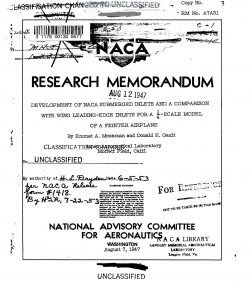
Characteristics of NACA submerged duct entries and wing leading-
edge inlets designed for a l/h—scale flow model of a fighter-«type
airplane powered by a Jet engine in the fuselage are presented. Duct
total—head losses at the simulated entrance to the Jet engine and
pressure distributions over the duct entries arelshown. A comparison
of the dynamic pressure recovery and critical Mach number of the two
intake systems is made. flicluded isa discussion of methods of
ameliorating a duct—flow instability which mayr appear with a twin—
entrance submerged duct system.

The dynamic pressure—recovery results indicate that, for a
Jet—propelled airplane with .the Jet engine in the fuselage, NACA
submerged duct entries afford a better method of supplying air to
the Jet engine than wing leading-edge duct entries. This choice of
the submerged entry is mainly due to the complex internal ducting
of the wing leading—edge system. The critical Mach number is shown
to be higher for these NACA submerged fuselage entries than for the
basic wing section or the wing leading—edge duct entries, through the
high—speed range down to_280 miles per hour (CL=O.20) , for sea level
flight.

Airplanes or missiles which utilize the oxygen of the atmosphere
for combustion in their propulsive systems require that the air be
ducted with a minimum pressure loss from the free streamto the
entrance of the engine. Small losses Ln internal—flow systems
handling the large quantities of air required by' Jet engines cause
serious decreases in the thrust and appreciable increases in the
fuel consumption so that the attainment of optimum performance from
a Jet—powered airplane depends, in great part, upon the selection ,
and design_of a ducting system which will supply air to the Jet
engine with maximum efficiency.

This report is.conoerned with the problem of obtaining maximum
ducting efficiency for a Jet—propelled airplane by partially convert—
ing the kinetic energy of the entering air_to pressure energy, and
conserving the remainder of the kinetic_energy so that a minimum
pressure loss results at the entrance to the Jet—engine'compressor.
In this inYestigation two ducting systems of dissimilar geometry were
designed and installed on a l/h—scale flow model of a typical fighter
airplane. one design incorporated NACA submerged inlets and the
other, wing leading—edge inlets. Because the _safie model was used for V 1
the two duct i_nstallati.ons and the air quantity requirements through
the range of flight attitudes_ were identical for_ the two systems,
this investigation afforded an excellent means of comparing their
relative merits.

FileAction
naca-rm-a7a31 Development of NACA Submerged Inlets and a Comparison with Wing Leading Edge Inlets for a Scale Model of a Fighter Airplane.pdfDownload 

Comment On This Post

Your email address will not be published. Required fields are marked *

naca-rm-a7a31

  • Version
  • 101 Downloads
  • 1.88 MB File Size
  • 1 File Count
  • April 15, 2017 Create Date
  • April 15, 2017 Last Updated
Scroll for Details

National Advisory Committee for Aeronautics, Research Memorandum - Development of NACA Submerged Inlets and a Comparison with Wing Leading Edge Inlets for a Scale Model of a Fighter Airplane

Characteristics of NACA submerged duct entries and wing leading-
edge inlets designed for a l/h—scale flow model of a fighter-«type
airplane powered by a Jet engine in the fuselage are presented. Duct
total—head losses at the simulated entrance to the Jet engine and
pressure distributions over the duct entries arelshown. A comparison
of the dynamic pressure recovery and critical Mach number of the two
intake systems is made. flicluded isa discussion of methods of
ameliorating a duct—flow instability which mayr appear with a twin—
entrance submerged duct system.

The dynamic pressure—recovery results indicate that, for a
Jet—propelled airplane with .the Jet engine in the fuselage, NACA
submerged duct entries afford a better method of supplying air to
the Jet engine than wing leading-edge duct entries. This choice of
the submerged entry is mainly due to the complex internal ducting
of the wing leading—edge system. The critical Mach number is shown
to be higher for these NACA submerged fuselage entries than for the
basic wing section or the wing leading—edge duct entries, through the
high—speed range down to_280 miles per hour (CL=O.20) , for sea level
flight.

Airplanes or missiles which utilize the oxygen of the atmosphere
for combustion in their propulsive systems require that the air be
ducted with a minimum pressure loss from the free streamto the
entrance of the engine. Small losses Ln internal—flow systems
handling the large quantities of air required by' Jet engines cause
serious decreases in the thrust and appreciable increases in the
fuel consumption so that the attainment of optimum performance from
a Jet—powered airplane depends, in great part, upon the selection ,
and design_of a ducting system which will supply air to the Jet
engine with maximum efficiency.

This report is.conoerned with the problem of obtaining maximum
ducting efficiency for a Jet—propelled airplane by partially convert—
ing the kinetic energy of the entering air_to pressure energy, and
conserving the remainder of the kinetic_energy so that a minimum
pressure loss results at the entrance to the Jet—engine'compressor.
In this inYestigation two ducting systems of dissimilar geometry were
designed and installed on a l/h—scale flow model of a typical fighter
airplane. one design incorporated NACA submerged inlets and the
other, wing leading—edge inlets. Because the _safie model was used for V 1
the two duct i_nstallati.ons and the air quantity requirements through
the range of flight attitudes_ were identical for_ the two systems,
this investigation afforded an excellent means of comparing their
relative merits.

FileAction
naca-rm-a7a31 Development of NACA Submerged Inlets and a Comparison with Wing Leading Edge Inlets for a Scale Model of a Fighter Airplane.pdfDownload 
17,005 Documents in our Technical Library
3306380 Total Downloads

Search The Technical Library

Newest Additions

NASA-RP-1060 Subsonic Aircraft: Evolution and the Matching of Size to Performance
AA-CP-20212-001
AA-CP-20212-001
ADPO10769 Occurrence of Corrosion in Airframes
The purpose of this lecture is to provide an overview ...
MIL-STD-1759 Rivets and Rivet Type Fasteners Preferred for Design
The purpose of this book form standard is to provide ...
MIL-STD-810G Environmental Engineering Considerations and Laboratory Tests
This standard contains materiel acquisition program planning and engineering direction ...