
17,005 Documents in our Technical Library
3247394 Total Downloads

Newest Additions

NASA-RP-1060 Subsonic Aircraft: Evolution and the Matching of Size to Performance
AA-CP-20212-001
AA-CP-20212-001
ADPO10769 Occurrence of Corrosion in Airframes
The purpose of this lecture is to provide an overview ...
MIL-STD-1759 Rivets and Rivet Type Fasteners Preferred for Design
The purpose of this book form standard is to provide ...
MIL-STD-810G Environmental Engineering Considerations and Laboratory Tests
This standard contains materiel acquisition program planning and engineering direction ...

NACA-REPORT-479

NACA-REPORT-479
  • Version
  • 243 Downloads
  • 1.73 MB File Size
  • 1 File Count
  • March 23, 2016 Create Date
  • March 23, 2016 Last Updated
Scroll for Details

National Advisory Committee for Aeronautics, Technical Notes - Stability of Thin-Walled Tubes Under Torsion
naca-report-479 Stability of Thin-Walled Tubes Under Torsion

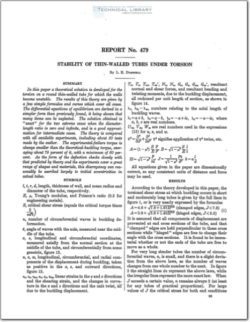
In this paper a theoretical solution is developed for the
torsion on a round thimvafled tube for which the walls
become unstable. The results of this theory are given by
a few simple formulas and curves which cover all cases.
The differential equations of equilibrium are derived in a
simpler form than previously found, it being shown that
many items can be neglected. The solution obtained is
“exact” for the two extreme cases when the diameter—
length ratio is zero and infinite, and is a good approxi-
mation for intermediate cases. The theory is compared
with all available experiments, including about 50 tests
made by the author. The experimental-failure torque is
always smaller than the theoretical-buckling torque, aver-
aging about 75 percent of it, with a minimum of 60 per-
cent. As the form of the deflection checks closely with
that predicted by theory and the experiments cover a great
range of shapes and materials, this discrepancy can rea-
sonably be ascribed largely to initial eccentricities in
actual tubes.

It is assumed that all components of displacement are
prevented at end cross sections of the tube, and that
“clamped” edges are held perpendicular to these cross
sections while “hinged” edges are free to change their
angle with the cross sections. It is found to be imma-
terial whether or not the ends of the tube are free to
move as a whole.

For very long slender tubes the number of circum-
ferential waves, n, is small, and there is a slight devia-
tion from the above laws, as the number of waves
changes from one whole number to the next. In figure
2 the straight lines de represent the above laws, while
the irregular lines represent the more exact law; When
J exceeds a certain value, n remains always 2 (at least
for any tubes of practical proportions).

FileAction
naca-report-479 Stability of Thin-Walled Tubes Under Torsion.pdfDownload 

Comment On This Post

Your email address will not be published. Required fields are marked *

NACA-REPORT-479

NACA-REPORT-479
  • Version
  • 243 Downloads
  • 1.73 MB File Size
  • 1 File Count
  • March 23, 2016 Create Date
  • March 23, 2016 Last Updated
Scroll for Details

National Advisory Committee for Aeronautics, Technical Notes - Stability of Thin-Walled Tubes Under Torsion

naca-report-479 Stability of Thin-Walled Tubes Under Torsion

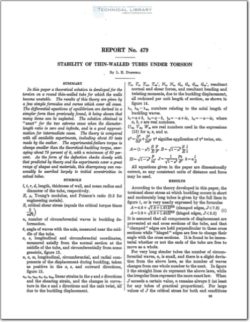
In this paper a theoretical solution is developed for the
torsion on a round thimvafled tube for which the walls
become unstable. The results of this theory are given by
a few simple formulas and curves which cover all cases.
The differential equations of equilibrium are derived in a
simpler form than previously found, it being shown that
many items can be neglected. The solution obtained is
“exact” for the two extreme cases when the diameter—
length ratio is zero and infinite, and is a good approxi-
mation for intermediate cases. The theory is compared
with all available experiments, including about 50 tests
made by the author. The experimental-failure torque is
always smaller than the theoretical-buckling torque, aver-
aging about 75 percent of it, with a minimum of 60 per-
cent. As the form of the deflection checks closely with
that predicted by theory and the experiments cover a great
range of shapes and materials, this discrepancy can rea-
sonably be ascribed largely to initial eccentricities in
actual tubes.

It is assumed that all components of displacement are
prevented at end cross sections of the tube, and that
“clamped” edges are held perpendicular to these cross
sections while “hinged” edges are free to change their
angle with the cross sections. It is found to be imma-
terial whether or not the ends of the tube are free to
move as a whole.

For very long slender tubes the number of circum-
ferential waves, n, is small, and there is a slight devia-
tion from the above laws, as the number of waves
changes from one whole number to the next. In figure
2 the straight lines de represent the above laws, while
the irregular lines represent the more exact law; When
J exceeds a certain value, n remains always 2 (at least
for any tubes of practical proportions).

FileAction
naca-report-479 Stability of Thin-Walled Tubes Under Torsion.pdfDownload 
17,005 Documents in our Technical Library
3247394 Total Downloads

Search The Technical Library

Newest Additions

NASA-RP-1060 Subsonic Aircraft: Evolution and the Matching of Size to Performance
AA-CP-20212-001
AA-CP-20212-001
ADPO10769 Occurrence of Corrosion in Airframes
The purpose of this lecture is to provide an overview ...
MIL-STD-1759 Rivets and Rivet Type Fasteners Preferred for Design
The purpose of this book form standard is to provide ...
MIL-STD-810G Environmental Engineering Considerations and Laboratory Tests
This standard contains materiel acquisition program planning and engineering direction ...