
17,005 Documents in our Technical Library
3180551 Total Downloads

Newest Additions

NASA-RP-1060 Subsonic Aircraft: Evolution and the Matching of Size to Performance
AA-CP-20212-001
AA-CP-20212-001
ADPO10769 Occurrence of Corrosion in Airframes
The purpose of this lecture is to provide an overview ...
MIL-STD-1759 Rivets and Rivet Type Fasteners Preferred for Design
The purpose of this book form standard is to provide ...
MIL-STD-810G Environmental Engineering Considerations and Laboratory Tests
This standard contains materiel acquisition program planning and engineering direction ...

AGARD-RTO-AG-160-V20
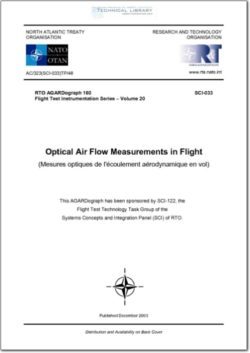
AGARD-RTO-AG-160-V20
  • Version
  • 329 Downloads
  • 2.43 MB File Size
  • 1 File Count
  • April 28, 2016 Create Date
  • April 28, 2016 Last Updated
Scroll for Details

Optical Air Flow Measurements in Flight
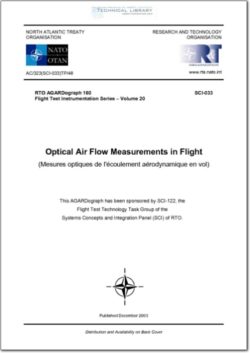
AGARD-RTO-AG-160-V20 Optical Air Flow Measurements in Flight
The goal of this AGARDograph is to provide an introductory practical overview of in—flight optical flow
measurement techniques. This document is written to aid an instrumentation engineer or research scientist in
making non—intrusive flow measurements on an aircraft. It is hoped that this document will be particularly
useful for the technologist with a limited background in optical theory and limited experience in applying
optical technology. The experience of the authors and numerous other contributors has been infused here to
provide guidance in avoiding expensive non—productive diversions that can occur when applying optical
technology for the first time in the flight environment. This AGARDograph provides basic knowledge and
techniques necessary for assessing the applicability of optical measurements and addressing effective optical
measurement techniques in flight. Key aspects of optical measurements are discussed and the tradeoffs are
identified, as they are currently understood. Basic components of optical measurement systems are discussed
and key requirements are identified. Specific systems designed for a variety of applications are discussed to
provide insight for the reader.
For many years, optical methods have been extensively used to perform detailed flow velocity
measurements in wind tunnels. Non-intrusive optically based measurements have given researchers insight
into the details of fluid dynamics that could not be obtained with any other technique. With optical methods,
the researcher can be confident that the measurement process has not disturbed the condition being measured,
and can therefore concentrate on results assessment instead of on developing calibrations or corrections for
measurement—induced flow disturbances. The wind tunnel environment, being ground—based, affords ample
space and power for equipment operation. Laser beams can be safely controlled in a ground situation. The air
in a wind tunnel, unlike the free atmosphere in-flight, is confined so special operations (like seeding the flow
with optical tracer particles) can be utilized. The enclosures of wind tunnels restrict the entry of light radiation
from extraneous natural or artificial sources, thereby preserving the signal-to-noise ratio in the ground
situation. For many of these reasons, the use of optical methods has become routine and one or more
laser-based velocimetry systems have become standard fixtures for most production wind tunnels, on a
worldwide basis. As conditions are often less favorable for aircraft in-flight testing, optical techniques have
been less practical for flight applications.

FileAction
AGARD-RTO-AG-160-V20 Optical Air Flow Measurements in Flight.pdfDownload 

Comment On This Post

Your email address will not be published. Required fields are marked *

AGARD-RTO-AG-160-V20

AGARD-RTO-AG-160-V20
  • Version
  • 329 Downloads
  • 2.43 MB File Size
  • 1 File Count
  • April 28, 2016 Create Date
  • April 28, 2016 Last Updated
Scroll for Details

Optical Air Flow Measurements in Flight
AGARD-RTO-AG-160-V20 Optical Air Flow Measurements in Flight
The goal of this AGARDograph is to provide an introductory practical overview of in—flight optical flow
measurement techniques. This document is written to aid an instrumentation engineer or research scientist in
making non—intrusive flow measurements on an aircraft. It is hoped that this document will be particularly
useful for the technologist with a limited background in optical theory and limited experience in applying
optical technology. The experience of the authors and numerous other contributors has been infused here to
provide guidance in avoiding expensive non—productive diversions that can occur when applying optical
technology for the first time in the flight environment. This AGARDograph provides basic knowledge and
techniques necessary for assessing the applicability of optical measurements and addressing effective optical
measurement techniques in flight. Key aspects of optical measurements are discussed and the tradeoffs are
identified, as they are currently understood. Basic components of optical measurement systems are discussed
and key requirements are identified. Specific systems designed for a variety of applications are discussed to
provide insight for the reader.
For many years, optical methods have been extensively used to perform detailed flow velocity
measurements in wind tunnels. Non-intrusive optically based measurements have given researchers insight
into the details of fluid dynamics that could not be obtained with any other technique. With optical methods,
the researcher can be confident that the measurement process has not disturbed the condition being measured,
and can therefore concentrate on results assessment instead of on developing calibrations or corrections for
measurement—induced flow disturbances. The wind tunnel environment, being ground—based, affords ample
space and power for equipment operation. Laser beams can be safely controlled in a ground situation. The air
in a wind tunnel, unlike the free atmosphere in-flight, is confined so special operations (like seeding the flow
with optical tracer particles) can be utilized. The enclosures of wind tunnels restrict the entry of light radiation
from extraneous natural or artificial sources, thereby preserving the signal-to-noise ratio in the ground
situation. For many of these reasons, the use of optical methods has become routine and one or more
laser-based velocimetry systems have become standard fixtures for most production wind tunnels, on a
worldwide basis. As conditions are often less favorable for aircraft in-flight testing, optical techniques have
been less practical for flight applications.

FileAction
AGARD-RTO-AG-160-V20 Optical Air Flow Measurements in Flight.pdfDownload 
17,005 Documents in our Technical Library
3180551 Total Downloads

Search The Technical Library

Newest Additions

NASA-RP-1060 Subsonic Aircraft: Evolution and the Matching of Size to Performance
AA-CP-20212-001
AA-CP-20212-001
ADPO10769 Occurrence of Corrosion in Airframes
The purpose of this lecture is to provide an overview ...
MIL-STD-1759 Rivets and Rivet Type Fasteners Preferred for Design
The purpose of this book form standard is to provide ...
MIL-STD-810G Environmental Engineering Considerations and Laboratory Tests
This standard contains materiel acquisition program planning and engineering direction ...