17,005 Documents in our Technical Library
3180748 Total Downloads

Newest Additions

NASA-RP-1060 Subsonic Aircraft: Evolution and the Matching of Size to Performance
AA-CP-20212-001
AA-CP-20212-001
ADPO10769 Occurrence of Corrosion in Airframes
The purpose of this lecture is to provide an overview ...
MIL-STD-1759 Rivets and Rivet Type Fasteners Preferred for Design
The purpose of this book form standard is to provide ...
MIL-STD-810G Environmental Engineering Considerations and Laboratory Tests
This standard contains materiel acquisition program planning and engineering direction ...

AGARD-R-819

AGARD-R-819
  • Version
  • 136 Downloads
  • 162.02 MB File Size
  • 1 File Count
  • April 25, 2016 Create Date
  • April 25, 2016 Last Updated
Scroll for Details

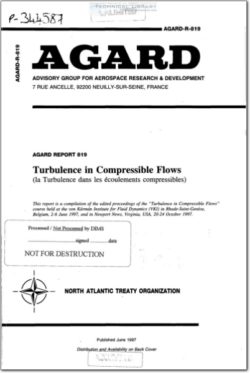
Turbulence in Compressible Flows
AGARD-R-819 Turbulence in Compressible Flows
The most important parameter in the description of in-
compressible turbulent boundary layer behavior is, of
course, the Reynolds number. Engineering applications
cover an extremely wide range and values based on the
streamwise distance can vary from 105 to 109. Most lab-
oratory experiments are performed at the lower end of
this range, and to be able to predict the behavior at very
high Reynolds numbers, as found in the flow over aircraft
and ships, it is therefore important to understand how
turbulent boundary layers scale with Reynolds number.
For compressible flows, the Mach number becomes an ad-
ditional scaling parameter. Because of the no-slip con-
dition, however, a subsonic region persists near the wall,
although the sonic line is located very close to the wall
at high Mach number. Furthermore, a significant tem-
perature gradient develops across the boundary layer at
supersonic speeds due to the high levels of Viscous dissipa-
tion near the wall. In fact, the static-temperature varia-
tion can be very large even in an adiabatic flow, resulting
in a low-density, high-viscosity region near the wall. In
turn, this leads to a skewed mass-flux profile, a thicker
boundary layer, and a region in which viscous effects are
somewhat more important than at an equivalent Reynolds
number in subsonic flow.
Figure 1 shows two sets of air boundary layer profiles at
about the same Reynolds number, one set measured on an
adiabatic wall, the other measured on an isothermal wall.
The momentum thickness Reynolds number R9 is approx-
imately 2200 when based on the freestream velocity us,
and the kinematic viscosity evaluated at the freestream
temperature tie, in accord with usual practice. That is,
R9 = Que/11,. The temperature of the air increases near
the wall, even for the adiabatic wall case, since the dissi-
pation of kinetic energy by friction is an important source
of heat in supersonic shear layers. Somewhat surprisingly,
the velocity, temperature and mass-flux profiles for these
two flows appear very much the same, even though the
boundary conditions, Mach numbers and heat transfer par
rameters differ considerably. The velocity profiles in the
outer region, in fact, follow a l/7th power law distribu-
tion quite well, just as a subsonic velocity profile would
at this Reynolds number. With increasing Mach num-
ber, however, the elevated temperature near the the wall
means that the bulk of the mass flux is increasingly found
toward the outer edge of the boundary layer. This effect
is strongly evident in the boundary-layer profiles shown in
figure 2, where the freestream Mach number was 10 for a
helium flow on an adiabatic wall. For this case, the tem-
perature ratio between the wall and the boundary layer
edge was about 30.

FileAction
AGARD-R-819 Turbulence in Compressible Flows.pdfDownload 

Comment On This Post

Your email address will not be published. Required fields are marked *

AGARD-R-819

AGARD-R-819
  • Version
  • 136 Downloads
  • 162.02 MB File Size
  • 1 File Count
  • April 25, 2016 Create Date
  • April 25, 2016 Last Updated
Scroll for Details

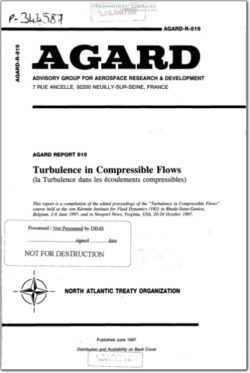
Turbulence in Compressible Flows
AGARD-R-819 Turbulence in Compressible Flows
The most important parameter in the description of in-
compressible turbulent boundary layer behavior is, of
course, the Reynolds number. Engineering applications
cover an extremely wide range and values based on the
streamwise distance can vary from 105 to 109. Most lab-
oratory experiments are performed at the lower end of
this range, and to be able to predict the behavior at very
high Reynolds numbers, as found in the flow over aircraft
and ships, it is therefore important to understand how
turbulent boundary layers scale with Reynolds number.
For compressible flows, the Mach number becomes an ad-
ditional scaling parameter. Because of the no-slip con-
dition, however, a subsonic region persists near the wall,
although the sonic line is located very close to the wall
at high Mach number. Furthermore, a significant tem-
perature gradient develops across the boundary layer at
supersonic speeds due to the high levels of Viscous dissipa-
tion near the wall. In fact, the static-temperature varia-
tion can be very large even in an adiabatic flow, resulting
in a low-density, high-viscosity region near the wall. In
turn, this leads to a skewed mass-flux profile, a thicker
boundary layer, and a region in which viscous effects are
somewhat more important than at an equivalent Reynolds
number in subsonic flow.
Figure 1 shows two sets of air boundary layer profiles at
about the same Reynolds number, one set measured on an
adiabatic wall, the other measured on an isothermal wall.
The momentum thickness Reynolds number R9 is approx-
imately 2200 when based on the freestream velocity us,
and the kinematic viscosity evaluated at the freestream
temperature tie, in accord with usual practice. That is,
R9 = Que/11,. The temperature of the air increases near
the wall, even for the adiabatic wall case, since the dissi-
pation of kinetic energy by friction is an important source
of heat in supersonic shear layers. Somewhat surprisingly,
the velocity, temperature and mass-flux profiles for these
two flows appear very much the same, even though the
boundary conditions, Mach numbers and heat transfer par
rameters differ considerably. The velocity profiles in the
outer region, in fact, follow a l/7th power law distribu-
tion quite well, just as a subsonic velocity profile would
at this Reynolds number. With increasing Mach num-
ber, however, the elevated temperature near the the wall
means that the bulk of the mass flux is increasingly found
toward the outer edge of the boundary layer. This effect
is strongly evident in the boundary-layer profiles shown in
figure 2, where the freestream Mach number was 10 for a
helium flow on an adiabatic wall. For this case, the tem-
perature ratio between the wall and the boundary layer
edge was about 30.

FileAction
AGARD-R-819 Turbulence in Compressible Flows.pdfDownload 
17,005 Documents in our Technical Library
3180748 Total Downloads

Search The Technical Library

Newest Additions

NASA-RP-1060 Subsonic Aircraft: Evolution and the Matching of Size to Performance
AA-CP-20212-001
AA-CP-20212-001
ADPO10769 Occurrence of Corrosion in Airframes
The purpose of this lecture is to provide an overview ...
MIL-STD-1759 Rivets and Rivet Type Fasteners Preferred for Design
The purpose of this book form standard is to provide ...
MIL-STD-810G Environmental Engineering Considerations and Laboratory Tests
This standard contains materiel acquisition program planning and engineering direction ...