17,005 Documents in our Technical Library
3206644 Total Downloads

Newest Additions

NASA-RP-1060 Subsonic Aircraft: Evolution and the Matching of Size to Performance
AA-CP-20212-001
AA-CP-20212-001
ADPO10769 Occurrence of Corrosion in Airframes
The purpose of this lecture is to provide an overview ...
MIL-STD-1759 Rivets and Rivet Type Fasteners Preferred for Design
The purpose of this book form standard is to provide ...
MIL-STD-810G Environmental Engineering Considerations and Laboratory Tests
This standard contains materiel acquisition program planning and engineering direction ...

AGARD-R-794

AGARD-R-794
  • Version
  • 285 Downloads
  • 46.28 MB File Size
  • 1 File Count
  • April 28, 2016 Create Date
  • April 28, 2016 Last Updated
Scroll for Details

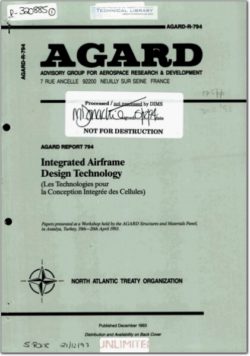
Integrated Airframe Design Technology
AGARD-R-794 Integrated Airframe Design Technology
In order to achieve economically viable high-
performance aircraft of the future, an
integrated aircraft design (IAD) process is
required. lntegrated airframe design em-
braces the concept of bringing together all of
the aspects of airframe design, including
various disciplines such as structures, mater-
ials, aerodynamics, propulsion, controls and
manufacturing, from conceptual design all the
way through to the final product and its repair
and maintenance. It also includes the sub-
disciplines which are involved in each
discipline and the interactions these have with
one another. Moreover, an lAD process also
affects organizational structure of personnel.
Typically, many organizational units are
involved in the design process. An lAD
approach increases the interactions between
these organizations as well as changes the way
they interact with one another. in contrast,
the conventional design process is basically
sequential or hierarchic in nature and is
broken down into many steps which are loosely
coupled to one another (i.e., there are few
iterations between design steps and limited
interaction between organizational units).
Moreover, the organizational structure is
typically set up to mimic the conventional
design process so it too is sequential. An lAD
process would be radically different from the
conventional design process. It would permit
many disciplines to operate in parallel thereby
reducing design cycle time.
It is strongly believed that the recent and
future advances in high-performance com-
puter hardware and software systems provide
the opportunity to create an lAD process that
will allow the process steps and disciplines to
interact with one another. Moreover, compre-
hensive data bases will provide organizational
units access to one anothers data and models,
thereby promoting more interaction between
organizations and moving toward a concurrent
engineering environment for airframe design.
Co-locaton of personnel with different disci-
pline backgrounds will be required, however,
this may take the form of "virtual co-location"
brought about by high-speed computer net-
works and audio-visual aids. This will make it
possible to create a more concurrent aircraft
design process and consequently, shorten the
design and manufacture process.

FileAction
AGARD-R-794 Integrated Airframe Design Technology.pdfDownload 

Comment On This Post

Your email address will not be published. Required fields are marked *

AGARD-R-794

AGARD-R-794
  • Version
  • 285 Downloads
  • 46.28 MB File Size
  • 1 File Count
  • April 28, 2016 Create Date
  • April 28, 2016 Last Updated
Scroll for Details

Integrated Airframe Design Technology
AGARD-R-794 Integrated Airframe Design Technology
In order to achieve economically viable high-
performance aircraft of the future, an
integrated aircraft design (IAD) process is
required. lntegrated airframe design em-
braces the concept of bringing together all of
the aspects of airframe design, including
various disciplines such as structures, mater-
ials, aerodynamics, propulsion, controls and
manufacturing, from conceptual design all the
way through to the final product and its repair
and maintenance. It also includes the sub-
disciplines which are involved in each
discipline and the interactions these have with
one another. Moreover, an lAD process also
affects organizational structure of personnel.
Typically, many organizational units are
involved in the design process. An lAD
approach increases the interactions between
these organizations as well as changes the way
they interact with one another. in contrast,
the conventional design process is basically
sequential or hierarchic in nature and is
broken down into many steps which are loosely
coupled to one another (i.e., there are few
iterations between design steps and limited
interaction between organizational units).
Moreover, the organizational structure is
typically set up to mimic the conventional
design process so it too is sequential. An lAD
process would be radically different from the
conventional design process. It would permit
many disciplines to operate in parallel thereby
reducing design cycle time.
It is strongly believed that the recent and
future advances in high-performance com-
puter hardware and software systems provide
the opportunity to create an lAD process that
will allow the process steps and disciplines to
interact with one another. Moreover, compre-
hensive data bases will provide organizational
units access to one anothers data and models,
thereby promoting more interaction between
organizations and moving toward a concurrent
engineering environment for airframe design.
Co-locaton of personnel with different disci-
pline backgrounds will be required, however,
this may take the form of "virtual co-location"
brought about by high-speed computer net-
works and audio-visual aids. This will make it
possible to create a more concurrent aircraft
design process and consequently, shorten the
design and manufacture process.

FileAction
AGARD-R-794 Integrated Airframe Design Technology.pdfDownload 
17,005 Documents in our Technical Library
3206644 Total Downloads

Search The Technical Library

Newest Additions

NASA-RP-1060 Subsonic Aircraft: Evolution and the Matching of Size to Performance
AA-CP-20212-001
AA-CP-20212-001
ADPO10769 Occurrence of Corrosion in Airframes
The purpose of this lecture is to provide an overview ...
MIL-STD-1759 Rivets and Rivet Type Fasteners Preferred for Design
The purpose of this book form standard is to provide ...
MIL-STD-810G Environmental Engineering Considerations and Laboratory Tests
This standard contains materiel acquisition program planning and engineering direction ...