
17,005 Documents in our Technical Library
3177335 Total Downloads

Newest Additions

NASA-RP-1060 Subsonic Aircraft: Evolution and the Matching of Size to Performance
AA-CP-20212-001
AA-CP-20212-001
ADPO10769 Occurrence of Corrosion in Airframes
The purpose of this lecture is to provide an overview ...
MIL-STD-1759 Rivets and Rivet Type Fasteners Preferred for Design
The purpose of this book form standard is to provide ...
MIL-STD-810G Environmental Engineering Considerations and Laboratory Tests
This standard contains materiel acquisition program planning and engineering direction ...

AGARD-R-790

AGARD-R-790
  • Version
  • 222 Downloads
  • 28.09 MB File Size
  • 1 File Count
  • April 28, 2016 Create Date
  • April 28, 2016 Last Updated
Scroll for Details

Impact of Materials Defects on Engine Structures Integrity
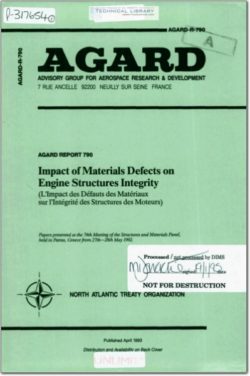
AGARD-R-790 Impact of Materials Defects on Engine Structures Integrity
Even though we have made significant progress in
increasing reliability of critical components of
aeroengines, we have far too many failures in both
military and commercial engines. As well,
maintenance costs, warranty costs (spares) and liability
costs are too high. In addition, designers of aeroengines
will undoubtedly always seek to increase performance
and efficiency as 'well as to increase the life of
components. At the same time, it is desirable to
decrease the need for inspections of components
because, in a sense, this adds no value to the product
and also causes down time. Designers attempt to
expand performance and increase efficiency by
increasing combustion and turbine inlet temperatures
and increasing operating stresses/strains on the
components by either increasing material strength or
decreasing component size (weight) or both. As well,
it is desirable to minimize risk of unexpectedfailure
while at the same time increasing component life.
Current component retirement practices also make it
desirable to increase utilization of residual life in
components. All of these factors continue to increase
the desire to adopt a defect/damage tolerant philosophy
of design (including materials selection,
characterization, and manufacturing route definition) of
critical components of aeroengines. The following
sections discuss the past, the present, and looks into the
future related to the continued development of gas
turbines. There is little doubt that as a community, the
gas turbine industry will continue to increase
performance, efficiency, and component life while
decreasing risk. It will be made clear why this writer
believes this cannot be done unless a holistic
damage/defect tolerant design philosophy is adopted.
From the very beginning of the development of the gas
turbine, there has been an interest in integrity [1-7]. A
recent version [8] of some of the excitement at the '
beginning of the jet age illustrates the highly volatile
state of the “human side of enterprise" of development
of the jet engine. As critical components were
developed in the early days, fatigue and defect tolerance
were not prime considerations [1-3, 9]. The “safe-life”
approach to fatigue design of aeroengines emerged
during the period 1940-1960 [1-3]. This was a natural
outgrowth of the evolution of fatigue design in the
aircraft industry as well as other industries. The
assumptions brought to the design process by the “safe-
life” paradigm are very useful.

FileAction
AGARD-R-790 Impact of Materials Defects on Engine Structures Integrity.pdfDownload 

Comment On This Post

Your email address will not be published. Required fields are marked *

AGARD-R-790

AGARD-R-790
  • Version
  • 222 Downloads
  • 28.09 MB File Size
  • 1 File Count
  • April 28, 2016 Create Date
  • April 28, 2016 Last Updated
Scroll for Details

Impact of Materials Defects on Engine Structures Integrity
AGARD-R-790 Impact of Materials Defects on Engine Structures Integrity
Even though we have made significant progress in
increasing reliability of critical components of
aeroengines, we have far too many failures in both
military and commercial engines. As well,
maintenance costs, warranty costs (spares) and liability
costs are too high. In addition, designers of aeroengines
will undoubtedly always seek to increase performance
and efficiency as 'well as to increase the life of
components. At the same time, it is desirable to
decrease the need for inspections of components
because, in a sense, this adds no value to the product
and also causes down time. Designers attempt to
expand performance and increase efficiency by
increasing combustion and turbine inlet temperatures
and increasing operating stresses/strains on the
components by either increasing material strength or
decreasing component size (weight) or both. As well,
it is desirable to minimize risk of unexpectedfailure
while at the same time increasing component life.
Current component retirement practices also make it
desirable to increase utilization of residual life in
components. All of these factors continue to increase
the desire to adopt a defect/damage tolerant philosophy
of design (including materials selection,
characterization, and manufacturing route definition) of
critical components of aeroengines. The following
sections discuss the past, the present, and looks into the
future related to the continued development of gas
turbines. There is little doubt that as a community, the
gas turbine industry will continue to increase
performance, efficiency, and component life while
decreasing risk. It will be made clear why this writer
believes this cannot be done unless a holistic
damage/defect tolerant design philosophy is adopted.
From the very beginning of the development of the gas
turbine, there has been an interest in integrity [1-7]. A
recent version [8] of some of the excitement at the '
beginning of the jet age illustrates the highly volatile
state of the “human side of enterprise" of development
of the jet engine. As critical components were
developed in the early days, fatigue and defect tolerance
were not prime considerations [1-3, 9]. The “safe-life”
approach to fatigue design of aeroengines emerged
during the period 1940-1960 [1-3]. This was a natural
outgrowth of the evolution of fatigue design in the
aircraft industry as well as other industries. The
assumptions brought to the design process by the “safe-
life” paradigm are very useful.

FileAction
AGARD-R-790 Impact of Materials Defects on Engine Structures Integrity.pdfDownload 
17,005 Documents in our Technical Library
3177335 Total Downloads

Search The Technical Library

Newest Additions

NASA-RP-1060 Subsonic Aircraft: Evolution and the Matching of Size to Performance
AA-CP-20212-001
AA-CP-20212-001
ADPO10769 Occurrence of Corrosion in Airframes
The purpose of this lecture is to provide an overview ...
MIL-STD-1759 Rivets and Rivet Type Fasteners Preferred for Design
The purpose of this book form standard is to provide ...
MIL-STD-810G Environmental Engineering Considerations and Laboratory Tests
This standard contains materiel acquisition program planning and engineering direction ...