
17,005 Documents in our Technical Library
3177278 Total Downloads

Newest Additions

NASA-RP-1060 Subsonic Aircraft: Evolution and the Matching of Size to Performance
AA-CP-20212-001
AA-CP-20212-001
ADPO10769 Occurrence of Corrosion in Airframes
The purpose of this lecture is to provide an overview ...
MIL-STD-1759 Rivets and Rivet Type Fasteners Preferred for Design
The purpose of this book form standard is to provide ...
MIL-STD-810G Environmental Engineering Considerations and Laboratory Tests
This standard contains materiel acquisition program planning and engineering direction ...

AGARD-R-785

AGARD-R-785
  • Version
  • 280 Downloads
  • 23.23 MB File Size
  • 1 File Count
  • April 25, 2016 Create Date
  • April 25, 2016 Last Updated
Scroll for Details

The Utilization of Advanced Composites in Military Aircraft
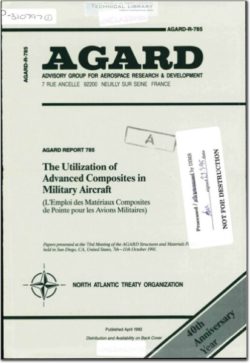
AGARD-R-785 The Utilization of Advanced Composites in Military Aircraft
Compression loading causes difficulty in the
development of test methods and failure criteria.
Compression testing has produced considerable
controversy with a number of different experimental
methods being considered. Each method, however,
often produces different values of apparent compression
strength. The failure mode is the key issue, as each test
method may produce a different failure mode. In
addition, the failure modes often depend on fiber and
matrix properties and on laminate geometry. When data
is reported the failure mode is often ignored. In
analyzing failure modes one must consider how relevant
the test geometry and load introduction is to the actual
application for which the data is being generated.
Development of failure criteria also creates difficulty
because of the various possible failure modes. This
paper considers these issues in detail.
Advancements in carbon fiber technology have
given rise to considerable weight-savings potential in
composite structures. Improvements in fiber tensile
strength and stiffness have not, however, been matched
by improvements in compressive strength. To
understand the reasons for this problem, considerable
research is being done in the field of compression
testing. The objective is to study the behavior of
composite components under compression loading and
to relate their behavior and failure modes to the intrinsic
properties of the materials. The final goal then is to
develop a reliable method for testing the compressive
strength of composites as related to design requirements.
The need to critically evaluate composite material
test methods has increased in recent years due to the
complex nature of data required for design
considerations. The heterogeneous, anisotropic nature
of fiber reinforced composites has required careful
scrutiny of any test method or proposed test method
from an applied mechanics point of view. Thus, a
number of papers have appeared in the technical
literature which addressed test methods from a
theoretical standpoint. Although the importance of
analysis in the development of experimental techniques
is well recognized, recent attention has been
concentrated in the area of failure modes associated with
certain test methods [Ref 1]. In particular, the failure
mode assumed in conjunction with a given data
reduction scheme may not be attained in practice.

FileAction
AGARD-R-785 The Utilization of Advanced Composites in Military Aircraft.pdfDownload 

Comment On This Post

Your email address will not be published. Required fields are marked *

AGARD-R-785

AGARD-R-785
  • Version
  • 280 Downloads
  • 23.23 MB File Size
  • 1 File Count
  • April 25, 2016 Create Date
  • April 25, 2016 Last Updated
Scroll for Details

The Utilization of Advanced Composites in Military Aircraft
AGARD-R-785 The Utilization of Advanced Composites in Military Aircraft
Compression loading causes difficulty in the
development of test methods and failure criteria.
Compression testing has produced considerable
controversy with a number of different experimental
methods being considered. Each method, however,
often produces different values of apparent compression
strength. The failure mode is the key issue, as each test
method may produce a different failure mode. In
addition, the failure modes often depend on fiber and
matrix properties and on laminate geometry. When data
is reported the failure mode is often ignored. In
analyzing failure modes one must consider how relevant
the test geometry and load introduction is to the actual
application for which the data is being generated.
Development of failure criteria also creates difficulty
because of the various possible failure modes. This
paper considers these issues in detail.
Advancements in carbon fiber technology have
given rise to considerable weight-savings potential in
composite structures. Improvements in fiber tensile
strength and stiffness have not, however, been matched
by improvements in compressive strength. To
understand the reasons for this problem, considerable
research is being done in the field of compression
testing. The objective is to study the behavior of
composite components under compression loading and
to relate their behavior and failure modes to the intrinsic
properties of the materials. The final goal then is to
develop a reliable method for testing the compressive
strength of composites as related to design requirements.
The need to critically evaluate composite material
test methods has increased in recent years due to the
complex nature of data required for design
considerations. The heterogeneous, anisotropic nature
of fiber reinforced composites has required careful
scrutiny of any test method or proposed test method
from an applied mechanics point of view. Thus, a
number of papers have appeared in the technical
literature which addressed test methods from a
theoretical standpoint. Although the importance of
analysis in the development of experimental techniques
is well recognized, recent attention has been
concentrated in the area of failure modes associated with
certain test methods [Ref 1]. In particular, the failure
mode assumed in conjunction with a given data
reduction scheme may not be attained in practice.

FileAction
AGARD-R-785 The Utilization of Advanced Composites in Military Aircraft.pdfDownload 
17,005 Documents in our Technical Library
3177278 Total Downloads

Search The Technical Library

Newest Additions

NASA-RP-1060 Subsonic Aircraft: Evolution and the Matching of Size to Performance
AA-CP-20212-001
AA-CP-20212-001
ADPO10769 Occurrence of Corrosion in Airframes
The purpose of this lecture is to provide an overview ...
MIL-STD-1759 Rivets and Rivet Type Fasteners Preferred for Design
The purpose of this book form standard is to provide ...
MIL-STD-810G Environmental Engineering Considerations and Laboratory Tests
This standard contains materiel acquisition program planning and engineering direction ...