
17,005 Documents in our Technical Library
3206443 Total Downloads

Newest Additions

NASA-RP-1060 Subsonic Aircraft: Evolution and the Matching of Size to Performance
AA-CP-20212-001
AA-CP-20212-001
ADPO10769 Occurrence of Corrosion in Airframes
The purpose of this lecture is to provide an overview ...
MIL-STD-1759 Rivets and Rivet Type Fasteners Preferred for Design
The purpose of this book form standard is to provide ...
MIL-STD-810G Environmental Engineering Considerations and Laboratory Tests
This standard contains materiel acquisition program planning and engineering direction ...

AGARD-R-784

AGARD-R-784
  • Version
  • 363 Downloads
  • 70.83 MB File Size
  • 1 File Count
  • April 12, 2016 Create Date
  • April 12, 2016 Last Updated
Scroll for Details

Integrated Design Analysis and Optimisation of Aircraft Structures
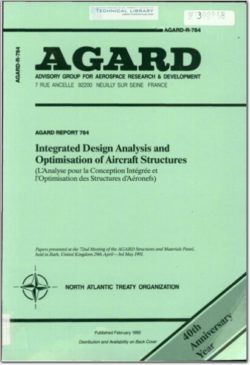
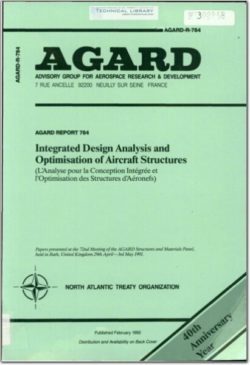
AGARD-R-784 Integrated Design Analysis and Optimisation of Aircraft Structures

The past iS years have seen major developments in the
power and applicability of structural optimisation
computer codes. These can perform complex sizing
exercises minimising structural weight subject to the
satisfaction of behavioural constraints. Some codes
are an integral part of a commercial finite element
program such as the MSC optimiser in NASI'RAN, OPT! in
the SAMCEF. or OPTISEN in SDRC's lDEAS suite.
Alternatively codes are available which can stand
outside of a specific system such as the WSCICON
STARS programme or the USAF's ASTROS programme but can
link with any FE code. in addition to these
commercially available systems there are a variety of
in-house programmes with equal power to those supplied
by vendors. Examples of these are the BAe ECLIPSE
programme. MBB's LAGRANGE and Gruman's FASTOP
programmes.

Clearly there is a wide availability of structural
optimisation programmes and this has resulted in the
extensive use of this capability in the Aerospace
industry. No new military f ixed-wing aircraft is
designed without the use of a minimum weight
structural optimisation programme. The growing
popularity of optimisation as a major design tool has
been matched by an ever increasing breadth of
applicability. A decade ago minimum weight designs
could only be realistically generated for structures
subject to static strength and stiffness constraints
for isotropic structures. Today the scope has
increased to the point where aeroelastlc factors
relating to efficiency. flutter speed limitations.
active control aspects etc. are routinely included
together with composite material properties. Current
developments are focused on Increasing the problem
scope still further to include performanceI avionics
aspects and in certain cases shape parameters. In
consequence optimisation programmes are being slowly
transformed in the direction of becoming genuine
multi-discipiinary design systems.

FileAction
AGARD-R-784 Integrated Design Analysis and Optimisation of Aircraft Structures.pdfDownload 

Comment On This Post

Your email address will not be published. Required fields are marked *

AGARD-R-784

AGARD-R-784
  • Version
  • 363 Downloads
  • 70.83 MB File Size
  • 1 File Count
  • April 12, 2016 Create Date
  • April 12, 2016 Last Updated
Scroll for Details

Integrated Design Analysis and Optimisation of Aircraft Structures

AGARD-R-784 Integrated Design Analysis and Optimisation of Aircraft Structures

The past iS years have seen major developments in the
power and applicability of structural optimisation
computer codes. These can perform complex sizing
exercises minimising structural weight subject to the
satisfaction of behavioural constraints. Some codes
are an integral part of a commercial finite element
program such as the MSC optimiser in NASI'RAN, OPT! in
the SAMCEF. or OPTISEN in SDRC's lDEAS suite.
Alternatively codes are available which can stand
outside of a specific system such as the WSCICON
STARS programme or the USAF's ASTROS programme but can
link with any FE code. in addition to these
commercially available systems there are a variety of
in-house programmes with equal power to those supplied
by vendors. Examples of these are the BAe ECLIPSE
programme. MBB's LAGRANGE and Gruman's FASTOP
programmes.

Clearly there is a wide availability of structural
optimisation programmes and this has resulted in the
extensive use of this capability in the Aerospace
industry. No new military f ixed-wing aircraft is
designed without the use of a minimum weight
structural optimisation programme. The growing
popularity of optimisation as a major design tool has
been matched by an ever increasing breadth of
applicability. A decade ago minimum weight designs
could only be realistically generated for structures
subject to static strength and stiffness constraints
for isotropic structures. Today the scope has
increased to the point where aeroelastlc factors
relating to efficiency. flutter speed limitations.
active control aspects etc. are routinely included
together with composite material properties. Current
developments are focused on Increasing the problem
scope still further to include performanceI avionics
aspects and in certain cases shape parameters. In
consequence optimisation programmes are being slowly
transformed in the direction of becoming genuine
multi-discipiinary design systems.

FileAction
AGARD-R-784 Integrated Design Analysis and Optimisation of Aircraft Structures.pdfDownload 
17,005 Documents in our Technical Library
3206443 Total Downloads

Search The Technical Library

Newest Additions

NASA-RP-1060 Subsonic Aircraft: Evolution and the Matching of Size to Performance
AA-CP-20212-001
AA-CP-20212-001
ADPO10769 Occurrence of Corrosion in Airframes
The purpose of this lecture is to provide an overview ...
MIL-STD-1759 Rivets and Rivet Type Fasteners Preferred for Design
The purpose of this book form standard is to provide ...
MIL-STD-810G Environmental Engineering Considerations and Laboratory Tests
This standard contains materiel acquisition program planning and engineering direction ...