
17,005 Documents in our Technical Library
3180541 Total Downloads

Newest Additions

NASA-RP-1060 Subsonic Aircraft: Evolution and the Matching of Size to Performance
AA-CP-20212-001
AA-CP-20212-001
ADPO10769 Occurrence of Corrosion in Airframes
The purpose of this lecture is to provide an overview ...
MIL-STD-1759 Rivets and Rivet Type Fasteners Preferred for Design
The purpose of this book form standard is to provide ...
MIL-STD-810G Environmental Engineering Considerations and Laboratory Tests
This standard contains materiel acquisition program planning and engineering direction ...

AGARD-R-600

AGARD-R-600
  • Version
  • 142 Downloads
  • 11.09 MB File Size
  • 1 File Count
  • April 25, 2016 Create Date
  • April 25, 2016 Last Updated
Scroll for Details

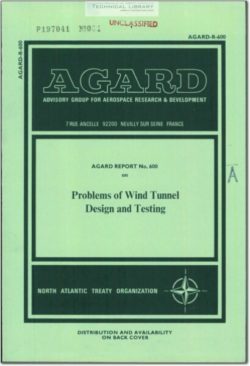
Problems of Wind Tunnel Design and Testing
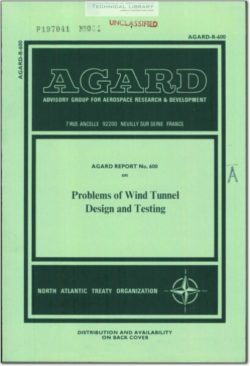
AGARD-R-600 Problems of Wind Tunnel Design and Testing
At the request of the AGARD LaWs Working Group, two series of possible future low-speed windtunnels have
been studied. The first series are high-Reynolds-number tunnels having a product of working section width in
metres and maximum pressure in atmospheres kept constant at a value of 45, but including in addition a 60m
atmospheric tunnel. The second series comprises atmospheric tunnels of widths ranging from 8m to 25m, and
these are of more modest cost and generally lower capability than the first series. Very broad estimates of possible
capital and running costs are given as an indication of the scale of expenditure which might be involved; no
precise quotations have been obtained. Brief statements are made of the capabilities of the tunnels considered.
Each series in turn appears to offer attractive possibilities for future provision Of low-speed tunnels in Europe.
During the discussions Of the AGARD LaWs Working Group, attention was given to Europe’s needs for future
low-speed tunnels. In order to provide a basis for these discussions, the present authors were asked tO study two
series of tunnels, to summarise their capabilities and to make cost estimates.
The first series studied consists of tunnels which could give high maximum Reynolds number, the value being
the same for each tunnel at any chosen Mach number up to 0.2. The product of the working section width in
metres and the maximum pressure in atmospheres is kept constant at a value of 45. But since there is a case for
requiring the maximum Reynolds number to increase as the maximum pressure decreases because one then has a
smaller range Of Reynolds number (at constant Mach number) from which to extrapolate, a 60m atmospheric
tunnel was added to the series.
Also, a second series of tunnels has been studied, comprising atmospheric tunnels havinngorking section
widths from 8m to 25m, which could meet some Of the requirements at more modest costs.
The authors each made completely independent estimates of the capital costs. Their totals agreed to better than
15 per cent, though it is not expected that the absolute values are as accurate as that might suggest. Mean values Of
the two estimates are given and it is believed that the orders of cost are correctly indicated. The figures given are
all based on 1971 price levels. Estimates have also been made of the running costs of each facility.

FileAction
AGARD-R-600 Problems of Wind Tunnel Design and Testing.pdfDownload 

Comment On This Post

Your email address will not be published. Required fields are marked *

AGARD-R-600

AGARD-R-600
  • Version
  • 142 Downloads
  • 11.09 MB File Size
  • 1 File Count
  • April 25, 2016 Create Date
  • April 25, 2016 Last Updated
Scroll for Details

Problems of Wind Tunnel Design and Testing
AGARD-R-600 Problems of Wind Tunnel Design and Testing
At the request of the AGARD LaWs Working Group, two series of possible future low-speed windtunnels have
been studied. The first series are high-Reynolds-number tunnels having a product of working section width in
metres and maximum pressure in atmospheres kept constant at a value of 45, but including in addition a 60m
atmospheric tunnel. The second series comprises atmospheric tunnels of widths ranging from 8m to 25m, and
these are of more modest cost and generally lower capability than the first series. Very broad estimates of possible
capital and running costs are given as an indication of the scale of expenditure which might be involved; no
precise quotations have been obtained. Brief statements are made of the capabilities of the tunnels considered.
Each series in turn appears to offer attractive possibilities for future provision Of low-speed tunnels in Europe.
During the discussions Of the AGARD LaWs Working Group, attention was given to Europe’s needs for future
low-speed tunnels. In order to provide a basis for these discussions, the present authors were asked tO study two
series of tunnels, to summarise their capabilities and to make cost estimates.
The first series studied consists of tunnels which could give high maximum Reynolds number, the value being
the same for each tunnel at any chosen Mach number up to 0.2. The product of the working section width in
metres and the maximum pressure in atmospheres is kept constant at a value of 45. But since there is a case for
requiring the maximum Reynolds number to increase as the maximum pressure decreases because one then has a
smaller range Of Reynolds number (at constant Mach number) from which to extrapolate, a 60m atmospheric
tunnel was added to the series.
Also, a second series of tunnels has been studied, comprising atmospheric tunnels havinngorking section
widths from 8m to 25m, which could meet some Of the requirements at more modest costs.
The authors each made completely independent estimates of the capital costs. Their totals agreed to better than
15 per cent, though it is not expected that the absolute values are as accurate as that might suggest. Mean values Of
the two estimates are given and it is believed that the orders of cost are correctly indicated. The figures given are
all based on 1971 price levels. Estimates have also been made of the running costs of each facility.

FileAction
AGARD-R-600 Problems of Wind Tunnel Design and Testing.pdfDownload 
17,005 Documents in our Technical Library
3180541 Total Downloads

Search The Technical Library

Newest Additions

NASA-RP-1060 Subsonic Aircraft: Evolution and the Matching of Size to Performance
AA-CP-20212-001
AA-CP-20212-001
ADPO10769 Occurrence of Corrosion in Airframes
The purpose of this lecture is to provide an overview ...
MIL-STD-1759 Rivets and Rivet Type Fasteners Preferred for Design
The purpose of this book form standard is to provide ...
MIL-STD-810G Environmental Engineering Considerations and Laboratory Tests
This standard contains materiel acquisition program planning and engineering direction ...