
17,005 Documents in our Technical Library
3210889 Total Downloads

Newest Additions

NASA-RP-1060 Subsonic Aircraft: Evolution and the Matching of Size to Performance
AA-CP-20212-001
AA-CP-20212-001
ADPO10769 Occurrence of Corrosion in Airframes
The purpose of this lecture is to provide an overview ...
MIL-STD-1759 Rivets and Rivet Type Fasteners Preferred for Design
The purpose of this book form standard is to provide ...
MIL-STD-810G Environmental Engineering Considerations and Laboratory Tests
This standard contains materiel acquisition program planning and engineering direction ...

AGARD-LS-190

AGARD-LS-190
  • Version
  • 178 Downloads
  • 7.85 MB File Size
  • 1 File Count
  • April 26, 2016 Create Date
  • April 26, 2016 Last Updated
Scroll for Details

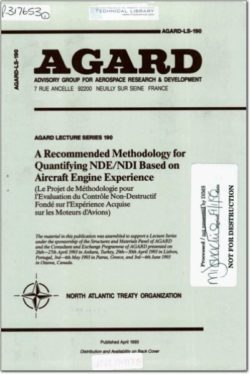
A Recommended Methodology for Quantifying NDE-NDI Base on Aircraft Engine Experience
AGARD-LS-190 A Recommended Methodology for Quantifying NDE-NDI Base on Aircraft Engine Experience
With the advent of the use of damage
tolerance philosophies to life engine hardware,
either for retirement-for-cause or for
consideration of inherent part defects, it has
become imperative .to be able to quantify the
probability of detection for NDE inspection
techniques and systems. NDE systems are
classified into either of two categories: those
which produce only qualitative information as
to the presence or absence of a flaw, i.e:
hit/miss data, and systems which also provide
some quantitative measure of the size of the
indicated flaw, Le: 3 vs. a data. This
document will establish all the necessary
procedures to assess reliability of NDE/NDI
systems. It begins with the basic general
requirements and then the specific
requirements for each type of system. The
Appendices provide all the background
information and equations necessary to
understand the derivatidn of the probability of
detection statistical analyses.
This section addresses the general
requirements for assessing the capability of an
NDE system in terms of the probability of
detection (POD) as a Function of flaw size, a .
These general requirements are applicable to
all NDE systems contained in this document
and address the demonstrator responsibilities
and the requirements for planning, conducting,
analyzing, and reporting NDE reliability
evaluations. Specific requirements that
pertain to Eddy Current (ET). Fluorescent
Penetrant (PT), Ultrasonic (UT), and Magnetic
Particle (MT) inspection systems are
contained in Section 5.
The ultimate responsibility for ensuring the
accuracy of the test/demonstration is the
demonstrator. It is his responsibility to ensure
that the requirements of this document have
been met and that variances and
discrepancies are noted and understood.
The NDE system must be precisely defined to
be evaluated in terms of the limits of
operational parameters and range of.
application and must demonstrate that the
system is in control. In addition to the physical
attributes of the NDE system, this may include
planned statistical assessments of those
components responsible for system variability.

FileAction
AGARD-LS-190 A Recommended Methodology for Quantifying NDE-NDI Base on Aircraft Engine Experience.pdfDownload 

Comment On This Post

Your email address will not be published. Required fields are marked *

AGARD-LS-190

AGARD-LS-190
  • Version
  • 178 Downloads
  • 7.85 MB File Size
  • 1 File Count
  • April 26, 2016 Create Date
  • April 26, 2016 Last Updated
Scroll for Details

A Recommended Methodology for Quantifying NDE-NDI Base on Aircraft Engine Experience
AGARD-LS-190 A Recommended Methodology for Quantifying NDE-NDI Base on Aircraft Engine Experience
With the advent of the use of damage
tolerance philosophies to life engine hardware,
either for retirement-for-cause or for
consideration of inherent part defects, it has
become imperative .to be able to quantify the
probability of detection for NDE inspection
techniques and systems. NDE systems are
classified into either of two categories: those
which produce only qualitative information as
to the presence or absence of a flaw, i.e:
hit/miss data, and systems which also provide
some quantitative measure of the size of the
indicated flaw, Le: 3 vs. a data. This
document will establish all the necessary
procedures to assess reliability of NDE/NDI
systems. It begins with the basic general
requirements and then the specific
requirements for each type of system. The
Appendices provide all the background
information and equations necessary to
understand the derivatidn of the probability of
detection statistical analyses.
This section addresses the general
requirements for assessing the capability of an
NDE system in terms of the probability of
detection (POD) as a Function of flaw size, a .
These general requirements are applicable to
all NDE systems contained in this document
and address the demonstrator responsibilities
and the requirements for planning, conducting,
analyzing, and reporting NDE reliability
evaluations. Specific requirements that
pertain to Eddy Current (ET). Fluorescent
Penetrant (PT), Ultrasonic (UT), and Magnetic
Particle (MT) inspection systems are
contained in Section 5.
The ultimate responsibility for ensuring the
accuracy of the test/demonstration is the
demonstrator. It is his responsibility to ensure
that the requirements of this document have
been met and that variances and
discrepancies are noted and understood.
The NDE system must be precisely defined to
be evaluated in terms of the limits of
operational parameters and range of.
application and must demonstrate that the
system is in control. In addition to the physical
attributes of the NDE system, this may include
planned statistical assessments of those
components responsible for system variability.

FileAction
AGARD-LS-190 A Recommended Methodology for Quantifying NDE-NDI Base on Aircraft Engine Experience.pdfDownload 
17,005 Documents in our Technical Library
3210889 Total Downloads

Search The Technical Library

Newest Additions

NASA-RP-1060 Subsonic Aircraft: Evolution and the Matching of Size to Performance
AA-CP-20212-001
AA-CP-20212-001
ADPO10769 Occurrence of Corrosion in Airframes
The purpose of this lecture is to provide an overview ...
MIL-STD-1759 Rivets and Rivet Type Fasteners Preferred for Design
The purpose of this book form standard is to provide ...
MIL-STD-810G Environmental Engineering Considerations and Laboratory Tests
This standard contains materiel acquisition program planning and engineering direction ...