17,005 Documents in our Technical Library
3180747 Total Downloads

Newest Additions

NASA-RP-1060 Subsonic Aircraft: Evolution and the Matching of Size to Performance
AA-CP-20212-001
AA-CP-20212-001
ADPO10769 Occurrence of Corrosion in Airframes
The purpose of this lecture is to provide an overview ...
MIL-STD-1759 Rivets and Rivet Type Fasteners Preferred for Design
The purpose of this book form standard is to provide ...
MIL-STD-810G Environmental Engineering Considerations and Laboratory Tests
This standard contains materiel acquisition program planning and engineering direction ...

AGARD-LS-188

AGARD-LS-188
  • Version
  • 260 Downloads
  • 25.60 MB File Size
  • 1 File Count
  • April 26, 2016 Create Date
  • April 26, 2016 Last Updated
Scroll for Details

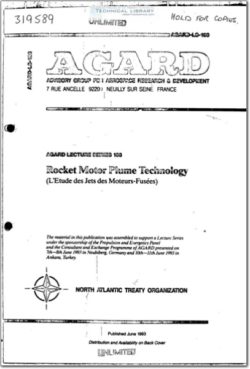
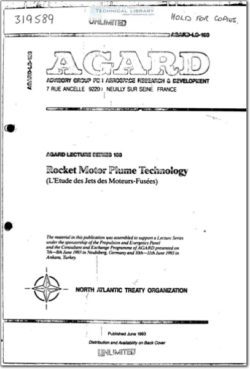
Rocket Motor Plume Technology
AGARD-LS-188 Rocket Motor Plume Technology
Rocket plume technology has been a subject
of interest and study for many countries engaged
in missile design and manufacture. For successful
operational deployment of missile systems it is
necessary to quantify the exhaust properties of
the propulsion unit and its effects on missile
guidance. tracking and signature. AGARD
Lecture Series l88 addresses some major topics of
this subject. The Seriesstems from the work of
AGARD PEP Working Group 2| which
investigated the question of terminology in the
field of solid propellant rocket exhaust signatures
with a view to agreeing and recommending a
common terminology. Particular emphasis was
placed on the ciassification of propellants in terms
of Primary and Secondary smoke. The work
resulted in the submission of a final report which
became AGARD Advisory Report 287 entitled
"Terminology and Assessrrent Methods of Solid
Propellant Rocket Exhaust Signatures" Principal
subjects were Primary and Secondary smokes.
smoke classification. plume radiation and
microwave properties: These were preceded by an
introduction and comprehensive overview and
supported by appendices.
The recommended "Smoke Classification"
went forward to become a NATO standard.
With few exceptions the‘ exhaust of a rocket
motor is seen as an embarrassment to‘ the missile
user. The nature of the exhaust. characterised by
the very rapid flow of chemically reacting, high
temperature turbulent gases. presents a problem to
the missile design team having concern for
guidance. tracking and vulnerability to detection.
In the context of detection. a rocket exhaust
signature is regarded as that set of properties
which may enable an observer to detect. locate
and identify a missile. Millimctric. infra-red.
visible and, ultra-violet radiations from an exhaust
afford opportunities for the passive detection and
identification of a missile. Propellant chemical
species contributing to a unique spectral pattern
may well provide this identification. Equally.
rocket exhausts often produce "Primary smoke"
(originating in the motor) or "Secondary smoke"
(plume condensates) which may also be detected
by passive means. These form an observable
contrast of exhaust smoke against background.
Active detection is also possible where free
electrons populating the turbulent fiowfield act to
present a radar cross section to an interrogating
radar.

FileAction
AGARD-LS-188 Rocket Motor Plume Technology.pdfDownload 

Comment On This Post

Your email address will not be published. Required fields are marked *

AGARD-LS-188

AGARD-LS-188
  • Version
  • 260 Downloads
  • 25.60 MB File Size
  • 1 File Count
  • April 26, 2016 Create Date
  • April 26, 2016 Last Updated
Scroll for Details

Rocket Motor Plume Technology
AGARD-LS-188 Rocket Motor Plume Technology
Rocket plume technology has been a subject
of interest and study for many countries engaged
in missile design and manufacture. For successful
operational deployment of missile systems it is
necessary to quantify the exhaust properties of
the propulsion unit and its effects on missile
guidance. tracking and signature. AGARD
Lecture Series l88 addresses some major topics of
this subject. The Seriesstems from the work of
AGARD PEP Working Group 2| which
investigated the question of terminology in the
field of solid propellant rocket exhaust signatures
with a view to agreeing and recommending a
common terminology. Particular emphasis was
placed on the ciassification of propellants in terms
of Primary and Secondary smoke. The work
resulted in the submission of a final report which
became AGARD Advisory Report 287 entitled
"Terminology and Assessrrent Methods of Solid
Propellant Rocket Exhaust Signatures" Principal
subjects were Primary and Secondary smokes.
smoke classification. plume radiation and
microwave properties: These were preceded by an
introduction and comprehensive overview and
supported by appendices.
The recommended "Smoke Classification"
went forward to become a NATO standard.
With few exceptions the‘ exhaust of a rocket
motor is seen as an embarrassment to‘ the missile
user. The nature of the exhaust. characterised by
the very rapid flow of chemically reacting, high
temperature turbulent gases. presents a problem to
the missile design team having concern for
guidance. tracking and vulnerability to detection.
In the context of detection. a rocket exhaust
signature is regarded as that set of properties
which may enable an observer to detect. locate
and identify a missile. Millimctric. infra-red.
visible and, ultra-violet radiations from an exhaust
afford opportunities for the passive detection and
identification of a missile. Propellant chemical
species contributing to a unique spectral pattern
may well provide this identification. Equally.
rocket exhausts often produce "Primary smoke"
(originating in the motor) or "Secondary smoke"
(plume condensates) which may also be detected
by passive means. These form an observable
contrast of exhaust smoke against background.
Active detection is also possible where free
electrons populating the turbulent fiowfield act to
present a radar cross section to an interrogating
radar.

FileAction
AGARD-LS-188 Rocket Motor Plume Technology.pdfDownload 
17,005 Documents in our Technical Library
3180747 Total Downloads

Search The Technical Library

Newest Additions

NASA-RP-1060 Subsonic Aircraft: Evolution and the Matching of Size to Performance
AA-CP-20212-001
AA-CP-20212-001
ADPO10769 Occurrence of Corrosion in Airframes
The purpose of this lecture is to provide an overview ...
MIL-STD-1759 Rivets and Rivet Type Fasteners Preferred for Design
The purpose of this book form standard is to provide ...
MIL-STD-810G Environmental Engineering Considerations and Laboratory Tests
This standard contains materiel acquisition program planning and engineering direction ...