
17,005 Documents in our Technical Library
3206450 Total Downloads

Newest Additions

NASA-RP-1060 Subsonic Aircraft: Evolution and the Matching of Size to Performance
AA-CP-20212-001
AA-CP-20212-001
ADPO10769 Occurrence of Corrosion in Airframes
The purpose of this lecture is to provide an overview ...
MIL-STD-1759 Rivets and Rivet Type Fasteners Preferred for Design
The purpose of this book form standard is to provide ...
MIL-STD-810G Environmental Engineering Considerations and Laboratory Tests
This standard contains materiel acquisition program planning and engineering direction ...

AGARD-LS-149

AGARD-LS-149
  • Version
  • 182 Downloads
  • 13.68 MB File Size
  • 1 File Count
  • March 9, 2016 Create Date
  • March 9, 2016 Last Updated
Scroll for Details

The Application of Microcomputers to Aerospace and Defense Scientific and Technical Information Work
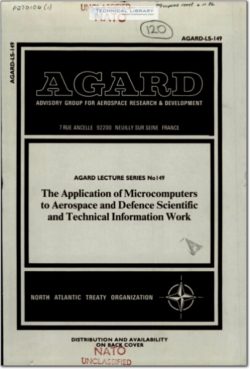
AGARD-LS-149 The Application of Microcomputers to Aerospace and Defense Scientific and Technical Work

In 1978 the theme of Lecture Series 92 was the opportunity offered in automation of library and information
services by cheaper, faster minicomputer equipment, and new database and applications software. Speakers
addressed the feasibility of automation; the techniques for the necessary systems studies; and cost effectiveness in
units of tens of man years of programming and equipment costing $100,000 or more.

There is now a radical change in what an information specialist may reasonably expect, due largely to the
development of the low cost, reliable, general purpose microcomputer. Investments may start as small as
$2,0001for a simple word processor or $20,000 for a package of software and hardware which will serve a small
library. Software is being written for many tasks, and the best is of high quality and well documented.

The speakers in this lecture series report the growing role of the micro-computer in cataloguing and library
housekeeping; in accessing shared information resources through local and wide networks; and in new
approaches to information management and retrieval.

The scope of scientific and technical information work is wide, and depends on many skills in creating,
validating, organising and distributing textual, numeric and graphic material in a variety of forms to many
diverse users. The use of computers to support these processes has developed more and more rapidly from small
beginnings in the 1960’s, until nowadays it requires some effort to envisage such information systems - at least
for english language material, and in developed countries - without such an electronic infrastructure. Setting
aside, for later papers, questions of languages and state of technological development, it seems only reasonable
to survey, if not fully to explain, how such a narrow aspect of technology as the general purpose microcomputer
has come to be so significant a component of the information specialist’s resources. A start may be made
through a series of ‘snapshots’ of what was going on at a few sampling points in the last decade.

FileAction
AGARD-LS-149 The Application of Microcomputers to Aerospace and Defense Scientific and Technical Information Work.pdfDownload 

Comment On This Post

Your email address will not be published. Required fields are marked *

AGARD-LS-149

AGARD-LS-149
  • Version
  • 182 Downloads
  • 13.68 MB File Size
  • 1 File Count
  • March 9, 2016 Create Date
  • March 9, 2016 Last Updated
Scroll for Details

The Application of Microcomputers to Aerospace and Defense Scientific and Technical Information Work

AGARD-LS-149 The Application of Microcomputers to Aerospace and Defense Scientific and Technical Work

In 1978 the theme of Lecture Series 92 was the opportunity offered in automation of library and information
services by cheaper, faster minicomputer equipment, and new database and applications software. Speakers
addressed the feasibility of automation; the techniques for the necessary systems studies; and cost effectiveness in
units of tens of man years of programming and equipment costing $100,000 or more.

There is now a radical change in what an information specialist may reasonably expect, due largely to the
development of the low cost, reliable, general purpose microcomputer. Investments may start as small as
$2,0001for a simple word processor or $20,000 for a package of software and hardware which will serve a small
library. Software is being written for many tasks, and the best is of high quality and well documented.

The speakers in this lecture series report the growing role of the micro-computer in cataloguing and library
housekeeping; in accessing shared information resources through local and wide networks; and in new
approaches to information management and retrieval.

The scope of scientific and technical information work is wide, and depends on many skills in creating,
validating, organising and distributing textual, numeric and graphic material in a variety of forms to many
diverse users. The use of computers to support these processes has developed more and more rapidly from small
beginnings in the 1960’s, until nowadays it requires some effort to envisage such information systems - at least
for english language material, and in developed countries - without such an electronic infrastructure. Setting
aside, for later papers, questions of languages and state of technological development, it seems only reasonable
to survey, if not fully to explain, how such a narrow aspect of technology as the general purpose microcomputer
has come to be so significant a component of the information specialist’s resources. A start may be made
through a series of ‘snapshots’ of what was going on at a few sampling points in the last decade.

FileAction
AGARD-LS-149 The Application of Microcomputers to Aerospace and Defense Scientific and Technical Information Work.pdfDownload 
17,005 Documents in our Technical Library
3206450 Total Downloads

Search The Technical Library

Newest Additions

NASA-RP-1060 Subsonic Aircraft: Evolution and the Matching of Size to Performance
AA-CP-20212-001
AA-CP-20212-001
ADPO10769 Occurrence of Corrosion in Airframes
The purpose of this lecture is to provide an overview ...
MIL-STD-1759 Rivets and Rivet Type Fasteners Preferred for Design
The purpose of this book form standard is to provide ...
MIL-STD-810G Environmental Engineering Considerations and Laboratory Tests
This standard contains materiel acquisition program planning and engineering direction ...