
17,005 Documents in our Technical Library
3206569 Total Downloads

Newest Additions

NASA-RP-1060 Subsonic Aircraft: Evolution and the Matching of Size to Performance
AA-CP-20212-001
AA-CP-20212-001
ADPO10769 Occurrence of Corrosion in Airframes
The purpose of this lecture is to provide an overview ...
MIL-STD-1759 Rivets and Rivet Type Fasteners Preferred for Design
The purpose of this book form standard is to provide ...
MIL-STD-810G Environmental Engineering Considerations and Laboratory Tests
This standard contains materiel acquisition program planning and engineering direction ...

AGARD-AR-36-71

AGARD-AR-36-71
  • Version
  • 242 Downloads
  • 39.06 MB File Size
  • 1 File Count
  • March 8, 2016 Create Date
  • March 8, 2016 Last Updated
Scroll for Details

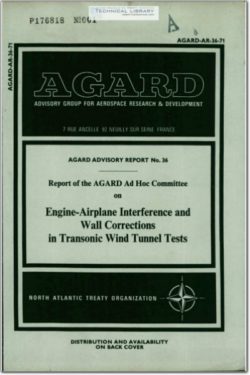
Engine-Airplane Interference and Wall Corrections in Transonic Wind Tunnel Tests
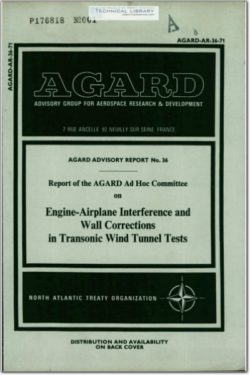
AGARD-AR-36-71 Engine-Airplane Interference and Wall Corrections in Transonic Wind Tunnel Tests

Within AGARD, particularly within the Propulsion and Energetics, and the Fluid Dynamics Panels, it is felt that
large uncertainties exist with respect to the present techniques for predicting aircraft performance at transonic speed,
particularly with respect to engine installation and high lift, In order to review the present techniques as used in the
various NATO countries and to gain insight into their specific merits and shortcomings, an Ad Hoc Committee under
the leadership of Prof A.Ferri, was proposed by the Director of AGARD, and approved by the National Delegates at
the 1970 Annual Meeting. The purpose was to study the above problems and, if possible, to make recommendations
for further studies.

The Committee selected a list of technical organizations interested in the accuracy of wind tunnel data derived
from three groups: (a) Wind tunnel operators and experimental research workers, (b) Airplane designers and air-
plane manufacturers, and (c) Airplane users and design evaluators.

As an initial step for the preparation of a meeting of the specialists, the Committee prepared a questionnaire
for the selected organizations interested in this problem in each country; this was distributed by the members of
the Committee of that country. The objective of the questionnaire was to obtain consistent and comparable sets of
information on the approaches used to simulate engine interference and to evaluate the effects of incomplete simu-
lation in wind tunnel tests of engine flow. A second questionnaire requested information on the type of corrections
used for evaluating wall interference at high lift, on the criteria used for justifying the lack of corrections where
corrections were not performed, and on the wind tunnel turbulence and its effects. Such questionnaires were pre-
pared and finalized at the first meeting of the Ad Hoc Committee which took place at AGARD Headquarters on
July 15—17, 1970. The questionnaire was distributed to all components of the three groups. A meeting of the
interested specialists was planned at that time. It was decided that the results of the different contributions would
be presented in an organized form and discussed, and that a set of conclusions and recommendations would then be '
generated. The Committee decided that at this second meeting only one representative of each organization that
responded to the questionnaire would be invited, and that observers would be excluded.

FileAction
AGARD-AR-36-71 Engine-Airplane Interference and Wall Corrections in Transonic Wind Tunnel Tests.pdfDownload 

Comment On This Post

Your email address will not be published. Required fields are marked *

AGARD-AR-36-71

AGARD-AR-36-71
  • Version
  • 242 Downloads
  • 39.06 MB File Size
  • 1 File Count
  • March 8, 2016 Create Date
  • March 8, 2016 Last Updated
Scroll for Details

Engine-Airplane Interference and Wall Corrections in Transonic Wind Tunnel Tests

AGARD-AR-36-71 Engine-Airplane Interference and Wall Corrections in Transonic Wind Tunnel Tests

Within AGARD, particularly within the Propulsion and Energetics, and the Fluid Dynamics Panels, it is felt that
large uncertainties exist with respect to the present techniques for predicting aircraft performance at transonic speed,
particularly with respect to engine installation and high lift, In order to review the present techniques as used in the
various NATO countries and to gain insight into their specific merits and shortcomings, an Ad Hoc Committee under
the leadership of Prof A.Ferri, was proposed by the Director of AGARD, and approved by the National Delegates at
the 1970 Annual Meeting. The purpose was to study the above problems and, if possible, to make recommendations
for further studies.

The Committee selected a list of technical organizations interested in the accuracy of wind tunnel data derived
from three groups: (a) Wind tunnel operators and experimental research workers, (b) Airplane designers and air-
plane manufacturers, and (c) Airplane users and design evaluators.

As an initial step for the preparation of a meeting of the specialists, the Committee prepared a questionnaire
for the selected organizations interested in this problem in each country; this was distributed by the members of
the Committee of that country. The objective of the questionnaire was to obtain consistent and comparable sets of
information on the approaches used to simulate engine interference and to evaluate the effects of incomplete simu-
lation in wind tunnel tests of engine flow. A second questionnaire requested information on the type of corrections
used for evaluating wall interference at high lift, on the criteria used for justifying the lack of corrections where
corrections were not performed, and on the wind tunnel turbulence and its effects. Such questionnaires were pre-
pared and finalized at the first meeting of the Ad Hoc Committee which took place at AGARD Headquarters on
July 15—17, 1970. The questionnaire was distributed to all components of the three groups. A meeting of the
interested specialists was planned at that time. It was decided that the results of the different contributions would
be presented in an organized form and discussed, and that a set of conclusions and recommendations would then be '
generated. The Committee decided that at this second meeting only one representative of each organization that
responded to the questionnaire would be invited, and that observers would be excluded.

FileAction
AGARD-AR-36-71 Engine-Airplane Interference and Wall Corrections in Transonic Wind Tunnel Tests.pdfDownload 
17,005 Documents in our Technical Library
3206569 Total Downloads

Search The Technical Library

Newest Additions

NASA-RP-1060 Subsonic Aircraft: Evolution and the Matching of Size to Performance
AA-CP-20212-001
AA-CP-20212-001
ADPO10769 Occurrence of Corrosion in Airframes
The purpose of this lecture is to provide an overview ...
MIL-STD-1759 Rivets and Rivet Type Fasteners Preferred for Design
The purpose of this book form standard is to provide ...
MIL-STD-810G Environmental Engineering Considerations and Laboratory Tests
This standard contains materiel acquisition program planning and engineering direction ...