
17,005 Documents in our Technical Library
3180771 Total Downloads

Newest Additions

NASA-RP-1060 Subsonic Aircraft: Evolution and the Matching of Size to Performance
AA-CP-20212-001
AA-CP-20212-001
ADPO10769 Occurrence of Corrosion in Airframes
The purpose of this lecture is to provide an overview ...
MIL-STD-1759 Rivets and Rivet Type Fasteners Preferred for Design
The purpose of this book form standard is to provide ...
MIL-STD-810G Environmental Engineering Considerations and Laboratory Tests
This standard contains materiel acquisition program planning and engineering direction ...

AGARD-AR-352

AGARD-AR-352
  • Version
  • 203 Downloads
  • 8.06 MB File Size
  • 1 File Count
  • April 25, 2016 Create Date
  • April 25, 2016 Last Updated
Scroll for Details

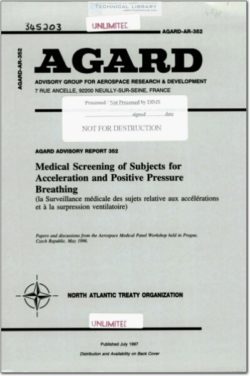
Medical Screening Subjects for Acceleration and Positive Pressure Breathing
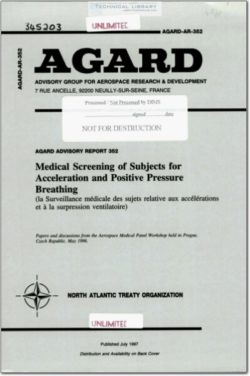
AGARD-AR-352 Medical Screening Subjects for Acceleration and Positive Pressure Breathing
Subjects for acceleration and positive
pressure breathing research are generally
a carefully screened and highly select
group. Most NATO laboratories carrying
out such research have a pool of subjects
from whom volunteers are solicited for
particular research protocols. Given the
nature of such research, these subjects are
often exposed to repeated high levels of
+Gz, and accumulate G—dosages that
exceed those of many operational pilots.
Subjects also participate in equipment
evaluations and trials which assess new
generation life-support equipment. These
trials often involve exposure to extended
G—envelopes well beyond those currently
used operationally. As well, subjects
may be exposed to high levels of positive
pressure breathing for altitude protection
(PPB) or G-protection (PPG).
Both because of the ethical issues related
to such research and concern for their
well-being, these subjects are generally
carefully medically screened both on
initial selection and during periodic
follow-up.
These subjects therefore constitute a
highly studied group in whom G-
exposure may be at least roughly
quantified, and in whom statistical
analysis of collective data may provide
evidence as to the acute or chronic effects
of +Gz and/or positive pressure
breathing.
The problem for most NATO research
facilities in analyzing collective data on
such subjects is the small number of
subjects at each facility. The concept is
appealing of pooling data from the
various NATO facilities involved in
acceleration research to answer important
occupational health concerns with respect
to exposure to high sustained G and
positive pressure breathing. The
Aerospace Medical Panel initiated this
Workshop to explore this possibility.

FileAction
AGARD-AR-352 Medical Screening Subjects for Acceleration and Positive Pressure Breathing.pdfDownload 

Comment On This Post

Your email address will not be published. Required fields are marked *

AGARD-AR-352

AGARD-AR-352
  • Version
  • 203 Downloads
  • 8.06 MB File Size
  • 1 File Count
  • April 25, 2016 Create Date
  • April 25, 2016 Last Updated
Scroll for Details

Medical Screening Subjects for Acceleration and Positive Pressure Breathing
AGARD-AR-352 Medical Screening Subjects for Acceleration and Positive Pressure Breathing
Subjects for acceleration and positive
pressure breathing research are generally
a carefully screened and highly select
group. Most NATO laboratories carrying
out such research have a pool of subjects
from whom volunteers are solicited for
particular research protocols. Given the
nature of such research, these subjects are
often exposed to repeated high levels of
+Gz, and accumulate G—dosages that
exceed those of many operational pilots.
Subjects also participate in equipment
evaluations and trials which assess new
generation life-support equipment. These
trials often involve exposure to extended
G—envelopes well beyond those currently
used operationally. As well, subjects
may be exposed to high levels of positive
pressure breathing for altitude protection
(PPB) or G-protection (PPG).
Both because of the ethical issues related
to such research and concern for their
well-being, these subjects are generally
carefully medically screened both on
initial selection and during periodic
follow-up.
These subjects therefore constitute a
highly studied group in whom G-
exposure may be at least roughly
quantified, and in whom statistical
analysis of collective data may provide
evidence as to the acute or chronic effects
of +Gz and/or positive pressure
breathing.
The problem for most NATO research
facilities in analyzing collective data on
such subjects is the small number of
subjects at each facility. The concept is
appealing of pooling data from the
various NATO facilities involved in
acceleration research to answer important
occupational health concerns with respect
to exposure to high sustained G and
positive pressure breathing. The
Aerospace Medical Panel initiated this
Workshop to explore this possibility.

FileAction
AGARD-AR-352 Medical Screening Subjects for Acceleration and Positive Pressure Breathing.pdfDownload 
17,005 Documents in our Technical Library
3180771 Total Downloads

Search The Technical Library

Newest Additions

NASA-RP-1060 Subsonic Aircraft: Evolution and the Matching of Size to Performance
AA-CP-20212-001
AA-CP-20212-001
ADPO10769 Occurrence of Corrosion in Airframes
The purpose of this lecture is to provide an overview ...
MIL-STD-1759 Rivets and Rivet Type Fasteners Preferred for Design
The purpose of this book form standard is to provide ...
MIL-STD-810G Environmental Engineering Considerations and Laboratory Tests
This standard contains materiel acquisition program planning and engineering direction ...