
17,005 Documents in our Technical Library
3187902 Total Downloads

Newest Additions

NASA-RP-1060 Subsonic Aircraft: Evolution and the Matching of Size to Performance
AA-CP-20212-001
AA-CP-20212-001
ADPO10769 Occurrence of Corrosion in Airframes
The purpose of this lecture is to provide an overview ...
MIL-STD-1759 Rivets and Rivet Type Fasteners Preferred for Design
The purpose of this book form standard is to provide ...
MIL-STD-810G Environmental Engineering Considerations and Laboratory Tests
This standard contains materiel acquisition program planning and engineering direction ...

AGARD-AR-325

AGARD-AR-325
  • Version
  • 72 Downloads
  • 10.59 MB File Size
  • 1 File Count
  • March 8, 2016 Create Date
  • March 8, 2016 Last Updated
Scroll for Details

Knowledge-Based Guidance and Control Functions
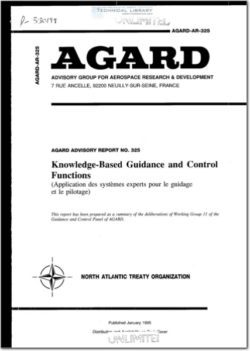
AGARD-AR-325 Knowledge-Based Guidance and Control Functions

Performing a functional analysis is the first step in a methodical approach to developing a solution to a complex
problem. Indeed, understanding the basic functionality required of a solution is a prerequisite to the formulation of a
design and ultimately the implementation of that design as the embodiment of the solution. In this section, a top
level functional analysis of a real—time, closed-loop work process1 is formulated. The analysis is performed at a
high level of abstraction in order to insure that it captures the basic functionality of a broad class of Guidance and
Control related work processes including those which implement decision—making, problem—solving and planning
functions. Although not discussed explicitly in this section, the technical distinctions that can be drawn in
differentiating among planning, decision-making and problem-solving are addressed in Chapter 3.

The functional analysis of a generic complex, real—time, closed—loop work process presented in this section serves
to establish a common framework and a common language for describing a variety of specific guidance and control
related work processes in ensuing sections. The two principal components of a functional analysis performed for
any system are ( l) a functional decomposition and (2) a detailed description of the information flow contained in the
interfaces between the individual functions comprising that decomposition. The approach taken here is the classical
structured analysis with a datailow representation. A dataflow representation has been chosen because it readily
lends itself to a hierarchical description. That is, each individual function can be further decomposed into more
refined subfunctions which, when taken together, have combined inputs and outputs which are consistent with those
of the original function. Neither control flow representations nor the emerging object-oriented analysis are
addressed.

The functional analysis of a complex, real-time, closed loop work process given here is not claimed to represent
the uniquely “correct” decomposition. Indeed, what is presented here reflects similarities with descriptions given
elsewhere for real-time planning and decision-making systems, leg, 2.1, 2.2]. Our intent is to develop a description
at a sufficiently high, abstract level that can be used as a template for the functional description of a variety of work
processes ranging from air traffic flow control or the hierarchy of decision-making, problem-solving and planning
functions required in a battlefield setting to the onboard functions required for the planning and execution of a
mission of a tactical fighter aircraft.

FileAction
AGARD-AR-325 Knowledge-Based Guidance and Control Functions.pdfDownload 

Comment On This Post

Your email address will not be published. Required fields are marked *

AGARD-AR-325

AGARD-AR-325
  • Version
  • 72 Downloads
  • 10.59 MB File Size
  • 1 File Count
  • March 8, 2016 Create Date
  • March 8, 2016 Last Updated
Scroll for Details

Knowledge-Based Guidance and Control Functions

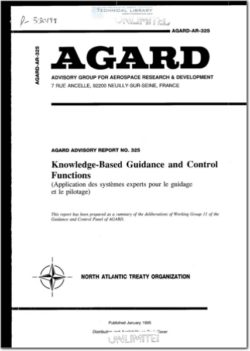
AGARD-AR-325 Knowledge-Based Guidance and Control Functions

Performing a functional analysis is the first step in a methodical approach to developing a solution to a complex
problem. Indeed, understanding the basic functionality required of a solution is a prerequisite to the formulation of a
design and ultimately the implementation of that design as the embodiment of the solution. In this section, a top
level functional analysis of a real—time, closed-loop work process1 is formulated. The analysis is performed at a
high level of abstraction in order to insure that it captures the basic functionality of a broad class of Guidance and
Control related work processes including those which implement decision—making, problem—solving and planning
functions. Although not discussed explicitly in this section, the technical distinctions that can be drawn in
differentiating among planning, decision-making and problem-solving are addressed in Chapter 3.

The functional analysis of a generic complex, real—time, closed—loop work process presented in this section serves
to establish a common framework and a common language for describing a variety of specific guidance and control
related work processes in ensuing sections. The two principal components of a functional analysis performed for
any system are ( l) a functional decomposition and (2) a detailed description of the information flow contained in the
interfaces between the individual functions comprising that decomposition. The approach taken here is the classical
structured analysis with a datailow representation. A dataflow representation has been chosen because it readily
lends itself to a hierarchical description. That is, each individual function can be further decomposed into more
refined subfunctions which, when taken together, have combined inputs and outputs which are consistent with those
of the original function. Neither control flow representations nor the emerging object-oriented analysis are
addressed.

The functional analysis of a complex, real-time, closed loop work process given here is not claimed to represent
the uniquely “correct” decomposition. Indeed, what is presented here reflects similarities with descriptions given
elsewhere for real-time planning and decision-making systems, leg, 2.1, 2.2]. Our intent is to develop a description
at a sufficiently high, abstract level that can be used as a template for the functional description of a variety of work
processes ranging from air traffic flow control or the hierarchy of decision-making, problem-solving and planning
functions required in a battlefield setting to the onboard functions required for the planning and execution of a
mission of a tactical fighter aircraft.

FileAction
AGARD-AR-325 Knowledge-Based Guidance and Control Functions.pdfDownload 
17,005 Documents in our Technical Library
3187902 Total Downloads

Search The Technical Library

Newest Additions

NASA-RP-1060 Subsonic Aircraft: Evolution and the Matching of Size to Performance
AA-CP-20212-001
AA-CP-20212-001
ADPO10769 Occurrence of Corrosion in Airframes
The purpose of this lecture is to provide an overview ...
MIL-STD-1759 Rivets and Rivet Type Fasteners Preferred for Design
The purpose of this book form standard is to provide ...
MIL-STD-810G Environmental Engineering Considerations and Laboratory Tests
This standard contains materiel acquisition program planning and engineering direction ...