17,005 Documents in our Technical Library
3180529 Total Downloads

Newest Additions

NASA-RP-1060 Subsonic Aircraft: Evolution and the Matching of Size to Performance
AA-CP-20212-001
AA-CP-20212-001
ADPO10769 Occurrence of Corrosion in Airframes
The purpose of this lecture is to provide an overview ...
MIL-STD-1759 Rivets and Rivet Type Fasteners Preferred for Design
The purpose of this book form standard is to provide ...
MIL-STD-810G Environmental Engineering Considerations and Laboratory Tests
This standard contains materiel acquisition program planning and engineering direction ...

AGARD-AR-314

AGARD-AR-314
  • Version
  • 262 Downloads
  • 28.59 MB File Size
  • 1 File Count
  • March 8, 2016 Create Date
  • March 8, 2016 Last Updated
Scroll for Details

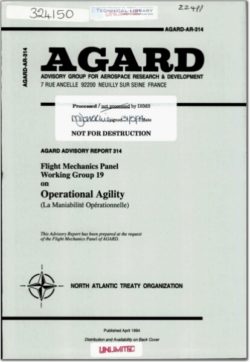
Operational Agility

AGARD-AR-314 Operational Agility

The environment in which a fighter pilot is required to operate is subject to continual change. This change arises
from advances in technology and the altering world political situation. The only prediction that can be made with
any confidence is that this change process is bound to continue with an unpredictable rate.

In dealing with change, it is easy to prescibe a process but extremely difficult to implement the process with success.
Success requires anticipation, reaction. re-evaluation and modification of tactics and processes. The need for change
must be recognised and accommodated. Such an approach, whether applied to fighter airplanes or any field of
human endeavour translates to agility.

The Flight Mechanics Panel of AGARD has sponsored this Working Group to investigate the topic of agility as it
applies to military combat aircraft. ln undertaking this work, the Group encountered many definitions of agility,
some of which represented widely difi'cring viewpoints. Often, in the past. protagonists of the varying ideas have
fallen into heated arguments as to who is right. From our deliberations and discussions, the answer has emerged
that no—one was wrong, that all were right, at least in part. However. few had taken the time to stand back and take
an all embracing view. Had they done so, then the message that all were trying to put forward might have had a
wider and more sympathetic audience.

Fortunately, within the Group. we have been able to stand back and examine the arguments with a dispassionate
approach which has enabled us to understand the various arguments and see the common ground, rather than the
differences.

All of the agility concepts that have been put forward have some merit. What was required was a way to relate the
ideas and be able to apply them in a manner that is both reasonable and logical from both the viewpoints of the
designer/supplier of aircraft and the customer/user of the vehicles that result.

In defining 3 Weapon System, it is essential to examine the component parts and their interaction, whether this be
airframe, propulsion system, sensors, cockpit and avionics or the weapons themselves and establish a balance and
synergistic integration between all of the components appropriate to the intended role and missions of the aircrafi. It
is the need to achieve balance and integration that is the prime driver for understanding Operational Agility as a set
of concepts, supported by metrics which fit into a generalisable framework, capable of evaluating a complex combat
aircraft design with a view to maximising the elfectiveness of that design within affordable cost limits.

FileAction
AGARD-AR-314 Operational Agility.pdfDownload 

Comment On This Post

Your email address will not be published. Required fields are marked *

AGARD-AR-314

AGARD-AR-314
  • Version
  • 262 Downloads
  • 28.59 MB File Size
  • 1 File Count
  • March 8, 2016 Create Date
  • March 8, 2016 Last Updated
Scroll for Details

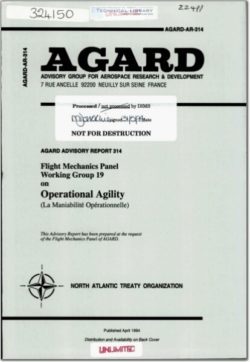
Operational Agility

AGARD-AR-314 Operational Agility

The environment in which a fighter pilot is required to operate is subject to continual change. This change arises
from advances in technology and the altering world political situation. The only prediction that can be made with
any confidence is that this change process is bound to continue with an unpredictable rate.

In dealing with change, it is easy to prescibe a process but extremely difficult to implement the process with success.
Success requires anticipation, reaction. re-evaluation and modification of tactics and processes. The need for change
must be recognised and accommodated. Such an approach, whether applied to fighter airplanes or any field of
human endeavour translates to agility.

The Flight Mechanics Panel of AGARD has sponsored this Working Group to investigate the topic of agility as it
applies to military combat aircraft. ln undertaking this work, the Group encountered many definitions of agility,
some of which represented widely difi'cring viewpoints. Often, in the past. protagonists of the varying ideas have
fallen into heated arguments as to who is right. From our deliberations and discussions, the answer has emerged
that no—one was wrong, that all were right, at least in part. However. few had taken the time to stand back and take
an all embracing view. Had they done so, then the message that all were trying to put forward might have had a
wider and more sympathetic audience.

Fortunately, within the Group. we have been able to stand back and examine the arguments with a dispassionate
approach which has enabled us to understand the various arguments and see the common ground, rather than the
differences.

All of the agility concepts that have been put forward have some merit. What was required was a way to relate the
ideas and be able to apply them in a manner that is both reasonable and logical from both the viewpoints of the
designer/supplier of aircraft and the customer/user of the vehicles that result.

In defining 3 Weapon System, it is essential to examine the component parts and their interaction, whether this be
airframe, propulsion system, sensors, cockpit and avionics or the weapons themselves and establish a balance and
synergistic integration between all of the components appropriate to the intended role and missions of the aircrafi. It
is the need to achieve balance and integration that is the prime driver for understanding Operational Agility as a set
of concepts, supported by metrics which fit into a generalisable framework, capable of evaluating a complex combat
aircraft design with a view to maximising the elfectiveness of that design within affordable cost limits.

FileAction
AGARD-AR-314 Operational Agility.pdfDownload 
17,005 Documents in our Technical Library
3180529 Total Downloads

Search The Technical Library

Newest Additions

NASA-RP-1060 Subsonic Aircraft: Evolution and the Matching of Size to Performance
AA-CP-20212-001
AA-CP-20212-001
ADPO10769 Occurrence of Corrosion in Airframes
The purpose of this lecture is to provide an overview ...
MIL-STD-1759 Rivets and Rivet Type Fasteners Preferred for Design
The purpose of this book form standard is to provide ...
MIL-STD-810G Environmental Engineering Considerations and Laboratory Tests
This standard contains materiel acquisition program planning and engineering direction ...