
17,005 Documents in our Technical Library
3187942 Total Downloads

Newest Additions

NASA-RP-1060 Subsonic Aircraft: Evolution and the Matching of Size to Performance
AA-CP-20212-001
AA-CP-20212-001
ADPO10769 Occurrence of Corrosion in Airframes
The purpose of this lecture is to provide an overview ...
MIL-STD-1759 Rivets and Rivet Type Fasteners Preferred for Design
The purpose of this book form standard is to provide ...
MIL-STD-810G Environmental Engineering Considerations and Laboratory Tests
This standard contains materiel acquisition program planning and engineering direction ...

AGARD-AR-25-70

AGARD-AR-25-70
  • Version
  • 157 Downloads
  • 5.69 MB File Size
  • 1 File Count
  • March 8, 2016 Create Date
  • March 8, 2016 Last Updated
Scroll for Details

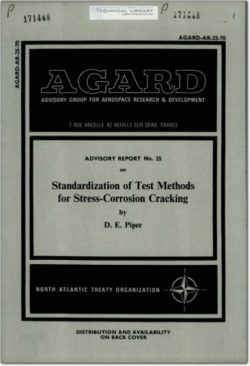
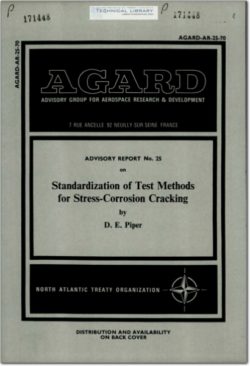
Standardization of Test Methods for Stress-Corrosion CrackingAGARD-AR-25-70 Standardization of Test Methods for Stress-Corrosion Cracking
As Coordinator to the Working Group on Stress Corrosion of Structures and Materials Panel of AGARD, it was my task to
survey the laboratories in Europe and North America and to report on the test methods used to measure susceptibility to stress-
corrosion cracking (SCC) with special reference to the possible standardization of techniques.

The European survey was conducted between May 30 and July 4, 1969, when 29 laboratories were visited. Of this number,
nine may be classified as research institutes: six as aircraft manufacturers, users, or laboratories; four as universities; two as corrosion
centers; and eight as metal producers. The research project at National Aerospace Laboratory, Amsterdam, was reported to me by
Mr H.P. Van Leeuwen at the 28th Panel meeting in Dayton. A synopsis of the European survey is included in this report. The
North American survey was accomplished in my capacity as project director of the Boeing component of the ARPA Coupling Program
on Stress-Corrosion Cracking and as chairman of ASTM’s committee G01.06.04 on Standardization of Precracked Specimens for SCC.
The summary conclusions of this North American survey are included in the final section of this report: “Discussion and
Recommendations”.

The European centers visited were recommended by the offices of the national coordinators of Norway, the Netherlands,
Belgium, France, Italy, Germany, and the United Kingdom. The techniques used by this broad classification of laboratories demon-
strated that the choice of test methods is often determined by the reason for conducting the stress-corrosion test. Most stress-
corrosion tests were conducted either to evaluate a material for a specific service application or to compare the relative behavior
of individual alloys or various heat treatments of one alloy in a specific environment. Scientists conducting mechanism studies at
the universities and research institutes also recognized the requirement for an unambiguous SCC test to demonstrate different
theories of cracking.

FileAction
AGARD-AR-25-70 Standardization of Test Methods for Stress-Corrosion Cracking.pdfDownload 

Comment On This Post

Your email address will not be published. Required fields are marked *

AGARD-AR-25-70

AGARD-AR-25-70
  • Version
  • 157 Downloads
  • 5.69 MB File Size
  • 1 File Count
  • March 8, 2016 Create Date
  • March 8, 2016 Last Updated
Scroll for Details

Standardization of Test Methods for Stress-Corrosion CrackingAGARD-AR-25-70 Standardization of Test Methods for Stress-Corrosion Cracking

As Coordinator to the Working Group on Stress Corrosion of Structures and Materials Panel of AGARD, it was my task to
survey the laboratories in Europe and North America and to report on the test methods used to measure susceptibility to stress-
corrosion cracking (SCC) with special reference to the possible standardization of techniques.

The European survey was conducted between May 30 and July 4, 1969, when 29 laboratories were visited. Of this number,
nine may be classified as research institutes: six as aircraft manufacturers, users, or laboratories; four as universities; two as corrosion
centers; and eight as metal producers. The research project at National Aerospace Laboratory, Amsterdam, was reported to me by
Mr H.P. Van Leeuwen at the 28th Panel meeting in Dayton. A synopsis of the European survey is included in this report. The
North American survey was accomplished in my capacity as project director of the Boeing component of the ARPA Coupling Program
on Stress-Corrosion Cracking and as chairman of ASTM’s committee G01.06.04 on Standardization of Precracked Specimens for SCC.
The summary conclusions of this North American survey are included in the final section of this report: “Discussion and
Recommendations”.

The European centers visited were recommended by the offices of the national coordinators of Norway, the Netherlands,
Belgium, France, Italy, Germany, and the United Kingdom. The techniques used by this broad classification of laboratories demon-
strated that the choice of test methods is often determined by the reason for conducting the stress-corrosion test. Most stress-
corrosion tests were conducted either to evaluate a material for a specific service application or to compare the relative behavior
of individual alloys or various heat treatments of one alloy in a specific environment. Scientists conducting mechanism studies at
the universities and research institutes also recognized the requirement for an unambiguous SCC test to demonstrate different
theories of cracking.

FileAction
AGARD-AR-25-70 Standardization of Test Methods for Stress-Corrosion Cracking.pdfDownload 
17,005 Documents in our Technical Library
3187942 Total Downloads

Search The Technical Library

Newest Additions

NASA-RP-1060 Subsonic Aircraft: Evolution and the Matching of Size to Performance
AA-CP-20212-001
AA-CP-20212-001
ADPO10769 Occurrence of Corrosion in Airframes
The purpose of this lecture is to provide an overview ...
MIL-STD-1759 Rivets and Rivet Type Fasteners Preferred for Design
The purpose of this book form standard is to provide ...
MIL-STD-810G Environmental Engineering Considerations and Laboratory Tests
This standard contains materiel acquisition program planning and engineering direction ...