
17,005 Documents in our Technical Library
3193318 Total Downloads

Newest Additions

NASA-RP-1060 Subsonic Aircraft: Evolution and the Matching of Size to Performance
AA-CP-20212-001
AA-CP-20212-001
ADPO10769 Occurrence of Corrosion in Airframes
The purpose of this lecture is to provide an overview ...
MIL-STD-1759 Rivets and Rivet Type Fasteners Preferred for Design
The purpose of this book form standard is to provide ...
MIL-STD-810G Environmental Engineering Considerations and Laboratory Tests
This standard contains materiel acquisition program planning and engineering direction ...

ADS-13F-HDBK

  • Version
  • 132 Downloads
  • 1.16 MB File Size
  • 1 File Count
  • February 9, 2017 Create Date
  • February 9, 2017 Last Updated
Scroll for Details

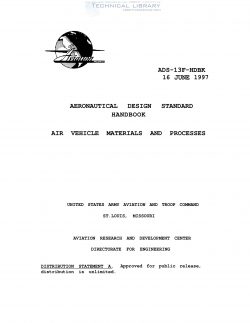
Aeronautical Design Standard, United States Army Aviation and Missile Command - Air Vehicle Materials and Processes
Flammabilitv characteristics. Materials used in aircraft should be selected to provide
a fire-retardant capability and should not absorb oils or hydraulic fluid. In addition,
materials should be self-extinguishing consistent with the state-of—the-art and should
comply with FAR 25.853, FAR 25.855, or FAR 25.1359, as applicable. Combustible
materials, if used, should be isolated from high-energy electrical circuits and components
and from other potential sources of combustion. Smoke generation characteristics and
products of combustion, particularly toxic fumes, should be identified, and appropriate
hazard warnings should be issued. The use of materials with undesirable flammability or
outgassing characteristics, such as halogenated materials like polyvinyl chloride (PVC),
should be justified by quantitative trade-off analyses.

Materials for survivability. The ability of aircraft materials to withstand the adverse
effects of ballistics, chemical and biological agents, nuclear environments, and directed
energy should be‘detennined in accordance with ADS-? 1. Whenever required, materials
selections should be made which harden/protect aircraft systems and which maximize the
resistance of aircraft systems to such threats.

Protection of critical subsystems and components should be accomplished
primarily by design. Armor, plastic foams, or the like to protect critical components
against projectile impacts may be used, provided that the method chosen is demonstrated to
be more efficientthan any other means of protection.

The effects of chemical agents and decontaminants on the properties of all
selected aircraft materials should be considered. Materials, material forms, coatings, and
finishing systems should be chosen to minimize the absorption of chemical agents and to
facilitate the rapid removal of such agents with decontaminants which are readily available
on the battlefield (e.g., detergent washing, D82, and STB). If a method of decontamination
is not specified for a particular system, the most practical method should be assumed.

FileAction
ADS-13F-HDBK Air Vehicle Materials and Processes.pdfDownload 

Comment On This Post

Your email address will not be published. Required fields are marked *

ADS-13F-HDBK

  • Version
  • 132 Downloads
  • 1.16 MB File Size
  • 1 File Count
  • February 9, 2017 Create Date
  • February 9, 2017 Last Updated
Scroll for Details

Aeronautical Design Standard, United States Army Aviation and Missile Command - Air Vehicle Materials and Processes

Flammabilitv characteristics. Materials used in aircraft should be selected to provide
a fire-retardant capability and should not absorb oils or hydraulic fluid. In addition,
materials should be self-extinguishing consistent with the state-of—the-art and should
comply with FAR 25.853, FAR 25.855, or FAR 25.1359, as applicable. Combustible
materials, if used, should be isolated from high-energy electrical circuits and components
and from other potential sources of combustion. Smoke generation characteristics and
products of combustion, particularly toxic fumes, should be identified, and appropriate
hazard warnings should be issued. The use of materials with undesirable flammability or
outgassing characteristics, such as halogenated materials like polyvinyl chloride (PVC),
should be justified by quantitative trade-off analyses.

Materials for survivability. The ability of aircraft materials to withstand the adverse
effects of ballistics, chemical and biological agents, nuclear environments, and directed
energy should be‘detennined in accordance with ADS-? 1. Whenever required, materials
selections should be made which harden/protect aircraft systems and which maximize the
resistance of aircraft systems to such threats.

Protection of critical subsystems and components should be accomplished
primarily by design. Armor, plastic foams, or the like to protect critical components
against projectile impacts may be used, provided that the method chosen is demonstrated to
be more efficientthan any other means of protection.

The effects of chemical agents and decontaminants on the properties of all
selected aircraft materials should be considered. Materials, material forms, coatings, and
finishing systems should be chosen to minimize the absorption of chemical agents and to
facilitate the rapid removal of such agents with decontaminants which are readily available
on the battlefield (e.g., detergent washing, D82, and STB). If a method of decontamination
is not specified for a particular system, the most practical method should be assumed.

FileAction
ADS-13F-HDBK Air Vehicle Materials and Processes.pdfDownload 
17,005 Documents in our Technical Library
3193318 Total Downloads

Search The Technical Library

Newest Additions

NASA-RP-1060 Subsonic Aircraft: Evolution and the Matching of Size to Performance
AA-CP-20212-001
AA-CP-20212-001
ADPO10769 Occurrence of Corrosion in Airframes
The purpose of this lecture is to provide an overview ...
MIL-STD-1759 Rivets and Rivet Type Fasteners Preferred for Design
The purpose of this book form standard is to provide ...
MIL-STD-810G Environmental Engineering Considerations and Laboratory Tests
This standard contains materiel acquisition program planning and engineering direction ...