
AGARD-R-792
- Version
- 233 Downloads
- 48.50 MB File Size
- 1 File Count
- April 28, 2016 Create Date
- April 28, 2016 Last Updated
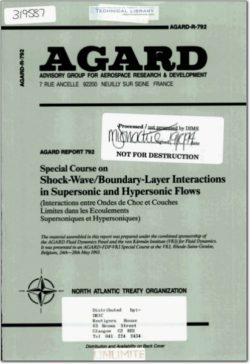
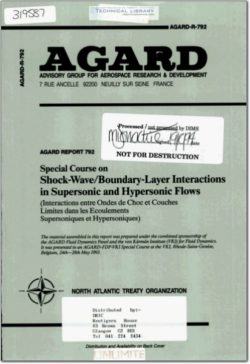
Shock Wave - Boundary Layer Interactions in Supersonic and Hypersonic Flows
The interactions of shock waves and boundary-layers
have long been a fundamental and critical problem
area of fluid dynamics. They represent the imposition
of the strongest adverse pressure gradients on viscous
layers which are susceptible to disruption by such
gradients. Unfortunately, the nature of high-speed
flow over practical missiles, aircraft, re-entry vehicles,
and turbomachinery components makes such
interactions unavoidable, with consequences ranging
from tolerable to (occasionally) disastrous.
Furthermore, the scale and performance constraints of
such practical applications almost always dictate that
the interactions in question will be both turbulent and
three-dimensional. This three-dimensionality usually
implies that the interactions are (or have components
which are) moderately to highly swept.
The past 20 years have seen intensive research on the
subject of swept shock wave/ turbulent boundary-layer
interactions. This research was conducted and
supported because it was recognized that such flows
are important, fundamental viscous/inviscid
interactions, are key building-blocks in high-speed
internal and external aerodynamic problems, and are
primary test cases for numerical simulations. From
the efforts of a number of investigators worldwide, a
limited understanding of such interactions is now
available whereas, only a few years ago, almost
nothing was known.
Several recent publications have attempted an
overview of this newfound understanding, including
those in 1986 and 1990 by the present author and D.
S. Dolling (Refs. 1,2). The present paper relies heavily
upon Ref. 2 for the interaction scaling laws and part
of the flowfield structure sections, while assembling
material not previously reviewed for the section on
experimental methods.
This discussion is thus restricted to supersonic
interactions with turbulent boundary layers, whence
the main body of available data derives. Even so, a
wide variety of swept interaction types exists. An
effort was made to classify and describe several of
these in Ref. 1, to which the reader is referred. Ref.
2, on the other hand, concentrated on the large body
of available information concerning the sharp-fm-
generated interaction with a turbulent boundary layer.
| File | Action |
|---|---|
| AGARD-R-792 Shock Wave - Boundary Layer Interactions in Supersonic and Hypersonic Flows.pdf | Download |
Comment On This Post