17,005 Documents in our Technical Library
3213617 Total Downloads

Newest Additions

NASA-RP-1060 Subsonic Aircraft: Evolution and the Matching of Size to Performance
AA-CP-20212-001
AA-CP-20212-001
ADPO10769 Occurrence of Corrosion in Airframes
The purpose of this lecture is to provide an overview ...
MIL-STD-1759 Rivets and Rivet Type Fasteners Preferred for Design
The purpose of this book form standard is to provide ...
MIL-STD-810G Environmental Engineering Considerations and Laboratory Tests
This standard contains materiel acquisition program planning and engineering direction ...

AGARD-LS-209

AGARD-LS-209
  • Version
  • 337 Downloads
  • 64.97 MB File Size
  • 1 File Count
  • April 12, 2016 Create Date
  • April 12, 2016 Last Updated
Scroll for Details

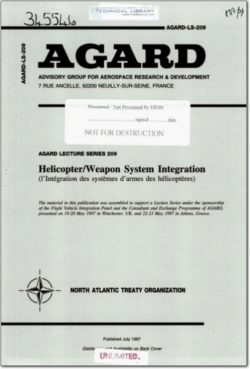
Helicopter-Weapon System Integration

AGARD-LS-209 Helicopter-Weapon System Integration

The helicopter is fast approaching a half century of service
as a weapon system. From humble beginnings after World
War II, largely in the roles of observation platforms and
search and rescue vehicles, rotorcraft have evolved to a
principal in the modern battle scenario. In the war at sea, the
helicopter forms an integral part of a task force capable of
launching devasting firepower at surface and subsurface
targets. In the airland battle, technology has made the heli-
copter into a tank killer, troop transport and night observa-
tion platform. Finally, in the most unlikely arena, air-to—air
combat, modern weaponry has shown the helicopter to be
effective against even high performance tactical aircraft.

Under ideal circumstances a new helicopter design is being
directed towards certain weapon capabilities, making the
weapon integration discipline a mature part of the design
process. However, the rapid pace of weapons development
often leads to airframe modification programs and weapons
kits make high-technology weapons subsystems a part of
older aircraft. In such cases, the system integration efforts
is sometimes reduced to “cut-and-try”. At best, such an
approach may be inefficient, at worst it may be unsafe.

The Lecture Series considers the range of interface prob-
lems that exist where weapon systems are mounted exter-
nally on helicopters. The focus is an aeromechanical and
structural aspects, and in addition operational issues and
special problems are discussed. Based on the excellent work
of the AGARD FMP Working Group 15, the Lecture Series
intends to address specifically new challenges in this field,
with a strong emphasis being placed on the lessons learned
form recent experiences in actual development programs.

In the modern battle scenario helicopters form an integral
part of the military forces and are used in a broad variety of
missions and tasks. In Figure l the main mission tasks of
military helicopters are outlined [Ref 1], including the
logistical or transport operations.

It is obvious that the originally “clean" helicopter needs to
be equipped with task oriented installations, in particular
with weapon systems for the tactical operations, including
guns, rockets and missiles. When arming helicopters with
external weapons, it is general practise to equip the aircraft
with weapon systems which are already in use on or are
derived from land based vehicles, or from fixed-wing air-
craft.

FileAction
AGARD-LS-209 Helicopter-Weapon System Integration.pdfDownload 

Comment On This Post

Your email address will not be published. Required fields are marked *

AGARD-LS-209

AGARD-LS-209
  • Version
  • 337 Downloads
  • 64.97 MB File Size
  • 1 File Count
  • April 12, 2016 Create Date
  • April 12, 2016 Last Updated
Scroll for Details

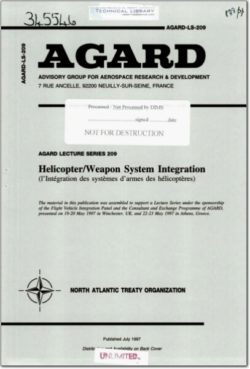
Helicopter-Weapon System Integration

AGARD-LS-209 Helicopter-Weapon System Integration

The helicopter is fast approaching a half century of service
as a weapon system. From humble beginnings after World
War II, largely in the roles of observation platforms and
search and rescue vehicles, rotorcraft have evolved to a
principal in the modern battle scenario. In the war at sea, the
helicopter forms an integral part of a task force capable of
launching devasting firepower at surface and subsurface
targets. In the airland battle, technology has made the heli-
copter into a tank killer, troop transport and night observa-
tion platform. Finally, in the most unlikely arena, air-to—air
combat, modern weaponry has shown the helicopter to be
effective against even high performance tactical aircraft.

Under ideal circumstances a new helicopter design is being
directed towards certain weapon capabilities, making the
weapon integration discipline a mature part of the design
process. However, the rapid pace of weapons development
often leads to airframe modification programs and weapons
kits make high-technology weapons subsystems a part of
older aircraft. In such cases, the system integration efforts
is sometimes reduced to “cut-and-try”. At best, such an
approach may be inefficient, at worst it may be unsafe.

The Lecture Series considers the range of interface prob-
lems that exist where weapon systems are mounted exter-
nally on helicopters. The focus is an aeromechanical and
structural aspects, and in addition operational issues and
special problems are discussed. Based on the excellent work
of the AGARD FMP Working Group 15, the Lecture Series
intends to address specifically new challenges in this field,
with a strong emphasis being placed on the lessons learned
form recent experiences in actual development programs.

In the modern battle scenario helicopters form an integral
part of the military forces and are used in a broad variety of
missions and tasks. In Figure l the main mission tasks of
military helicopters are outlined [Ref 1], including the
logistical or transport operations.

It is obvious that the originally “clean" helicopter needs to
be equipped with task oriented installations, in particular
with weapon systems for the tactical operations, including
guns, rockets and missiles. When arming helicopters with
external weapons, it is general practise to equip the aircraft
with weapon systems which are already in use on or are
derived from land based vehicles, or from fixed-wing air-
craft.

FileAction
AGARD-LS-209 Helicopter-Weapon System Integration.pdfDownload 
17,005 Documents in our Technical Library
3213617 Total Downloads

Search The Technical Library

Newest Additions

NASA-RP-1060 Subsonic Aircraft: Evolution and the Matching of Size to Performance
AA-CP-20212-001
AA-CP-20212-001
ADPO10769 Occurrence of Corrosion in Airframes
The purpose of this lecture is to provide an overview ...
MIL-STD-1759 Rivets and Rivet Type Fasteners Preferred for Design
The purpose of this book form standard is to provide ...
MIL-STD-810G Environmental Engineering Considerations and Laboratory Tests
This standard contains materiel acquisition program planning and engineering direction ...