
17,005 Documents in our Technical Library
3210338 Total Downloads

Newest Additions

NASA-RP-1060 Subsonic Aircraft: Evolution and the Matching of Size to Performance
AA-CP-20212-001
AA-CP-20212-001
ADPO10769 Occurrence of Corrosion in Airframes
The purpose of this lecture is to provide an overview ...
MIL-STD-1759 Rivets and Rivet Type Fasteners Preferred for Design
The purpose of this book form standard is to provide ...
MIL-STD-810G Environmental Engineering Considerations and Laboratory Tests
This standard contains materiel acquisition program planning and engineering direction ...

AGARD-AG-18

AGARD-AG-18
  • Version
  • 207 Downloads
  • 50.63 MB File Size
  • 1 File Count
  • September 20, 2016 Create Date
  • September 20, 2016 Last Updated
Scroll for Details

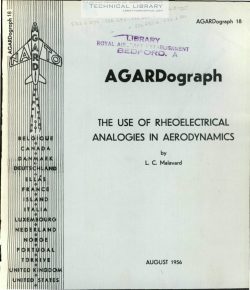
The Use of Rheoelectrical Analogies in Aerodynamics
agard-ag-18-the-use-of-rheoelectrical-analogies-in-aerodynamics-1

The rheoelectric analogy method is based
on the identity between the equations which
govern certain fluid flows and those for the
distribution of electric potential ina continu-
ous conducting medium (electric tank, con-
ducting paper, etc.).

After a review of the principle of this
method, the study describes the equipment
and experimental techniques used in model
construction, in the physical realization of
the given problem data, in the exploration
of the potential fields, and in carrying out
the necessary adjustments and measure-
ments.

Next the different aerodynamic applica-
tions are examined: representations of plane
flows, studies of airfoil sections and turbine
blade lattices, practical accomplishment of
conformal mappings, and studies of axially
symmetric and three-dimensional flows. De-
tailed descriptions are given of the analog
methods and set-ups used for the solution
of lifting line, propeller, lifting surface, and
compressible flow problems.

The electric analogy method, based on
experimental analysis of the distribution of
electric potential in a continuous electrical
conductor (in the electric tank or by other
procedures) has now become classic, and its
use for solving various aerodynamic prob-
lems has become widespread in the course
of the last twenty years. Yet, certain of
its aspects are still relatively little knowu
and remain, therefore, unexploited. This
method presents advantages, however, which
are comparable with those of other trans-
position techniques for which important an-
alog computers have been built: electronic
differential analyzers, flight simulators,
etc.

It is commonly considered that the rheo-
electric‘ analogy is a convenient procedure
'for exploring a theoretical field and more
particularly for tracing the graphical image
of a given flow. Though this is aclassic
application, both easy to conceive of and
interesting in itself, it must not be thought
that this is the only type of result which
can be hoped for from this method. In this
regard, it is perhaps useful to emphasize
certain other aspects, consideration of which
may considerably broaden the field of ap-
plication of the technique. To view the
various possibilities as a group it is often
necessary to consider the electric tank as
one of the special elements of an analog
machine, the other parts of which are elec-
trical devices which fulfill some of the con-
ditions necessary to the solution of the
problem. This viewpoint leads one quite
naturally to seek the advantages to be gained
from the measurement of electrical quan-
tities found inside the field under study, or
on its boundaries, or at points of the other
electrical apparatus of the machine.

FileAction
AGARD-AG-18 The Use of Rheoelectrical Analogies in Aerodynamics.pdfDownload 

Comment On This Post

Your email address will not be published. Required fields are marked *

AGARD-AG-18

AGARD-AG-18
  • Version
  • 207 Downloads
  • 50.63 MB File Size
  • 1 File Count
  • September 20, 2016 Create Date
  • September 20, 2016 Last Updated
Scroll for Details

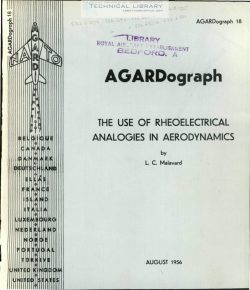
The Use of Rheoelectrical Analogies in Aerodynamics

agard-ag-18-the-use-of-rheoelectrical-analogies-in-aerodynamics-1

The rheoelectric analogy method is based
on the identity between the equations which
govern certain fluid flows and those for the
distribution of electric potential ina continu-
ous conducting medium (electric tank, con-
ducting paper, etc.).

After a review of the principle of this
method, the study describes the equipment
and experimental techniques used in model
construction, in the physical realization of
the given problem data, in the exploration
of the potential fields, and in carrying out
the necessary adjustments and measure-
ments.

Next the different aerodynamic applica-
tions are examined: representations of plane
flows, studies of airfoil sections and turbine
blade lattices, practical accomplishment of
conformal mappings, and studies of axially
symmetric and three-dimensional flows. De-
tailed descriptions are given of the analog
methods and set-ups used for the solution
of lifting line, propeller, lifting surface, and
compressible flow problems.

The electric analogy method, based on
experimental analysis of the distribution of
electric potential in a continuous electrical
conductor (in the electric tank or by other
procedures) has now become classic, and its
use for solving various aerodynamic prob-
lems has become widespread in the course
of the last twenty years. Yet, certain of
its aspects are still relatively little knowu
and remain, therefore, unexploited. This
method presents advantages, however, which
are comparable with those of other trans-
position techniques for which important an-
alog computers have been built: electronic
differential analyzers, flight simulators,
etc.

It is commonly considered that the rheo-
electric‘ analogy is a convenient procedure
'for exploring a theoretical field and more
particularly for tracing the graphical image
of a given flow. Though this is aclassic
application, both easy to conceive of and
interesting in itself, it must not be thought
that this is the only type of result which
can be hoped for from this method. In this
regard, it is perhaps useful to emphasize
certain other aspects, consideration of which
may considerably broaden the field of ap-
plication of the technique. To view the
various possibilities as a group it is often
necessary to consider the electric tank as
one of the special elements of an analog
machine, the other parts of which are elec-
trical devices which fulfill some of the con-
ditions necessary to the solution of the
problem. This viewpoint leads one quite
naturally to seek the advantages to be gained
from the measurement of electrical quan-
tities found inside the field under study, or
on its boundaries, or at points of the other
electrical apparatus of the machine.

FileAction
AGARD-AG-18 The Use of Rheoelectrical Analogies in Aerodynamics.pdfDownload 
17,005 Documents in our Technical Library
3210338 Total Downloads

Search The Technical Library

Newest Additions

NASA-RP-1060 Subsonic Aircraft: Evolution and the Matching of Size to Performance
AA-CP-20212-001
AA-CP-20212-001
ADPO10769 Occurrence of Corrosion in Airframes
The purpose of this lecture is to provide an overview ...
MIL-STD-1759 Rivets and Rivet Type Fasteners Preferred for Design
The purpose of this book form standard is to provide ...
MIL-STD-810G Environmental Engineering Considerations and Laboratory Tests
This standard contains materiel acquisition program planning and engineering direction ...