17,005 Documents in our Technical Library
3213262 Total Downloads

Newest Additions

NASA-RP-1060 Subsonic Aircraft: Evolution and the Matching of Size to Performance
AA-CP-20212-001
AA-CP-20212-001
ADPO10769 Occurrence of Corrosion in Airframes
The purpose of this lecture is to provide an overview ...
MIL-STD-1759 Rivets and Rivet Type Fasteners Preferred for Design
The purpose of this book form standard is to provide ...
MIL-STD-810G Environmental Engineering Considerations and Laboratory Tests
This standard contains materiel acquisition program planning and engineering direction ...

AGARD-LS-039-70

AGARD-LS-039-70
  • Version
  • 210 Downloads
  • 31.30 MB File Size
  • 1 File Count
  • March 9, 2016 Create Date
  • March 9, 2016 Last Updated
Scroll for Details

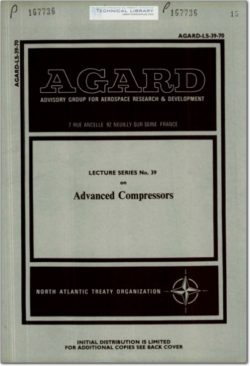
Advanced Compressors

AGARD-LS-039-70 Advanced Compressors

During the last decade. considerable success has been achieved in the improvement of
compressor performance. The development of successful axial compressors has continued
to follow its steady place of the years 50. and. due to a strong revival of interest
for many applications. the radial compressor has seen its rate of progress accelerated
considerably.

As in the past. most of the improvement has come from the exacting requirements of the
aircraft industry. but. at the same time. the knowledge gained in this privileged
sector has been diffusing, at an increasing rate. into the more conventional industry.
with some degree of original achievements ((1). for instance).

The evolution of axial compressors for the large and medium size jet engines is sum-
marized in figs. 1 and 2. replotted partly from 2]. with additional data on comparable
machines coming from tests carried out at VKI. Within the last 10 years. a 60% increase
in stage pressure ratio has been achieved, mainly through an increase of the average
Mach number level. relative to the rotor bladings. while maintaining practically the
same efficiency. The maximum pressure ratio of multistages machines has been raised
from 10 about to 27. and could reach more if this was requested by the gas turbine
cycle. This fact proves that the interstage matching problem has been largely mastered.
The progress has been obtained in the whole ranges of stage types. from the front fan
with very low hub to tip ratio (down to 0.3) and high relative rotor inlet Mach .number
(up to 1.7!at the tip) where the streamline equilibrium problem is predominant. to the
high hub to tip ratio (up to 0.9). subsonic rear stages, where end wall effects is the
most important factor.

Similar if not larger progress has been achieved in the field of small turbojet and of
small gas turbines (500 to 2000 HP) for lane. helicopter or terrestrial propulsion.
as witnessed by fig. 3 replotted from (3) and completed. The progress has been stimu-
lated by intelligent government sponsored programs such as the U.S. Army Advanced
Component Technology program (h). and it is not unrealistic to predict that. within
the next decade. the gas turbine will compete successfully with the diesel engine for
many classical applications (5). Although the increase of turbine inlet temperature is
the key element for success. it would be fruitless without a parallel increase in com-
pressor pressure ratio. as shown in fig. h. Due to the small volume flow involved.
blade size is always small and end wall effects are predominant. whatever the type of
compressor used.

FileAction
AGARD-LS-039-70 Advanced Compressors.pdfDownload 

Comment On This Post

Your email address will not be published. Required fields are marked *

AGARD-LS-039-70

AGARD-LS-039-70
  • Version
  • 210 Downloads
  • 31.30 MB File Size
  • 1 File Count
  • March 9, 2016 Create Date
  • March 9, 2016 Last Updated
Scroll for Details

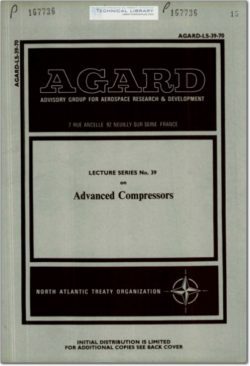
Advanced Compressors

AGARD-LS-039-70 Advanced Compressors

During the last decade. considerable success has been achieved in the improvement of
compressor performance. The development of successful axial compressors has continued
to follow its steady place of the years 50. and. due to a strong revival of interest
for many applications. the radial compressor has seen its rate of progress accelerated
considerably.

As in the past. most of the improvement has come from the exacting requirements of the
aircraft industry. but. at the same time. the knowledge gained in this privileged
sector has been diffusing, at an increasing rate. into the more conventional industry.
with some degree of original achievements ((1). for instance).

The evolution of axial compressors for the large and medium size jet engines is sum-
marized in figs. 1 and 2. replotted partly from 2]. with additional data on comparable
machines coming from tests carried out at VKI. Within the last 10 years. a 60% increase
in stage pressure ratio has been achieved, mainly through an increase of the average
Mach number level. relative to the rotor bladings. while maintaining practically the
same efficiency. The maximum pressure ratio of multistages machines has been raised
from 10 about to 27. and could reach more if this was requested by the gas turbine
cycle. This fact proves that the interstage matching problem has been largely mastered.
The progress has been obtained in the whole ranges of stage types. from the front fan
with very low hub to tip ratio (down to 0.3) and high relative rotor inlet Mach .number
(up to 1.7!at the tip) where the streamline equilibrium problem is predominant. to the
high hub to tip ratio (up to 0.9). subsonic rear stages, where end wall effects is the
most important factor.

Similar if not larger progress has been achieved in the field of small turbojet and of
small gas turbines (500 to 2000 HP) for lane. helicopter or terrestrial propulsion.
as witnessed by fig. 3 replotted from (3) and completed. The progress has been stimu-
lated by intelligent government sponsored programs such as the U.S. Army Advanced
Component Technology program (h). and it is not unrealistic to predict that. within
the next decade. the gas turbine will compete successfully with the diesel engine for
many classical applications (5). Although the increase of turbine inlet temperature is
the key element for success. it would be fruitless without a parallel increase in com-
pressor pressure ratio. as shown in fig. h. Due to the small volume flow involved.
blade size is always small and end wall effects are predominant. whatever the type of
compressor used.

FileAction
AGARD-LS-039-70 Advanced Compressors.pdfDownload 
17,005 Documents in our Technical Library
3213262 Total Downloads

Search The Technical Library

Newest Additions

NASA-RP-1060 Subsonic Aircraft: Evolution and the Matching of Size to Performance
AA-CP-20212-001
AA-CP-20212-001
ADPO10769 Occurrence of Corrosion in Airframes
The purpose of this lecture is to provide an overview ...
MIL-STD-1759 Rivets and Rivet Type Fasteners Preferred for Design
The purpose of this book form standard is to provide ...
MIL-STD-810G Environmental Engineering Considerations and Laboratory Tests
This standard contains materiel acquisition program planning and engineering direction ...