
17,005 Documents in our Technical Library
3168000 Total Downloads

Newest Additions

NASA-RP-1060 Subsonic Aircraft: Evolution and the Matching of Size to Performance
AA-CP-20212-001
AA-CP-20212-001
ADPO10769 Occurrence of Corrosion in Airframes
The purpose of this lecture is to provide an overview ...
MIL-STD-1759 Rivets and Rivet Type Fasteners Preferred for Design
The purpose of this book form standard is to provide ...
MIL-STD-810G Environmental Engineering Considerations and Laboratory Tests
This standard contains materiel acquisition program planning and engineering direction ...

NASA-TM-4003

NASA-TM-4003
  • Version
  • 439 Downloads
  • 3.28 MB File Size
  • 1 File Count
  • August 14, 2016 Create Date
  • August 14, 2016 Last Updated
Scroll for Details

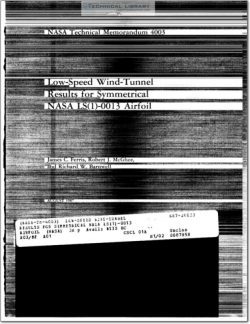
Low Speed Wind Tunnel Results for Symmetrical NASA LS(1)-0013 Airfoil
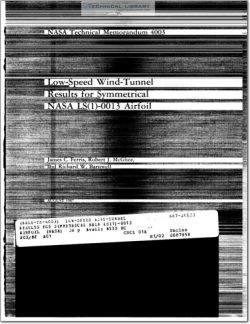
NASA-TM-4003 Low Speed Wind Tunnel Results for Symmetrical NASA LS(1)-0013 Airfoil

A wind-tunnel investigation was conducted in the
Langley Low-Turbulence Pressure Tunnel to evaluate
the performance of a symmetrical NASA LS(1)-0013
low-speed airfoil. The airfoil contour was obtained
from the thickness distribution of a 13—percent—
thick, high-performance airfoil developed for general
aviation airplanes and is intended for use on the
tail and other aerodynamic control surfaces. The
tests were conducted at Mach numbers (111) from
0.10 to 0.37 over a Reynolds number (R) range from
about 0.6 X 10⁶ to 12.0 X 10°. The angle of attack
varied from about —8° to 20°.

The results indicate that the aerodynamic char-
acteristics of the present airfoil are similar to those
of the NACA 0012 airfoil. The lift—curve slope at.
small angles of attack for the present airfoil is slightly
larger than that for the NACA 0012, and the maxi—
mum lift coefficient is also larger for Reynolds num~
hers greater than about 4.0 X 10°. For smaller
Reynolds numbers, the maximum lift coefficients for
the two airfoils are about the same. The zero-lift drag
coefficient with roughness applied is slightly greater
for the present model for the test Reynolds numbers
(2.2 X 10°, 4.0 X 10°, and 6.0 X 10°). The opposite
trend was obtained for the airfoils without rough-
ness. The stall characteristics of the present airfoil
are of the turbulent or trailing-edge type. The stall
angle of the present airfoil is 1° or 2° larger than
that of the NAC-A 0012 airfoil.

Research on advanced technology airfoils has
received considerable attention at the Langley Re—
search Center in the last several years. Refer—
ence 1 reports the results for an initial thickness
family of airfoils developed for low-speed general
aviation application. These results Show that the
13—percent-thick member of this airfoil family pro-
vides the best overall performance (maximum lift and
lift-drag ratio). In this report, the basic low—speed
characteristics for a symmetrical version of this airfoil
are presented.

FileAction
NASA-TM-4003 Low Speed Wind Tunnel Results for Symmetrical NASA LS(1)-0013 Airfoil.pdfDownload 

Comment On This Post

Your email address will not be published. Required fields are marked *

NASA-TM-4003

NASA-TM-4003
  • Version
  • 439 Downloads
  • 3.28 MB File Size
  • 1 File Count
  • August 14, 2016 Create Date
  • August 14, 2016 Last Updated
Scroll for Details

Low Speed Wind Tunnel Results for Symmetrical NASA LS(1)-0013 Airfoil

NASA-TM-4003 Low Speed Wind Tunnel Results for Symmetrical NASA LS(1)-0013 Airfoil

A wind-tunnel investigation was conducted in the
Langley Low-Turbulence Pressure Tunnel to evaluate
the performance of a symmetrical NASA LS(1)-0013
low-speed airfoil. The airfoil contour was obtained
from the thickness distribution of a 13—percent—
thick, high-performance airfoil developed for general
aviation airplanes and is intended for use on the
tail and other aerodynamic control surfaces. The
tests were conducted at Mach numbers (111) from
0.10 to 0.37 over a Reynolds number (R) range from
about 0.6 X 10⁶ to 12.0 X 10°. The angle of attack
varied from about —8° to 20°.

The results indicate that the aerodynamic char-
acteristics of the present airfoil are similar to those
of the NACA 0012 airfoil. The lift—curve slope at.
small angles of attack for the present airfoil is slightly
larger than that for the NACA 0012, and the maxi—
mum lift coefficient is also larger for Reynolds num~
hers greater than about 4.0 X 10°. For smaller
Reynolds numbers, the maximum lift coefficients for
the two airfoils are about the same. The zero-lift drag
coefficient with roughness applied is slightly greater
for the present model for the test Reynolds numbers
(2.2 X 10°, 4.0 X 10°, and 6.0 X 10°). The opposite
trend was obtained for the airfoils without rough-
ness. The stall characteristics of the present airfoil
are of the turbulent or trailing-edge type. The stall
angle of the present airfoil is 1° or 2° larger than
that of the NAC-A 0012 airfoil.

Research on advanced technology airfoils has
received considerable attention at the Langley Re—
search Center in the last several years. Refer—
ence 1 reports the results for an initial thickness
family of airfoils developed for low-speed general
aviation application. These results Show that the
13—percent-thick member of this airfoil family pro-
vides the best overall performance (maximum lift and
lift-drag ratio). In this report, the basic low—speed
characteristics for a symmetrical version of this airfoil
are presented.

FileAction
NASA-TM-4003 Low Speed Wind Tunnel Results for Symmetrical NASA LS(1)-0013 Airfoil.pdfDownload 
17,005 Documents in our Technical Library
3168000 Total Downloads

Search The Technical Library

Newest Additions

NASA-RP-1060 Subsonic Aircraft: Evolution and the Matching of Size to Performance
AA-CP-20212-001
AA-CP-20212-001
ADPO10769 Occurrence of Corrosion in Airframes
The purpose of this lecture is to provide an overview ...
MIL-STD-1759 Rivets and Rivet Type Fasteners Preferred for Design
The purpose of this book form standard is to provide ...
MIL-STD-810G Environmental Engineering Considerations and Laboratory Tests
This standard contains materiel acquisition program planning and engineering direction ...