
17,005 Documents in our Technical Library
3168087 Total Downloads

Newest Additions

NASA-RP-1060 Subsonic Aircraft: Evolution and the Matching of Size to Performance
AA-CP-20212-001
AA-CP-20212-001
ADPO10769 Occurrence of Corrosion in Airframes
The purpose of this lecture is to provide an overview ...
MIL-STD-1759 Rivets and Rivet Type Fasteners Preferred for Design
The purpose of this book form standard is to provide ...
MIL-STD-810G Environmental Engineering Considerations and Laboratory Tests
This standard contains materiel acquisition program planning and engineering direction ...

naca-wr-l-95

  • Version
  • 182 Downloads
  • 2.24 MB File Size
  • 1 File Count
  • April 15, 2017 Create Date
  • April 15, 2017 Last Updated
Scroll for Details

A Method for Predicting the Elevator Deflection Required to Land
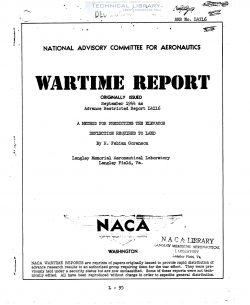
A method is presented for predicting from basic
airplane characteristics the elevator deflection required
to maintain optimum landing attitude. Charts for
evaluating the components of the equation for the
elevator deflection required to land, as well as a
comparison of computed and measured values for 15 air-
planes, are included. This comparison of experimental
and computed results shows that, for preliminary design
purposes, the elevator deflection required to land can
be satisfactorily predicted from the basic airplane
dimensions. Because of variations in piloting technique,
the computed deflection is considered as the minimum
value required to maintain landing attitude.

A simplified method of obtaining the downwash angle
near the ground and a limited analysis of the effect of
flap type and deflection on the aerodynamic-center
location and pitching—moment coefficient are presented
as appendixes.

An important consideration in the horizontal-tail
design is the provision of_adequate elevator power to
maintain optimum landing attitude. In view of this
fact, flight measurements of elevator deflections used
during landings were published in reference 1; however
no analytical method for estimating the elevator
deflection required to land was available at that time.
The present study was therefore undertaken in order to
develop a method by which estimates of the elevator
deflection required to land could be determined from
the basic dimensions of a preliminary layout.

The equilibrium equation of reference 2 has been
extended by means of references 5 and h to include the
ground effect on the downwash angle, wake location, and
tail pitching moment. The ground effect on the wing
and fuselage pitching moments has been neglected because
available data indicate that these effects are small
and inconsistent.

FileAction
naca-wr-l-95 A Method for Predicting the Elevator Deflection Required to Land.pdfDownload 

Comment On This Post

Your email address will not be published. Required fields are marked *

naca-wr-l-95

  • Version
  • 182 Downloads
  • 2.24 MB File Size
  • 1 File Count
  • April 15, 2017 Create Date
  • April 15, 2017 Last Updated
Scroll for Details

A Method for Predicting the Elevator Deflection Required to Land

A method is presented for predicting from basic
airplane characteristics the elevator deflection required
to maintain optimum landing attitude. Charts for
evaluating the components of the equation for the
elevator deflection required to land, as well as a
comparison of computed and measured values for 15 air-
planes, are included. This comparison of experimental
and computed results shows that, for preliminary design
purposes, the elevator deflection required to land can
be satisfactorily predicted from the basic airplane
dimensions. Because of variations in piloting technique,
the computed deflection is considered as the minimum
value required to maintain landing attitude.

A simplified method of obtaining the downwash angle
near the ground and a limited analysis of the effect of
flap type and deflection on the aerodynamic-center
location and pitching—moment coefficient are presented
as appendixes.

An important consideration in the horizontal-tail
design is the provision of_adequate elevator power to
maintain optimum landing attitude. In view of this
fact, flight measurements of elevator deflections used
during landings were published in reference 1; however
no analytical method for estimating the elevator
deflection required to land was available at that time.
The present study was therefore undertaken in order to
develop a method by which estimates of the elevator
deflection required to land could be determined from
the basic dimensions of a preliminary layout.

The equilibrium equation of reference 2 has been
extended by means of references 5 and h to include the
ground effect on the downwash angle, wake location, and
tail pitching moment. The ground effect on the wing
and fuselage pitching moments has been neglected because
available data indicate that these effects are small
and inconsistent.

FileAction
naca-wr-l-95 A Method for Predicting the Elevator Deflection Required to Land.pdfDownload 
17,005 Documents in our Technical Library
3168087 Total Downloads

Search The Technical Library

Newest Additions

NASA-RP-1060 Subsonic Aircraft: Evolution and the Matching of Size to Performance
AA-CP-20212-001
AA-CP-20212-001
ADPO10769 Occurrence of Corrosion in Airframes
The purpose of this lecture is to provide an overview ...
MIL-STD-1759 Rivets and Rivet Type Fasteners Preferred for Design
The purpose of this book form standard is to provide ...
MIL-STD-810G Environmental Engineering Considerations and Laboratory Tests
This standard contains materiel acquisition program planning and engineering direction ...

Popular Items