
17,005 Documents in our Technical Library
3198130 Total Downloads

Newest Additions

NASA-RP-1060 Subsonic Aircraft: Evolution and the Matching of Size to Performance
AA-CP-20212-001
AA-CP-20212-001
ADPO10769 Occurrence of Corrosion in Airframes
The purpose of this lecture is to provide an overview ...
MIL-STD-1759 Rivets and Rivet Type Fasteners Preferred for Design
The purpose of this book form standard is to provide ...
MIL-STD-810G Environmental Engineering Considerations and Laboratory Tests
This standard contains materiel acquisition program planning and engineering direction ...

naca-rm-e8g02d

  • Version
  • 47 Downloads
  • 2.42 MB File Size
  • 1 File Count
  • April 21, 2017 Create Date
  • April 21, 2017 Last Updated
Scroll for Details

National Advisory Committee for Aeronautics, Research Memorandum - Investigation of the I-40 Jet Propulsion Engine in the Cleveland Altitude Wind Tunnel - V - Operational Characteristics
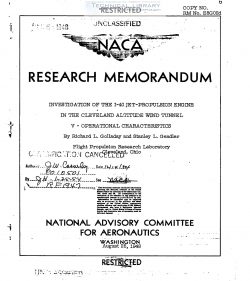
An investigation has been conducted in the Cleveland altitude
wind tunnel to determine the operational characteristics of the
I—4-O Jet-propulsion engine over a range of pressure altitudes
from 10,000 to 50,000 feet and ram pressure ratios from 1.00
to 1.76. Engine operational data were obtained with the engine
in the standard configuration and with various modifications of
the fuel system, the electrical system, and the combustion cham-
bers. The effects of altitude and. airspeed on operating speed
range, starting, windmilling, acceleration, speed regulation,
cooling, and vibration of the standard and modified engines were
determined, and damage to parts was noted.

Maximum engine speed was obtainable at all altitudes and air-
speeds with each fuel-control system investigated. The minimum
idling speed was raised by increases in altitude and airspeed. The
lowest minimum stable speeds were obtained with the standard con-
figuration using 40-gallon nozzles with individual metering plugs.

The engine was started normally at altitudes as high as
20, 000 feet with all of the fuel systems and ignition combinations
except one. Ignition at 50, 000 feet was difficult and, although
successful ignition occurred, acceleration was slow and usually
characterized by excessive tail-pipe temerature. During wind-
milling investigations of the engine equipped with the standard
fuel system, the engine could not be started at ram pressure ratios
of 1.1 to 1.? at altitudes of 10,000, 20,000, and 30,000 feet.

When equipped with the production barometric and Monarch
éo-gallon nozzles, the engine accelerated in 12 seconds from an
engine speed of 6000 rpm to 11,000 rpm at 20,000 feet and an aver-
temperature, all the engine configurations had approximately the
same rate of acceleration. The Woodward governor produced the
safest accelerations, inasmuch as it could be adjusted to auto-
matically prevent acceleration blowsout.

The engine speed was held constant by the Wbodward governor
and the Edwards regulator during simulated dives and climbs at
constant throttle position.

FileAction
naca-rm-e8g02d Investigation of the I-40 Jet Propulsion Engine in the Cleveland Altitude Wind Tunnel - V - Operational Characteristics.pdfDownload 

Comment On This Post

Your email address will not be published. Required fields are marked *

naca-rm-e8g02d

  • Version
  • 47 Downloads
  • 2.42 MB File Size
  • 1 File Count
  • April 21, 2017 Create Date
  • April 21, 2017 Last Updated
Scroll for Details

National Advisory Committee for Aeronautics, Research Memorandum - Investigation of the I-40 Jet Propulsion Engine in the Cleveland Altitude Wind Tunnel - V - Operational Characteristics

An investigation has been conducted in the Cleveland altitude
wind tunnel to determine the operational characteristics of the
I—4-O Jet-propulsion engine over a range of pressure altitudes
from 10,000 to 50,000 feet and ram pressure ratios from 1.00
to 1.76. Engine operational data were obtained with the engine
in the standard configuration and with various modifications of
the fuel system, the electrical system, and the combustion cham-
bers. The effects of altitude and. airspeed on operating speed
range, starting, windmilling, acceleration, speed regulation,
cooling, and vibration of the standard and modified engines were
determined, and damage to parts was noted.

Maximum engine speed was obtainable at all altitudes and air-
speeds with each fuel-control system investigated. The minimum
idling speed was raised by increases in altitude and airspeed. The
lowest minimum stable speeds were obtained with the standard con-
figuration using 40-gallon nozzles with individual metering plugs.

The engine was started normally at altitudes as high as
20, 000 feet with all of the fuel systems and ignition combinations
except one. Ignition at 50, 000 feet was difficult and, although
successful ignition occurred, acceleration was slow and usually
characterized by excessive tail-pipe temerature. During wind-
milling investigations of the engine equipped with the standard
fuel system, the engine could not be started at ram pressure ratios
of 1.1 to 1.? at altitudes of 10,000, 20,000, and 30,000 feet.

When equipped with the production barometric and Monarch
éo-gallon nozzles, the engine accelerated in 12 seconds from an
engine speed of 6000 rpm to 11,000 rpm at 20,000 feet and an aver-
temperature, all the engine configurations had approximately the
same rate of acceleration. The Woodward governor produced the
safest accelerations, inasmuch as it could be adjusted to auto-
matically prevent acceleration blowsout.

The engine speed was held constant by the Wbodward governor
and the Edwards regulator during simulated dives and climbs at
constant throttle position.

FileAction
naca-rm-e8g02d Investigation of the I-40 Jet Propulsion Engine in the Cleveland Altitude Wind Tunnel - V - Operational Characteristics.pdfDownload 
17,005 Documents in our Technical Library
3198130 Total Downloads

Search The Technical Library

Newest Additions

NASA-RP-1060 Subsonic Aircraft: Evolution and the Matching of Size to Performance
AA-CP-20212-001
AA-CP-20212-001
ADPO10769 Occurrence of Corrosion in Airframes
The purpose of this lecture is to provide an overview ...
MIL-STD-1759 Rivets and Rivet Type Fasteners Preferred for Design
The purpose of this book form standard is to provide ...
MIL-STD-810G Environmental Engineering Considerations and Laboratory Tests
This standard contains materiel acquisition program planning and engineering direction ...