
naca-report-692
- Version
- 218 Downloads
- 890.04 KB File Size
- 1 File Count
- August 30, 2016 Create Date
- August 30, 2016 Last Updated
National Advisory Committee for Aeronautics, Report - Effective Gust Structure at Low Altitudes as Determined from the Reactions of an Airplane
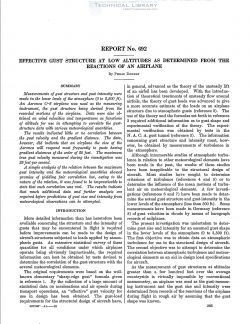
Measurements of gust structure and gust intensity were
made in the lower levels of the atmosphere (0 to 3,500 ft).
An Aeronca 0—2 airplane was used as the measuring
instrument, the gust structure being derived from the
recorded motions of the airplane. Data were also ob-
tained on wind velocities and temperatures as functions
of altitude for use in attempting to correlate the gust-
structure data with various meteorological quantities.
The results indicated little or no correlation between
the gust velocity and the gradient distance. The data,
however, did indicate that an airplane the size of the
Aeronea will respond most frequently to gusts having
gradient distances of the order of 30 feet. The maximum
true gust velocity measured during the investigation was
25 feet per second.
A simple analysis of the relation between the maximum
gust intensity and the meteorological quantities showed
promise of yielding fair correlation but, owing to the
nature of the relation, it was found to be impracticable to
state that such correlation was real. The results indicate
that much additional data and further analysis are
required before predictions of gust size and intensity from
meteorological observations can be attempted.
More detailed information than has heretofore been
available concerning the structure and the intensity of
gusts that may be encountered in flight is required
before improvements can be made to the design of
aircraft structures subjected to loads applied by atmos-
pheric gusts. An extensive statistical survey of these
quantities for all conditions under which airplanes
operate being obviously impracticable, the required
information can best be obtained by tests devised to
determine the correlation of the gust structure with the
several meteorological elements.
The original requirements were based on the well-
known elementary “sharp—edge gust” formula given
in reference 1. By the collection of a large amount of
statistical data on accelerations and air speeds during
transport operations, an “effective” gust velocity for
use in design has been obtained.
| File | Action |
|---|---|
| naca-report-692 Effective Gust Structure at Low Altitudes as Determined from the Reactions of an Airplane.pdf | Download |
Comment On This Post