17,005 Documents in our Technical Library
3210393 Total Downloads

Newest Additions

NASA-RP-1060 Subsonic Aircraft: Evolution and the Matching of Size to Performance
AA-CP-20212-001
AA-CP-20212-001
ADPO10769 Occurrence of Corrosion in Airframes
The purpose of this lecture is to provide an overview ...
MIL-STD-1759 Rivets and Rivet Type Fasteners Preferred for Design
The purpose of this book form standard is to provide ...
MIL-STD-810G Environmental Engineering Considerations and Laboratory Tests
This standard contains materiel acquisition program planning and engineering direction ...

AGARD-RTO-AG-339

AGARD-RTO-AG-339
  • Version
  • 327 Downloads
  • 28.94 MB File Size
  • 1 File Count
  • April 28, 2016 Create Date
  • April 28, 2016 Last Updated
Scroll for Details

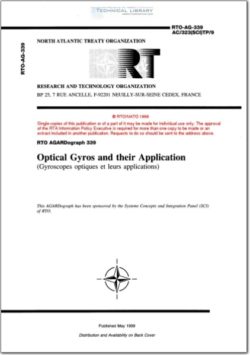
Optical Gyros and Their Application
AGARD-RTO-AG-339 Optical Gyros and Their Application
The second half of the 20‘h century is marked not only by social changes; but also intensive and
thorough investigations in fundamental and applied science. Two aspects are to be of the paramount
importance in the field of navigation: 1) creation of global satellite navigation systems, such as Transit,
GPS and GLONASS; 2) the advent of a new generation of inertial navigation sensors — laser and fiber
optical gyros (LG and FOG). These optical devices, making use of fundamental properties of
electromagnetic waves, provide a basis for a new line of investigations in inertial navigation and make
it possible to give up the fast rotating rotor. This situation opens a possibility to use new progressive
technology in mass production.
Exceptional properties of optical gyros (high accuracy, wide dynamic range, non-sensitivity to linear
acceleration, et a1.) stimulated the evolution of various highly-accurate strapdown inertial navigation
systems (SINS) which are in great demand on the market today. Integration of SINS based on optical
gyros with Satellite Navigation Systems, such as GPS and GLONASS, allows new positive properties
necessary for dual usage in military and commercial technology. It is necessary to note considerable
and extremely important progress in FOG in the last few years due to deeper understanding of physical
processes in electromagnetic wave propagation in optical fiber and a wide use of integral optics. All
this permits realization of an optimal architecture of FOG and using of micromechanical sensors to
create a new modification of low life-cycle cost, small-sized and low production cost SINS.
The most important scientific and practical results in the field of laser and fiber gyros have been
obtained through military and industrial complexes of leading states. This fact remained a serious
obstacle to wide international cooperation for a long time, particularly in the sphere of modern high
technologies. A new era was opened in 1990 after the historical Declaration at the London Summit
Meeting in the light of the changes that had taken place in Europe. In 1991 the Alliance furthered this
process with the Declaration on Peace and Cooperation and publication of a new Strategic Concept to
bring NATO’s overall strategy in line with future needs. As a result of these steps AGARD’s Technical
Cooperation Program was worked out and the initiative of publishing the monography “Optical Gyros
and their Application” by an international body of authors was supported.
This volume consists of 15 chapters that are divided into four main parts. The first one gives a detailed
description of the laser and fiber optical gyro theory, the main sources of errors and the methods used
to reduce their influence.

FileAction
AGARD-RTO-AG-339 Optical Gyros and Their Application.pdfDownload 

Comment On This Post

Your email address will not be published. Required fields are marked *

AGARD-RTO-AG-339

AGARD-RTO-AG-339
  • Version
  • 327 Downloads
  • 28.94 MB File Size
  • 1 File Count
  • April 28, 2016 Create Date
  • April 28, 2016 Last Updated
Scroll for Details

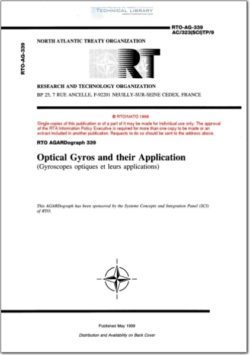
Optical Gyros and Their Application
AGARD-RTO-AG-339 Optical Gyros and Their Application
The second half of the 20‘h century is marked not only by social changes; but also intensive and
thorough investigations in fundamental and applied science. Two aspects are to be of the paramount
importance in the field of navigation: 1) creation of global satellite navigation systems, such as Transit,
GPS and GLONASS; 2) the advent of a new generation of inertial navigation sensors — laser and fiber
optical gyros (LG and FOG). These optical devices, making use of fundamental properties of
electromagnetic waves, provide a basis for a new line of investigations in inertial navigation and make
it possible to give up the fast rotating rotor. This situation opens a possibility to use new progressive
technology in mass production.
Exceptional properties of optical gyros (high accuracy, wide dynamic range, non-sensitivity to linear
acceleration, et a1.) stimulated the evolution of various highly-accurate strapdown inertial navigation
systems (SINS) which are in great demand on the market today. Integration of SINS based on optical
gyros with Satellite Navigation Systems, such as GPS and GLONASS, allows new positive properties
necessary for dual usage in military and commercial technology. It is necessary to note considerable
and extremely important progress in FOG in the last few years due to deeper understanding of physical
processes in electromagnetic wave propagation in optical fiber and a wide use of integral optics. All
this permits realization of an optimal architecture of FOG and using of micromechanical sensors to
create a new modification of low life-cycle cost, small-sized and low production cost SINS.
The most important scientific and practical results in the field of laser and fiber gyros have been
obtained through military and industrial complexes of leading states. This fact remained a serious
obstacle to wide international cooperation for a long time, particularly in the sphere of modern high
technologies. A new era was opened in 1990 after the historical Declaration at the London Summit
Meeting in the light of the changes that had taken place in Europe. In 1991 the Alliance furthered this
process with the Declaration on Peace and Cooperation and publication of a new Strategic Concept to
bring NATO’s overall strategy in line with future needs. As a result of these steps AGARD’s Technical
Cooperation Program was worked out and the initiative of publishing the monography “Optical Gyros
and their Application” by an international body of authors was supported.
This volume consists of 15 chapters that are divided into four main parts. The first one gives a detailed
description of the laser and fiber optical gyro theory, the main sources of errors and the methods used
to reduce their influence.

FileAction
AGARD-RTO-AG-339 Optical Gyros and Their Application.pdfDownload 
17,005 Documents in our Technical Library
3210393 Total Downloads

Search The Technical Library

Newest Additions

NASA-RP-1060 Subsonic Aircraft: Evolution and the Matching of Size to Performance
AA-CP-20212-001
AA-CP-20212-001
ADPO10769 Occurrence of Corrosion in Airframes
The purpose of this lecture is to provide an overview ...
MIL-STD-1759 Rivets and Rivet Type Fasteners Preferred for Design
The purpose of this book form standard is to provide ...
MIL-STD-810G Environmental Engineering Considerations and Laboratory Tests
This standard contains materiel acquisition program planning and engineering direction ...