
AGARD-R-583
- Version
- 185 Downloads
- 9.21 MB File Size
- 1 File Count
- April 28, 2016 Create Date
- April 28, 2016 Last Updated
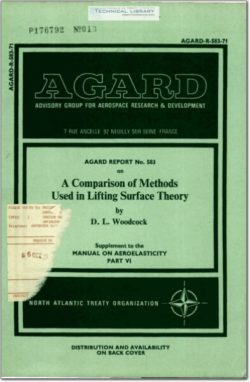
A Comparison of Methods Used in Lifting Surface Theory
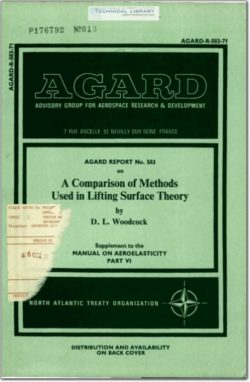
Calculated values, obtained by linearised potential flow the_ory, of the air forces on
oscillating thin wings are presented for a selection of planforms, modes of oscillation, fre-
quencies and airspeeds. Results from a number of different computer programs and methods
are compared in the three regimes: subsonic, sonic, and supersonic. No attempt is made,
however, to assess which programs are the most accurate. A survey of the different methods
is included indicating their main features and how they differ from each other.
Whereas the first five volumes of the Manual on Aeroelasticity were devoted to the
description of the theories used for predicting aeroelastic phenomena and to the basic
lessons derived from their comparison with experimental data, the sixth (and last) volume
aims at being a practical working tool for the designers faced with these major problems;
this is why the most complete numerical tables on two-dimensional aerodynamic forces
now existing are to be found in its first part.
As far as the three—dimensional field is concerned. it is beyond present possibilities to
give in a Manual the numerical values concerning the potential multiplicity of wing shapes. A
description of computation methods and comments upon them are essentially what the
reader expects to find. A few standard shapes only are to be kept in mind, as examples.
in order to illustrate the application of and comparisons between methods. In this way,
the numerical values most likely to be encountered are provided for known cases and
enable the designer to test the programme he intends to adopt prior to undertaking studies
on a new shape.
Such are the considerations which have guided the AGARD Structures and Materials
Panel in the preparation of this second part of Volume VI. After discussing the matter
and reaching agreement as to the choice of a number of aerofoils, the countries which were
able to devote efforts to this task distributed the work among themselves; each of them,
by means of its own methods, calculated the aerodynamic coefficients for the list which
had been drawn up. This joint effort is presented by Mr D.L.Woodcock from the Royal
Aircraft Establishment, with notable clarity and objectiveness.
| File | Action |
|---|---|
| AGARD-R-583 A Comparison of Methods Used in Lifting Surface Theory.pdf | Download |
Comment On This Post