
17,005 Documents in our Technical Library
3180803 Total Downloads

Newest Additions

NASA-RP-1060 Subsonic Aircraft: Evolution and the Matching of Size to Performance
AA-CP-20212-001
AA-CP-20212-001
ADPO10769 Occurrence of Corrosion in Airframes
The purpose of this lecture is to provide an overview ...
MIL-STD-1759 Rivets and Rivet Type Fasteners Preferred for Design
The purpose of this book form standard is to provide ...
MIL-STD-810G Environmental Engineering Considerations and Laboratory Tests
This standard contains materiel acquisition program planning and engineering direction ...

AGARD-LS-182

AGARD-LS-182
  • Version
  • 217 Downloads
  • 10.47 MB File Size
  • 1 File Count
  • April 26, 2016 Create Date
  • April 26, 2016 Last Updated
Scroll for Details

Fundamentals and Special Problems of Synthetic Aperture Radar (SAR)
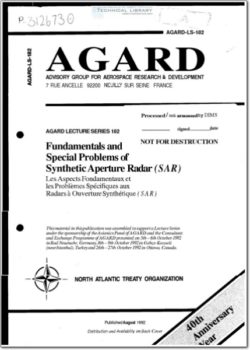
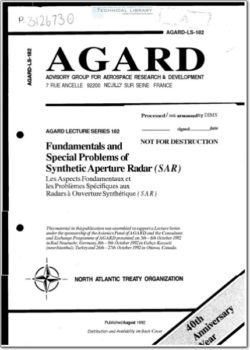
AGARD-LS-182 Fundamentals and Special Problems of Synthetic Aperture Radar (SAR)
The basic principles of SAR will be explained.
Equations for geometric and radiometric reso—
lution and their inter—relations will be gi-
ven in addition to a range equation. The dif—
ference between focussed and unfocussed SAR
and the conception of beam sharpening will be
explained.
For remote sensing purposes the resolution of
the respective sensor is one of the main fac—
tors. Resolution in the wide sense is defined
as the degree to which a sensor can discrimina—
te two closely spaced targets, having similar
properties (geometry, colour, velocity, etch
However, angular resolution is a matter of do—
minant concern. It is defined as the minimum
angular separation between two items which can
be distinguished by a system.
Note that for all systems using elecromagnetic
waves, the laws of optics apply. The angular
resolution of an optical system is principally
limited by both the aperture diameter and the
turbulence of the wave propagation medium (i.e.
the earth's atmosphere). Quantitatively the an—
gular resolution of an aperture of a given size
l is found by the ratio of wavelength 1 over
this size.
The human eye, for example, is an optical sy—
steHn the resolution r ofwhich is limited by
the pupil diameter. under mean illumination
with a wavelength of about 5 x 10“1 mm the pu-
pil diameter varies between 1 mm and 8 mm and
an angular resolution power between about 2 arc
minutes and 10 arc seconds results. The mean
resolution power of l are minute corresponds to
a ground resolution of 3 m for a distance of 10
km. (Thisvalue can be experienced (approxima—
tely!) by looking down to the ground from an
aircraft). For optics with diameters roughly a
factor lOO larger and at altitude of about 100
km, a resolution power in the order of 10 cm
results. This corresponds excellently to values
known or guessed for military satellites which
are now operational.
Diffraction limiting laws of optics apply to
microwave remote sensing systems, too. Here,
the antenna is the lens of the System and the
antenna aperture, the diameter or length deter—
mines the aperture size.

FileAction
AGARD-LS-182 Fundamentals and Special Problems of Synthetic Aperture Radar (SAR).pdfDownload 

Comment On This Post

Your email address will not be published. Required fields are marked *

AGARD-LS-182

AGARD-LS-182
  • Version
  • 217 Downloads
  • 10.47 MB File Size
  • 1 File Count
  • April 26, 2016 Create Date
  • April 26, 2016 Last Updated
Scroll for Details

Fundamentals and Special Problems of Synthetic Aperture Radar (SAR)
AGARD-LS-182 Fundamentals and Special Problems of Synthetic Aperture Radar (SAR)
The basic principles of SAR will be explained.
Equations for geometric and radiometric reso—
lution and their inter—relations will be gi-
ven in addition to a range equation. The dif—
ference between focussed and unfocussed SAR
and the conception of beam sharpening will be
explained.
For remote sensing purposes the resolution of
the respective sensor is one of the main fac—
tors. Resolution in the wide sense is defined
as the degree to which a sensor can discrimina—
te two closely spaced targets, having similar
properties (geometry, colour, velocity, etch
However, angular resolution is a matter of do—
minant concern. It is defined as the minimum
angular separation between two items which can
be distinguished by a system.
Note that for all systems using elecromagnetic
waves, the laws of optics apply. The angular
resolution of an optical system is principally
limited by both the aperture diameter and the
turbulence of the wave propagation medium (i.e.
the earth's atmosphere). Quantitatively the an—
gular resolution of an aperture of a given size
l is found by the ratio of wavelength 1 over
this size.
The human eye, for example, is an optical sy—
steHn the resolution r ofwhich is limited by
the pupil diameter. under mean illumination
with a wavelength of about 5 x 10“1 mm the pu-
pil diameter varies between 1 mm and 8 mm and
an angular resolution power between about 2 arc
minutes and 10 arc seconds results. The mean
resolution power of l are minute corresponds to
a ground resolution of 3 m for a distance of 10
km. (Thisvalue can be experienced (approxima—
tely!) by looking down to the ground from an
aircraft). For optics with diameters roughly a
factor lOO larger and at altitude of about 100
km, a resolution power in the order of 10 cm
results. This corresponds excellently to values
known or guessed for military satellites which
are now operational.
Diffraction limiting laws of optics apply to
microwave remote sensing systems, too. Here,
the antenna is the lens of the System and the
antenna aperture, the diameter or length deter—
mines the aperture size.

FileAction
AGARD-LS-182 Fundamentals and Special Problems of Synthetic Aperture Radar (SAR).pdfDownload 
17,005 Documents in our Technical Library
3180803 Total Downloads

Search The Technical Library

Newest Additions

NASA-RP-1060 Subsonic Aircraft: Evolution and the Matching of Size to Performance
AA-CP-20212-001
AA-CP-20212-001
ADPO10769 Occurrence of Corrosion in Airframes
The purpose of this lecture is to provide an overview ...
MIL-STD-1759 Rivets and Rivet Type Fasteners Preferred for Design
The purpose of this book form standard is to provide ...
MIL-STD-810G Environmental Engineering Considerations and Laboratory Tests
This standard contains materiel acquisition program planning and engineering direction ...