
17,005 Documents in our Technical Library
3208130 Total Downloads

Newest Additions

NASA-RP-1060 Subsonic Aircraft: Evolution and the Matching of Size to Performance
AA-CP-20212-001
AA-CP-20212-001
ADPO10769 Occurrence of Corrosion in Airframes
The purpose of this lecture is to provide an overview ...
MIL-STD-1759 Rivets and Rivet Type Fasteners Preferred for Design
The purpose of this book form standard is to provide ...
MIL-STD-810G Environmental Engineering Considerations and Laboratory Tests
This standard contains materiel acquisition program planning and engineering direction ...

AGARD-LS-037-70

AGARD-LS-037-70
  • Version
  • 269 Downloads
  • 31.18 MB File Size
  • 1 File Count
  • March 9, 2016 Create Date
  • March 9, 2016 Last Updated
Scroll for Details

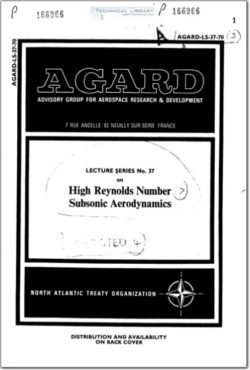
High Reynolds Number Subsonic Aerodynamics
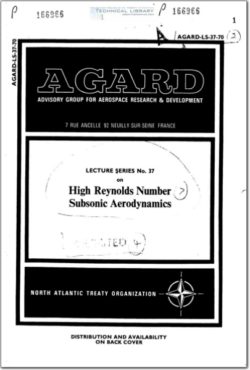
AGARD-LS-037-70 High Reynolds Number Subsonic Aerodynamics

After a period of almost a decade in which emphasis on space flight diverted attention away from aeronautical
research and development, there is currently a new interest in aerodynamics - even the rather mundane field of
subsonic aerodynamics. Engineers and scientists are finding that there is not only considerable technical
challenge remaining in this field but considerable need as well. Furthermore some of the methods developed for
analysis of hypersonic flow problems give us new approaches for problems at lower speeds.

An example is the nonsteady flow approach used to obtain solutions for the flow field in front of a blunt
nosed re-entry body. Godunov et a1. (1961) obtained such a solution by leaving the time dependent terms in the
basic equations and solving for the case where t a m . This is now a promising approach for transonic flows.
At the present time the future for aircraft aerodynamicists looks bright.

It should not be expected that the major emphasis now being placed on subsonic high speed aircraft will
continue indefinitely, but it does appear that we’ve settled down to a more orderly progression than was
obvious a few years back, and that rather than a quantum jump in operational speeds from say M = 0.8 to M = 10
we shall probably see, for commercial aircraft at least, a slower and more orderly advance.

Assuming that no major international conflicts develop - or perhaps that those conflicts we have do not
escalate substantially - the outlook for growth in commercial passenger air traffic is very promising. A
forecast made by Lockheed market analysts is shown in Figure 1. One can see that revenue passenger miles have
doubled in the last five years, and the present quantity is forecast to double again in about 5-7 years. The
figures shown are from a study made in connection with the Lockheed L-1011 program, but they are supported by
other forecasters who predict the same trends.

In Figure 2 the projected need of Figure 1 is compared with the projected available commercial aircraft
capacity based on a 55% load factor. These figures also come from L-1011 studies and thus do not reflect the
impact of L-1011’s and DC—10’s that have recently been purchased. The block labeled “Additional Capacity
Required" is. of course the one in which we are most interested. By 1975 it is expected that the commercial
fleet needed will be about double the size of that existing today. And as this figure indicates, it is expected
that this need will be met by the L-1011’s. DC-lO’s, Boeing 747’s, A-300's and other large subsonic aircraft.
That last category “other large subsonic aircraft” should not be ignored. Several companies in the USA are
already investigating this need and making preliminary proposals to meet the need.

FileAction
AGARD-LS-037-70 High Reynolds Number Subsonic Aerodynamics.pdfDownload 

Comment On This Post

Your email address will not be published. Required fields are marked *

AGARD-LS-037-70

AGARD-LS-037-70
  • Version
  • 269 Downloads
  • 31.18 MB File Size
  • 1 File Count
  • March 9, 2016 Create Date
  • March 9, 2016 Last Updated
Scroll for Details

High Reynolds Number Subsonic Aerodynamics

AGARD-LS-037-70 High Reynolds Number Subsonic Aerodynamics

After a period of almost a decade in which emphasis on space flight diverted attention away from aeronautical
research and development, there is currently a new interest in aerodynamics - even the rather mundane field of
subsonic aerodynamics. Engineers and scientists are finding that there is not only considerable technical
challenge remaining in this field but considerable need as well. Furthermore some of the methods developed for
analysis of hypersonic flow problems give us new approaches for problems at lower speeds.

An example is the nonsteady flow approach used to obtain solutions for the flow field in front of a blunt
nosed re-entry body. Godunov et a1. (1961) obtained such a solution by leaving the time dependent terms in the
basic equations and solving for the case where t a m . This is now a promising approach for transonic flows.
At the present time the future for aircraft aerodynamicists looks bright.

It should not be expected that the major emphasis now being placed on subsonic high speed aircraft will
continue indefinitely, but it does appear that we’ve settled down to a more orderly progression than was
obvious a few years back, and that rather than a quantum jump in operational speeds from say M = 0.8 to M = 10
we shall probably see, for commercial aircraft at least, a slower and more orderly advance.

Assuming that no major international conflicts develop - or perhaps that those conflicts we have do not
escalate substantially - the outlook for growth in commercial passenger air traffic is very promising. A
forecast made by Lockheed market analysts is shown in Figure 1. One can see that revenue passenger miles have
doubled in the last five years, and the present quantity is forecast to double again in about 5-7 years. The
figures shown are from a study made in connection with the Lockheed L-1011 program, but they are supported by
other forecasters who predict the same trends.

In Figure 2 the projected need of Figure 1 is compared with the projected available commercial aircraft
capacity based on a 55% load factor. These figures also come from L-1011 studies and thus do not reflect the
impact of L-1011’s and DC—10’s that have recently been purchased. The block labeled “Additional Capacity
Required" is. of course the one in which we are most interested. By 1975 it is expected that the commercial
fleet needed will be about double the size of that existing today. And as this figure indicates, it is expected
that this need will be met by the L-1011’s. DC-lO’s, Boeing 747’s, A-300's and other large subsonic aircraft.
That last category “other large subsonic aircraft” should not be ignored. Several companies in the USA are
already investigating this need and making preliminary proposals to meet the need.

FileAction
AGARD-LS-037-70 High Reynolds Number Subsonic Aerodynamics.pdfDownload 
17,005 Documents in our Technical Library
3208130 Total Downloads

Search The Technical Library

Newest Additions

NASA-RP-1060 Subsonic Aircraft: Evolution and the Matching of Size to Performance
AA-CP-20212-001
AA-CP-20212-001
ADPO10769 Occurrence of Corrosion in Airframes
The purpose of this lecture is to provide an overview ...
MIL-STD-1759 Rivets and Rivet Type Fasteners Preferred for Design
The purpose of this book form standard is to provide ...
MIL-STD-810G Environmental Engineering Considerations and Laboratory Tests
This standard contains materiel acquisition program planning and engineering direction ...