
17,005 Documents in our Technical Library
3191955 Total Downloads

Newest Additions

NASA-RP-1060 Subsonic Aircraft: Evolution and the Matching of Size to Performance
AA-CP-20212-001
AA-CP-20212-001
ADPO10769 Occurrence of Corrosion in Airframes
The purpose of this lecture is to provide an overview ...
MIL-STD-1759 Rivets and Rivet Type Fasteners Preferred for Design
The purpose of this book form standard is to provide ...
MIL-STD-810G Environmental Engineering Considerations and Laboratory Tests
This standard contains materiel acquisition program planning and engineering direction ...

AD-A276713 Honeycomb Sandwich Structures-Vented Versus Unvented Design for Space Systems
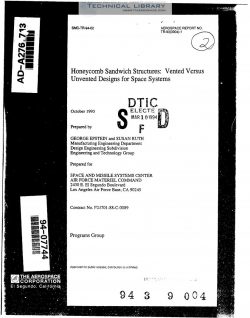
AD-A276713 Honeycomb Sandwich Structures-Vented Versus Unvented Design for Space Systems
  • Version
  • 131 Downloads
  • 772.90 KB File Size
  • 1 File Count
  • May 11, 2020 Create Date
  • May 11, 2020 Last Updated
Scroll for Details

Several space systems programs have experienced significant anomalies associated with failures of unvented honeycomb sandwich structures. Based on documentation and personal experience, this report provides descriptions of the structures involved, the circumstances of the failures, and corrective actions. Of special note, it is concluded that failures occur due to internal pressure when the external environment is reduced in ambient pressure. Such failures are initiated at weak bond areas (presumed to result from a manufacturing "defect" - areas that were riot previously identified/repaired. Once initiated, separation of the skin-to-core bond propagates very rapidly and has been described as "explosive,". It is recommended that honeycomb structures for space systems be adequately vented whenever possible. In situations where venting is not feasible, a series of recommendations is presented to minimize the likelihood of failure. Design and manufacturing parameters are listed for honeycomb sandwich panels that are not fully vented, in order to reduce the likelihood of failure.

FileAction
AD-A276713 Honeycomb Sandwich Structures-Vented Versus Unvented Design for Space Systems.pdfDownload 

Comment On This Post

Your email address will not be published. Required fields are marked *

AD-A276713 Honeycomb Sandwich Structures-Vented Versus Unvented Design for Space Systems

AD-A276713 Honeycomb Sandwich Structures-Vented Versus Unvented Design for Space Systems
  • Version
  • 131 Downloads
  • 772.90 KB File Size
  • 1 File Count
  • May 11, 2020 Create Date
  • May 11, 2020 Last Updated
Scroll for Details

Several space systems programs have experienced significant anomalies associated with failures of unvented honeycomb sandwich structures. Based on documentation and personal experience, this report provides descriptions of the structures involved, the circumstances of the failures, and corrective actions. Of special note, it is concluded that failures occur due to internal pressure when the external environment is reduced in ambient pressure. Such failures are initiated at weak bond areas (presumed to result from a manufacturing "defect" - areas that were riot previously identified/repaired. Once initiated, separation of the skin-to-core bond propagates very rapidly and has been described as "explosive,". It is recommended that honeycomb structures for space systems be adequately vented whenever possible. In situations where venting is not feasible, a series of recommendations is presented to minimize the likelihood of failure. Design and manufacturing parameters are listed for honeycomb sandwich panels that are not fully vented, in order to reduce the likelihood of failure.

FileAction
AD-A276713 Honeycomb Sandwich Structures-Vented Versus Unvented Design for Space Systems.pdfDownload 
17,005 Documents in our Technical Library
3191955 Total Downloads

Search The Technical Library

Newest Additions

NASA-RP-1060 Subsonic Aircraft: Evolution and the Matching of Size to Performance
AA-CP-20212-001
AA-CP-20212-001
ADPO10769 Occurrence of Corrosion in Airframes
The purpose of this lecture is to provide an overview ...
MIL-STD-1759 Rivets and Rivet Type Fasteners Preferred for Design
The purpose of this book form standard is to provide ...
MIL-STD-810G Environmental Engineering Considerations and Laboratory Tests
This standard contains materiel acquisition program planning and engineering direction ...