
17,005 Documents in our Technical Library
3451608 Total Downloads

Newest Additions

NASA-RP-1060 Subsonic Aircraft: Evolution and the Matching of Size to Performance
AA-CP-20212-001
AA-CP-20212-001
ADPO10769 Occurrence of Corrosion in Airframes
The purpose of this lecture is to provide an overview ...
MIL-STD-1759 Rivets and Rivet Type Fasteners Preferred for Design
The purpose of this book form standard is to provide ...
MIL-STD-810G Environmental Engineering Considerations and Laboratory Tests
This standard contains materiel acquisition program planning and engineering direction ...

NACA-TN-868

NACA-TN-868
  • Version
  • 178 Downloads
  • 2.47 MB File Size
  • 1 File Count
  • December 4, 2015 Create Date
  • December 4, 2015 Last Updated
Scroll for Details

National Advisory Committee for Aeronautics, Technical Notes - Influence of Impact Velocity on Tensile Characteristics
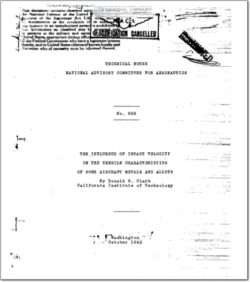
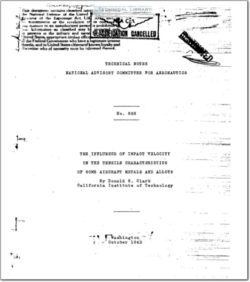
naca-tn-868 The Influence of Impact Velocity on the Tensile Characteristics of Some AIrcraft Metals and Alloys

This report deals principally with the results of
tension tests on sixteen metals and alloys, most of which
are employed extensively in aircraft construction. The
tension characteristics are discussed for static condi—
tions and rates of deformation up to about 150 feet per
second.

The equipment and procedure employed in these tests
are described. Velocities are obtained by means of a
heavy rotating disk. The forces acting during impact are
determined by means of a strain— sensitive resistance dyna-
monster and are recorded with a cathode—ray oscillograph.
The effective constant velocity of the rotating_ dis_k per—
mite the development of stress— strain diagrame.

As a result of these tests, it has heen shown that
Dowmetal M and lB—percent chromium - 8— percent nickel
stainless steel _are adversely affected by an increasing
rate of deformation. The other materials tested exhioit ""T
changes of vield stress, eltimate strength, and other ten—
sile properties.

An investigation of the effect of decreasing the gage
length of specimens below 1 inch-is reported. The results
indicate that there is no major effect until the ratio of
gage length to diameter is reduced to unity.

In a strict sense, impact testing refers to a study
of the behavior of materials under the application of 3
suddenly applied load, or to a study of the rapid deforma—
tion of matehials. Heretdfone, the term "impact testing"
has been most closely associated with those tests in which
a notched specimen in bending was used; This, however, is
more properly referred to as notched bar testing. There
are, in general, three types offimpact tests; that is,
notched bar testing, torsion impact testing, and tension
impact testing.

The notched bar tests have been found to be useful in
the study of the susceptibility of materials to embrittl_e—_
ment by the presence of a notch. At the present time, it
has been employed in a qualitative manner since it has not
been pessible to correlate.the results in a quantitative
manner with other'teste’or experience.

FileAction
naca-tn-868.pdfDownload 

Comment On This Post

Your email address will not be published. Required fields are marked *

NACA-TN-868

NACA-TN-868
  • Version
  • 178 Downloads
  • 2.47 MB File Size
  • 1 File Count
  • December 4, 2015 Create Date
  • December 4, 2015 Last Updated
Scroll for Details

National Advisory Committee for Aeronautics, Technical Notes - Influence of Impact Velocity on Tensile Characteristics

naca-tn-868 The Influence of Impact Velocity on the Tensile Characteristics of Some AIrcraft Metals and Alloys

This report deals principally with the results of
tension tests on sixteen metals and alloys, most of which
are employed extensively in aircraft construction. The
tension characteristics are discussed for static condi—
tions and rates of deformation up to about 150 feet per
second.

The equipment and procedure employed in these tests
are described. Velocities are obtained by means of a
heavy rotating disk. The forces acting during impact are
determined by means of a strain— sensitive resistance dyna-
monster and are recorded with a cathode—ray oscillograph.
The effective constant velocity of the rotating_ dis_k per—
mite the development of stress— strain diagrame.

As a result of these tests, it has heen shown that
Dowmetal M and lB—percent chromium - 8— percent nickel
stainless steel _are adversely affected by an increasing
rate of deformation. The other materials tested exhioit ""T
changes of vield stress, eltimate strength, and other ten—
sile properties.

An investigation of the effect of decreasing the gage
length of specimens below 1 inch-is reported. The results
indicate that there is no major effect until the ratio of
gage length to diameter is reduced to unity.

In a strict sense, impact testing refers to a study
of the behavior of materials under the application of 3
suddenly applied load, or to a study of the rapid deforma—
tion of matehials. Heretdfone, the term "impact testing"
has been most closely associated with those tests in which
a notched specimen in bending was used; This, however, is
more properly referred to as notched bar testing. There
are, in general, three types offimpact tests; that is,
notched bar testing, torsion impact testing, and tension
impact testing.

The notched bar tests have been found to be useful in
the study of the susceptibility of materials to embrittl_e—_
ment by the presence of a notch. At the present time, it
has been employed in a qualitative manner since it has not
been pessible to correlate.the results in a quantitative
manner with other'teste’or experience.

FileAction
naca-tn-868.pdfDownload 
17,005 Documents in our Technical Library
3451608 Total Downloads

Search The Technical Library

Newest Additions

NASA-RP-1060 Subsonic Aircraft: Evolution and the Matching of Size to Performance
AA-CP-20212-001
AA-CP-20212-001
ADPO10769 Occurrence of Corrosion in Airframes
The purpose of this lecture is to provide an overview ...
MIL-STD-1759 Rivets and Rivet Type Fasteners Preferred for Design
The purpose of this book form standard is to provide ...
MIL-STD-810G Environmental Engineering Considerations and Laboratory Tests
This standard contains materiel acquisition program planning and engineering direction ...