17,005 Documents in our Technical Library
3211052 Total Downloads

Newest Additions

NASA-RP-1060 Subsonic Aircraft: Evolution and the Matching of Size to Performance
AA-CP-20212-001
AA-CP-20212-001
ADPO10769 Occurrence of Corrosion in Airframes
The purpose of this lecture is to provide an overview ...
MIL-STD-1759 Rivets and Rivet Type Fasteners Preferred for Design
The purpose of this book form standard is to provide ...
MIL-STD-810G Environmental Engineering Considerations and Laboratory Tests
This standard contains materiel acquisition program planning and engineering direction ...

AGARD-LS-199

AGARD-LS-199
  • Version
  • 292 Downloads
  • 42.00 MB File Size
  • 1 File Count
  • April 25, 2016 Create Date
  • April 25, 2016 Last Updated
Scroll for Details

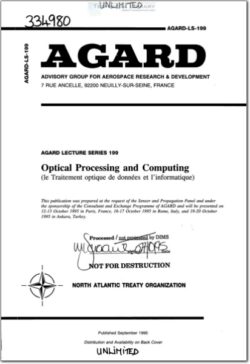
Optical Processing and Computing
AGARD-LS-199 Optical Processing and Computing
Electronics and optics deal, by and large, with handling and manipulating
electrons and photons, respectively. The main potential edge of optics over
electronics is that photons, unless electrons, are massless and do not practically
interact among themselves. Are these properties which are basically responsible for
the intrinsic parallelism of optical processing and the extremely large bandwidths
achievable in the frame of optical communications. Besides, optics possesses other
inherent advantages associated with the interactions taking place inside nonlinear
media providing the possibility of manipulating light with light (nonlinear optics,
NLO).
Even if integrated electronics is to date much more advanced than integrated
optics (VLSI technology has the capability of accomodating about 1010 logic gates
on a single wafer, each of them being able to perform a logic operation in a time
period less than 10‘10 sec) , optical interconnection by itself can offer many
advantages. It is thus to be expected that an hybrid technology, exploiting the
strenghts of both electronics and optics, will be'adopted in the future as optimal for
computing systems. Among the optical elements which are at the basis of optical
interconnection, holograms play a specialrole since they can be tailored to act as
efficient fixed interconnections between elements with different spatial geometry
(see Fig. l ).
Paper presented at the AGARD SPP Lecture Series on “Optical Processing and Computing ”
held in Paris, France from 12-13 October 1995; Rome, Italy from 16-17 October 1995 and
Ankara, Turkey from 19-20 October I 995 and published in LS-I99.
The above arguments are also valid when comparing electronic and optical
implementation of neural networks, whose basic architecture mimics that of
biological neural systems and which consists (see Fig.2) of many identical
elements (neurons) linked by interconnections (synapses). While integrated-circuit
logic elements operate in nanoseconds and have dimensions of the order of
microns, achieving the necessary connectivity in electronic circuits poses serious
problems. They can be overcome by interconnecting neurons by means of light
beams which can simultaneously propagate and overlap without interaction in three
dimensions, thus going beyond the intrinsic planarity of integrated circuits. Optical
implementation also requires a device capable of converting the input patterns into
an appropriate format (e.g., electrical to optical) and a thresholding device for the
output unit.
Despite their obvious advantages, there are many practical problems with optical
implementations since optical devices have their own physical characteristic which
often do not exactly match the requirements of artificial neural networks. It is thus
expedient to any real understanding of the potential of their use a basic description
of the principal optical processes which can be put to work to advantage in the
frame of optical processing and computing.

FileAction
AGARD-LS-199 Optical Processing and Computing.pdfDownload 

Comment On This Post

Your email address will not be published. Required fields are marked *

AGARD-LS-199

AGARD-LS-199
  • Version
  • 292 Downloads
  • 42.00 MB File Size
  • 1 File Count
  • April 25, 2016 Create Date
  • April 25, 2016 Last Updated
Scroll for Details

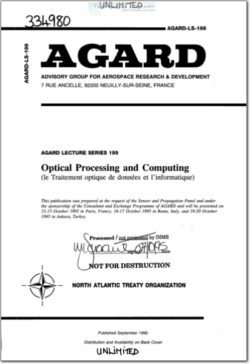
Optical Processing and Computing
AGARD-LS-199 Optical Processing and Computing
Electronics and optics deal, by and large, with handling and manipulating
electrons and photons, respectively. The main potential edge of optics over
electronics is that photons, unless electrons, are massless and do not practically
interact among themselves. Are these properties which are basically responsible for
the intrinsic parallelism of optical processing and the extremely large bandwidths
achievable in the frame of optical communications. Besides, optics possesses other
inherent advantages associated with the interactions taking place inside nonlinear
media providing the possibility of manipulating light with light (nonlinear optics,
NLO).
Even if integrated electronics is to date much more advanced than integrated
optics (VLSI technology has the capability of accomodating about 1010 logic gates
on a single wafer, each of them being able to perform a logic operation in a time
period less than 10‘10 sec) , optical interconnection by itself can offer many
advantages. It is thus to be expected that an hybrid technology, exploiting the
strenghts of both electronics and optics, will be'adopted in the future as optimal for
computing systems. Among the optical elements which are at the basis of optical
interconnection, holograms play a specialrole since they can be tailored to act as
efficient fixed interconnections between elements with different spatial geometry
(see Fig. l ).
Paper presented at the AGARD SPP Lecture Series on “Optical Processing and Computing ”
held in Paris, France from 12-13 October 1995; Rome, Italy from 16-17 October 1995 and
Ankara, Turkey from 19-20 October I 995 and published in LS-I99.
The above arguments are also valid when comparing electronic and optical
implementation of neural networks, whose basic architecture mimics that of
biological neural systems and which consists (see Fig.2) of many identical
elements (neurons) linked by interconnections (synapses). While integrated-circuit
logic elements operate in nanoseconds and have dimensions of the order of
microns, achieving the necessary connectivity in electronic circuits poses serious
problems. They can be overcome by interconnecting neurons by means of light
beams which can simultaneously propagate and overlap without interaction in three
dimensions, thus going beyond the intrinsic planarity of integrated circuits. Optical
implementation also requires a device capable of converting the input patterns into
an appropriate format (e.g., electrical to optical) and a thresholding device for the
output unit.
Despite their obvious advantages, there are many practical problems with optical
implementations since optical devices have their own physical characteristic which
often do not exactly match the requirements of artificial neural networks. It is thus
expedient to any real understanding of the potential of their use a basic description
of the principal optical processes which can be put to work to advantage in the
frame of optical processing and computing.

FileAction
AGARD-LS-199 Optical Processing and Computing.pdfDownload 
17,005 Documents in our Technical Library
3211052 Total Downloads

Search The Technical Library

Newest Additions

NASA-RP-1060 Subsonic Aircraft: Evolution and the Matching of Size to Performance
AA-CP-20212-001
AA-CP-20212-001
ADPO10769 Occurrence of Corrosion in Airframes
The purpose of this lecture is to provide an overview ...
MIL-STD-1759 Rivets and Rivet Type Fasteners Preferred for Design
The purpose of this book form standard is to provide ...
MIL-STD-810G Environmental Engineering Considerations and Laboratory Tests
This standard contains materiel acquisition program planning and engineering direction ...