
17,005 Documents in our Technical Library
3210292 Total Downloads

Newest Additions

NASA-RP-1060 Subsonic Aircraft: Evolution and the Matching of Size to Performance
AA-CP-20212-001
AA-CP-20212-001
ADPO10769 Occurrence of Corrosion in Airframes
The purpose of this lecture is to provide an overview ...
MIL-STD-1759 Rivets and Rivet Type Fasteners Preferred for Design
The purpose of this book form standard is to provide ...
MIL-STD-810G Environmental Engineering Considerations and Laboratory Tests
This standard contains materiel acquisition program planning and engineering direction ...

AGARD-AR-351

AGARD-AR-351
  • Version
  • 178 Downloads
  • 13.63 MB File Size
  • 1 File Count
  • April 25, 2016 Create Date
  • April 25, 2016 Last Updated
Scroll for Details

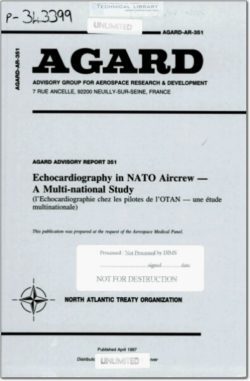
Echocardiography in NATO Aircrew - A Multi National Study
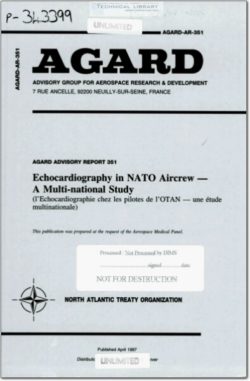
AGARD-AR-351 Echocardiography in NATO Aircrew - A Multi National Study
In health, the human cardiovascular system
operates in Earth's gravitational field (Hg) with
great efficiency. During abrupt changes of
posture, rest and exertion, and during metabolic
demands, circulatory perfusion of all organs and
systems is maintained, adequately if not optimally.
Modern high—performance military. aircraft flight
imposes massive and unprecedented gravito—
inertial forces on the circulatory system, which
shows remarkable ability to adapt acutely to these
unfamiliar stressors. That there are limits to this
cardiovascular adaptability was, however, realised
early in the history of military combat flying (Ref
1). High positive G forces (+Gz) would induce
visual loss (grey—out), soon followed by loss of
consciousness (LOC, blackout) due to cerebral
ischemia. Trained pilots could counter these
effects by straining manoeuvres, but ultimately
high enough +Gz would defeat these efforts.
A large part of aviation medical research over many
years has been devoted to finding ways of
increasing the pilot's G-tolerance and thus his
ability to fly ever more powerful and agile
interceptor aircraft (Ref 2). However, even with'
modern counter-pressure garments, tilt—back seats
and positive pressure breathing, there are limits to
human tolerance of +Gz. Though consciousness
may be retained at up to +12 Gz, other systems, _
notably the pulmonary (Ref 13) and musculo—
skeletal systems, limit significant progress beyond
this point.
The'acute effects of high G-forccs include extreme
deformation of soft tissues including the heart,
great vessels and other mediastinal structures (Ref
3). These effects are rapidly reversed with the off-
set of G-forces. In animal studies, subendocardial
petechiae have been observed in miniature swine
following exposure to very high G-forces (Ref
4,5), though this effect may have been '
attributable, at least in part, to catecholamine
secretion due to the stress of handling and restraint
(Ref 14).

FileAction
AGARD-AR-351 Echocardiography in NATO Aircrew - A Multi National Study.pdfDownload 

Comment On This Post

Your email address will not be published. Required fields are marked *

AGARD-AR-351

AGARD-AR-351
  • Version
  • 178 Downloads
  • 13.63 MB File Size
  • 1 File Count
  • April 25, 2016 Create Date
  • April 25, 2016 Last Updated
Scroll for Details

Echocardiography in NATO Aircrew - A Multi National Study
AGARD-AR-351 Echocardiography in NATO Aircrew - A Multi National Study
In health, the human cardiovascular system
operates in Earth's gravitational field (Hg) with
great efficiency. During abrupt changes of
posture, rest and exertion, and during metabolic
demands, circulatory perfusion of all organs and
systems is maintained, adequately if not optimally.
Modern high—performance military. aircraft flight
imposes massive and unprecedented gravito—
inertial forces on the circulatory system, which
shows remarkable ability to adapt acutely to these
unfamiliar stressors. That there are limits to this
cardiovascular adaptability was, however, realised
early in the history of military combat flying (Ref
1). High positive G forces (+Gz) would induce
visual loss (grey—out), soon followed by loss of
consciousness (LOC, blackout) due to cerebral
ischemia. Trained pilots could counter these
effects by straining manoeuvres, but ultimately
high enough +Gz would defeat these efforts.
A large part of aviation medical research over many
years has been devoted to finding ways of
increasing the pilot's G-tolerance and thus his
ability to fly ever more powerful and agile
interceptor aircraft (Ref 2). However, even with'
modern counter-pressure garments, tilt—back seats
and positive pressure breathing, there are limits to
human tolerance of +Gz. Though consciousness
may be retained at up to +12 Gz, other systems, _
notably the pulmonary (Ref 13) and musculo—
skeletal systems, limit significant progress beyond
this point.
The'acute effects of high G-forccs include extreme
deformation of soft tissues including the heart,
great vessels and other mediastinal structures (Ref
3). These effects are rapidly reversed with the off-
set of G-forces. In animal studies, subendocardial
petechiae have been observed in miniature swine
following exposure to very high G-forces (Ref
4,5), though this effect may have been '
attributable, at least in part, to catecholamine
secretion due to the stress of handling and restraint
(Ref 14).

FileAction
AGARD-AR-351 Echocardiography in NATO Aircrew - A Multi National Study.pdfDownload 
17,005 Documents in our Technical Library
3210292 Total Downloads

Search The Technical Library

Newest Additions

NASA-RP-1060 Subsonic Aircraft: Evolution and the Matching of Size to Performance
AA-CP-20212-001
AA-CP-20212-001
ADPO10769 Occurrence of Corrosion in Airframes
The purpose of this lecture is to provide an overview ...
MIL-STD-1759 Rivets and Rivet Type Fasteners Preferred for Design
The purpose of this book form standard is to provide ...
MIL-STD-810G Environmental Engineering Considerations and Laboratory Tests
This standard contains materiel acquisition program planning and engineering direction ...