
17,005 Documents in our Technical Library
3206568 Total Downloads

Newest Additions

NASA-RP-1060 Subsonic Aircraft: Evolution and the Matching of Size to Performance
AA-CP-20212-001
AA-CP-20212-001
ADPO10769 Occurrence of Corrosion in Airframes
The purpose of this lecture is to provide an overview ...
MIL-STD-1759 Rivets and Rivet Type Fasteners Preferred for Design
The purpose of this book form standard is to provide ...
MIL-STD-810G Environmental Engineering Considerations and Laboratory Tests
This standard contains materiel acquisition program planning and engineering direction ...

AGARD-AR-335

AGARD-AR-335
  • Version
  • 209 Downloads
  • 24.31 MB File Size
  • 1 File Count
  • April 25, 2016 Create Date
  • April 25, 2016 Last Updated
Scroll for Details

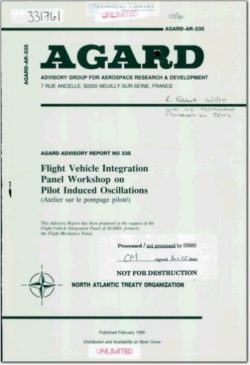
Flight Vehicle Integration Panel Workshop on Pilot Induced Oscillations
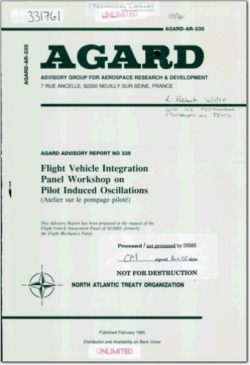
AGARD-AR-335 Flight Vehicle Integration Panel Workshop on Pilot Induced Oscillations
Instability of the pilot/airframe combination has been a
problem from the beginning of manned flight. The rapid
advances made in aviation following the Second World War
greatly increased the incidence of P10 problems and led to a
large amount of research and development work aimed at
understanding and mitigating these difficulties. Criteria and
requirements were developed which could be used in design
to obtain satisfactory PIO qualifies. Nevertheless, in spite of
all this work, and even with the great flexibility in modern
control technologies available to the designer, PIO problems
still often occur with new aircrafl; in fact it is the power and
responsiveness of modem control systems which makes them
susceptible to various "non-linear" effects such as time delays,
rate limits, actuator saturation, etc, leading to unexpected
P10 difficulties. With current experience, it is clear that a
universal solution of the P10 problem still evades the
engineering community. The cost of these problems - in
programme delay and financial terms is significant. The
gathering together of specialists to discuss this problem, from
their various points of view, has led to positive gains in the
state of knowledge regarding PIOs; it has provided a
significant step toward their elimination and contributed to
the avoidance of P10 associated programme costs and
penalties.
A number of experts in the fields of Flying Qualities, Flight
Testing, and Pilot Modelling were invited to attend the
workshop and give their views and experience before an
audience made up of those pilots and ACT engineering
specialists, with an interest in the P10 problem, who cared to
stay on in Turin for the extra day.
All of the contributors created an open and frank discussion of
the problems which exist and with which the flight controls
and flying qualities communities are still struggling to
overcome. There were a number of significant inputs from the
floor , either in response to questions or as comments
regarding the individuals experience.

FileAction
AGARD-AR-335 Flight Vehicle Integration Panel Workshop on Pilot Induced Oscillations.pdfDownload 

Comment On This Post

Your email address will not be published. Required fields are marked *

AGARD-AR-335

AGARD-AR-335
  • Version
  • 209 Downloads
  • 24.31 MB File Size
  • 1 File Count
  • April 25, 2016 Create Date
  • April 25, 2016 Last Updated
Scroll for Details

Flight Vehicle Integration Panel Workshop on Pilot Induced Oscillations
AGARD-AR-335 Flight Vehicle Integration Panel Workshop on Pilot Induced Oscillations
Instability of the pilot/airframe combination has been a
problem from the beginning of manned flight. The rapid
advances made in aviation following the Second World War
greatly increased the incidence of P10 problems and led to a
large amount of research and development work aimed at
understanding and mitigating these difficulties. Criteria and
requirements were developed which could be used in design
to obtain satisfactory PIO qualifies. Nevertheless, in spite of
all this work, and even with the great flexibility in modern
control technologies available to the designer, PIO problems
still often occur with new aircrafl; in fact it is the power and
responsiveness of modem control systems which makes them
susceptible to various "non-linear" effects such as time delays,
rate limits, actuator saturation, etc, leading to unexpected
P10 difficulties. With current experience, it is clear that a
universal solution of the P10 problem still evades the
engineering community. The cost of these problems - in
programme delay and financial terms is significant. The
gathering together of specialists to discuss this problem, from
their various points of view, has led to positive gains in the
state of knowledge regarding PIOs; it has provided a
significant step toward their elimination and contributed to
the avoidance of P10 associated programme costs and
penalties.
A number of experts in the fields of Flying Qualities, Flight
Testing, and Pilot Modelling were invited to attend the
workshop and give their views and experience before an
audience made up of those pilots and ACT engineering
specialists, with an interest in the P10 problem, who cared to
stay on in Turin for the extra day.
All of the contributors created an open and frank discussion of
the problems which exist and with which the flight controls
and flying qualities communities are still struggling to
overcome. There were a number of significant inputs from the
floor , either in response to questions or as comments
regarding the individuals experience.

FileAction
AGARD-AR-335 Flight Vehicle Integration Panel Workshop on Pilot Induced Oscillations.pdfDownload 
17,005 Documents in our Technical Library
3206568 Total Downloads

Search The Technical Library

Newest Additions

NASA-RP-1060 Subsonic Aircraft: Evolution and the Matching of Size to Performance
AA-CP-20212-001
AA-CP-20212-001
ADPO10769 Occurrence of Corrosion in Airframes
The purpose of this lecture is to provide an overview ...
MIL-STD-1759 Rivets and Rivet Type Fasteners Preferred for Design
The purpose of this book form standard is to provide ...
MIL-STD-810G Environmental Engineering Considerations and Laboratory Tests
This standard contains materiel acquisition program planning and engineering direction ...