
17,005 Documents in our Technical Library
3214694 Total Downloads

Newest Additions

NASA-RP-1060 Subsonic Aircraft: Evolution and the Matching of Size to Performance
AA-CP-20212-001
AA-CP-20212-001
ADPO10769 Occurrence of Corrosion in Airframes
The purpose of this lecture is to provide an overview ...
MIL-STD-1759 Rivets and Rivet Type Fasteners Preferred for Design
The purpose of this book form standard is to provide ...
MIL-STD-810G Environmental Engineering Considerations and Laboratory Tests
This standard contains materiel acquisition program planning and engineering direction ...

NASA-TP-2004-212041

NASA-TP-2004-212041
  • Version
  • 216 Downloads
  • 1.56 MB File Size
  • 1 File Count
  • April 21, 2016 Create Date
  • April 21, 2016 Last Updated
Scroll for Details

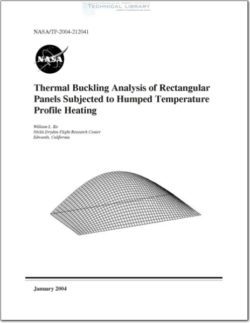
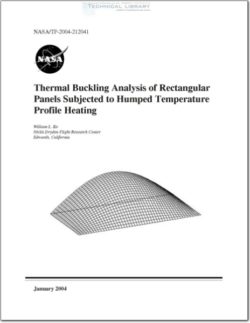
Thermal Buckling Analysis of Rectangular Panels Subjected to Humped Temperature Profile Heating
NASA-TP-2004-212041 Thermal Buckling Analysis of Rectangular Panels Subjected to Humped Temperature Profile Heating
Hypersonic aircraft are subjected to severe aerodynamic heating during flights. To maintain the structural
integrity under high temperature environment, the vehicle structural design concepts of hypersonic flight vehicles
are different from those of low Mach number aircraft. Depending on the operating temperature range, vehicle
structures may be called “hot” structures or “warm” structures. The “hot” structures fabricated with high
temperature alloys can operate at elevated temperatures in the range of 1000 °F to 1500 °F. If fabricated with the
carbon/carbon composite material, the operating temperature of the “hot” structures could go as high as 3000 oF.
Typical candidate “hot” structural components for hypersonic flight vehicles are hat—stiffened panels fabricated
with either monolithic titanium alloys or metal-matrix composite materials; honeycomb sandwich panels
fabricated with super-alloy; and carbon/carbon composite elevon (or body flap).
The “warm” structures are fabricated with lightweight materials, such as aluminum, and can operate only up to
moderate temperature limit of 350 oF. The space shuttle orbiter is a good example of the “warm” structure. The
entire vehicle is protected with the thermal protection system (TPS) to shield the aluminum substructure from
overheating beyond the “warm” temperature limit.
Hot structural panels are usually fastened to the cooler substructures that function as heat sinks because of less
heating. Thus, even under the uniform surface heat flux, the temperature distribution over the hot structural panels
will not be uniform but looks like camel-humped shape (refs. 1—3). This camel-humped shaped temperature
distribution is always observed in supported hot structural panels. The buckling behavior of the panel with heat
sinks is therefore quite different from the case without heat sinks. Earlier K0 extensively studied thermal buckling
problems of hot structural panels under uniform temperature profile heating (without heat sinks effects)
(refs. 4710).
This report studies the thermal buckling behavior of rectangular panels under different types of
humped-shaped temperature profile heating to simulate the existence of the supporting boundary heat sink and also
studies the effect of the heat sink temperature on the panel buckling temperature. The results are compared to the
results of uniform temperature profile heating cases without the heat sink effect.

FileAction
NASA-TP-2004-212041 Thermal Buckling Analysis of Rectangular Panels Subjected to Humped Temperature Profile Heating.pdfDownload 

Comment On This Post

Your email address will not be published. Required fields are marked *

NASA-TP-2004-212041

NASA-TP-2004-212041
  • Version
  • 216 Downloads
  • 1.56 MB File Size
  • 1 File Count
  • April 21, 2016 Create Date
  • April 21, 2016 Last Updated
Scroll for Details

Thermal Buckling Analysis of Rectangular Panels Subjected to Humped Temperature Profile Heating
NASA-TP-2004-212041 Thermal Buckling Analysis of Rectangular Panels Subjected to Humped Temperature Profile Heating
Hypersonic aircraft are subjected to severe aerodynamic heating during flights. To maintain the structural
integrity under high temperature environment, the vehicle structural design concepts of hypersonic flight vehicles
are different from those of low Mach number aircraft. Depending on the operating temperature range, vehicle
structures may be called “hot” structures or “warm” structures. The “hot” structures fabricated with high
temperature alloys can operate at elevated temperatures in the range of 1000 °F to 1500 °F. If fabricated with the
carbon/carbon composite material, the operating temperature of the “hot” structures could go as high as 3000 oF.
Typical candidate “hot” structural components for hypersonic flight vehicles are hat—stiffened panels fabricated
with either monolithic titanium alloys or metal-matrix composite materials; honeycomb sandwich panels
fabricated with super-alloy; and carbon/carbon composite elevon (or body flap).
The “warm” structures are fabricated with lightweight materials, such as aluminum, and can operate only up to
moderate temperature limit of 350 oF. The space shuttle orbiter is a good example of the “warm” structure. The
entire vehicle is protected with the thermal protection system (TPS) to shield the aluminum substructure from
overheating beyond the “warm” temperature limit.
Hot structural panels are usually fastened to the cooler substructures that function as heat sinks because of less
heating. Thus, even under the uniform surface heat flux, the temperature distribution over the hot structural panels
will not be uniform but looks like camel-humped shape (refs. 1—3). This camel-humped shaped temperature
distribution is always observed in supported hot structural panels. The buckling behavior of the panel with heat
sinks is therefore quite different from the case without heat sinks. Earlier K0 extensively studied thermal buckling
problems of hot structural panels under uniform temperature profile heating (without heat sinks effects)
(refs. 4710).
This report studies the thermal buckling behavior of rectangular panels under different types of
humped-shaped temperature profile heating to simulate the existence of the supporting boundary heat sink and also
studies the effect of the heat sink temperature on the panel buckling temperature. The results are compared to the
results of uniform temperature profile heating cases without the heat sink effect.

FileAction
NASA-TP-2004-212041 Thermal Buckling Analysis of Rectangular Panels Subjected to Humped Temperature Profile Heating.pdfDownload 
17,005 Documents in our Technical Library
3214694 Total Downloads

Search The Technical Library

Newest Additions

NASA-RP-1060 Subsonic Aircraft: Evolution and the Matching of Size to Performance
AA-CP-20212-001
AA-CP-20212-001
ADPO10769 Occurrence of Corrosion in Airframes
The purpose of this lecture is to provide an overview ...
MIL-STD-1759 Rivets and Rivet Type Fasteners Preferred for Design
The purpose of this book form standard is to provide ...
MIL-STD-810G Environmental Engineering Considerations and Laboratory Tests
This standard contains materiel acquisition program planning and engineering direction ...